


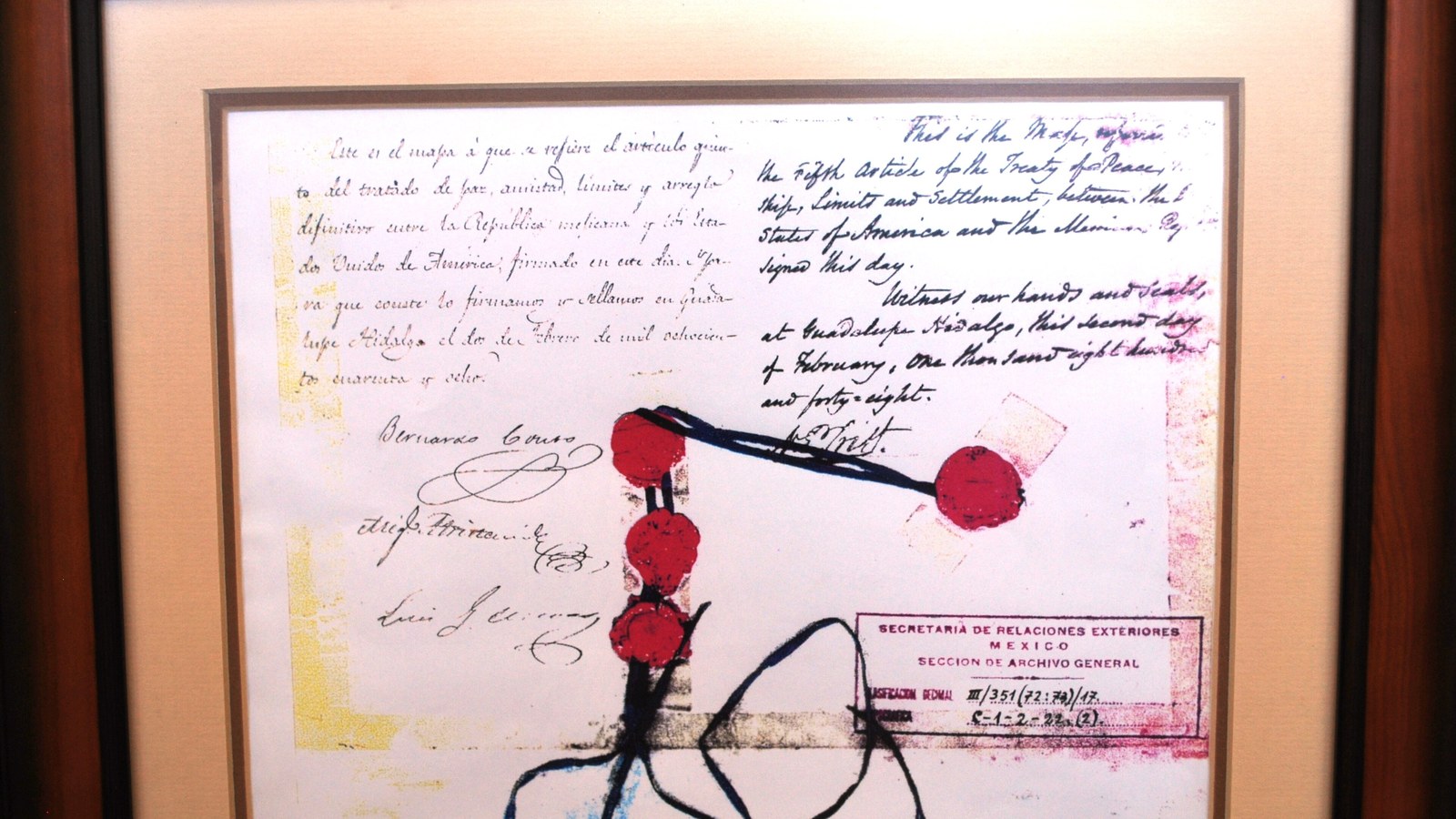
On 2 February 1848, in Villa de Guadalupe Hidalgo, north of occupied Mexico City, the Treaty of Peace, Friendship, Limits, and Settlement between the United States and the Mexican Republic was signed. Nicholas Trist signed for Washington; Luis Gonzaga Cuevas, José Bernardo Couto and Miguel de Atristain for Mexico. The place was the altar of the old Basilica of Guadalupe.
The Mexican–American War, opened in 1846 after the annexation of Texas, had ended in the field in September 1847, when General Winfield Scott’s troops took the capital. President James K. Polk had recalled Trist to Washington. The message was slow; Trist refused the order and negotiated anyway, convinced that the last chance of peace would otherwise be lost.
Article V does not list provinces; it draws the border: the Rio Grande to New Mexico, then west to the 110th meridian, the Gila, and a straight line toward the port of San Diego. Mexico thus ceded about 55 percent of the territory it had claimed before the war: Alta California and the western part of Santa Fe de Nuevo México — California, Nevada, Utah, most of Arizona and parts of New Mexico, Colorado and Wyoming.
The United States paid $15 million “in consideration of the extension acquired by the boundaries” and took on Mexican debts to American citizens, about $3.25 million. Articles VIII and IX were to protect the property and civil rights of Mexicans remaining in the ceded land. Residents had a year to choose citizenship; more than 90 percent chose American.
The U.S. Senate ratified the act in March but struck Article X, which guaranteed land grants made by Spain and Mexico. Article IX was weakened: admission to citizenship would come “at the proper time,” as judged by Congress, not “as soon as possible.” Mexico ratified in May; ratifications were exchanged on 30 May at Querétaro.
The National Archives notes that Polk chose to send the Senate the work of his discredited subordinate because it secured California and New Mexico. Trist lost his career. Land disputes between the descendants of Mexican grantees and Anglo-American settlers continued after the treaty.
The Gadsden Purchase of 1853 cut a further strip from southern Arizona and New Mexico and annulled Article XI, which had bound Washington to check Indigenous raids into Mexico. It is not part of the Guadalupe Hidalgo act. The map after 1848 is the result of the war, not of a peaceful sale.
Image: Alejandro Linares Garcia, signature page of the Treaty of Guadalupe Hidalgo, Naval History Museum, Mexico City, 19 September 2009, CC BY-SA 4.0, Wikimedia Commons. Cropped to 16:9.
Source consulted: Treaty of Guadalupe Hidalgo. Treaty text: The Treaty of Guadalupe Hidalgo — National Archives.











0 Comments
No comments on this article yet. Be the first!