


On 9 January 1792, at Iași, in Moldavia, the Treaty of perpetual peace and friendship is signed between the Russian Empire and the Ottoman Porte. Old Style: 29 December 1791. Authorizing: Count Aleksandr Andreyevich Bezborodko, for Catherine II, after the death of Grigory Potemkin; Grand Vizier Yusuf Pasha, for Sultan Selim III. The plenipotentiaries who sign: Aleksandr Samoilov, José de Ribas, Sergei Lashkarev; Reis Effendi Abdullah Biri, Ibrahim Ismet Bey and Muhammed Durri Efendi. Two languages: Russian and Ottoman Turkish. The war of 1787 ends. Ismail, taken by Suvorov on 22 December 1790, had hurried the table.
Article 1: perpetual peace on land and water, mutual amnesty, release of those held in the galleys and in prison, return of the exiled, restoration of honours and property. No hostility, secret or open. Article 2 confirms, article by article, the Treaty of Küçük Kaynarca of 10 July 1774, the explanatory convention of 1779, the commercial treaty of 10 June 1783 and the act of 28 December 1783 by which Crimea and Taman belong to Russia and the Kuban is the Caucasian frontier. What this treaty or later acts alter, falls away.
Article 3 transfers to Russia Ochakov and Yedisan, the land between the Dniester and the Southern Bug. The Dniester becomes the Russo-Ottoman frontier in Europe. The Kuban, in Asia, is unchanged. Ismail, at the Danube mouths, and Anapa, on the Caucasian shore, go back to the Porte. Moldavia and Wallachia revert to Ottoman suzerainty. For the first time Russia is the direct neighbour of the Principality of Moldavia.
Article 4: the hospodars of Moldavia and Wallachia are appointed for seven years, with Russian approval. Article 6: the Porte undertakes to restrain the peoples on the left bank of the Kuban from raids, plunder and the taking of captives; if within six months of a complaint there is no redress, it pays from the treasury within a month. Article 7: liability for the plunder of Russian merchants by Muslim corsairs, in line with the Peace of Sistova.
Prisoners are released without ransom, except converts to Islam, under Article 8. Russia drops its demand for a war indemnity. The Porte acknowledges Russian patronage of the Kingdom of Kartli-Kakheti, proclaimed by the Treaty of Georgievsk in 1783, and drops its claims on Georgia. Ratifications are exchanged, still at Iași, on 29 January 1792 Old Style.
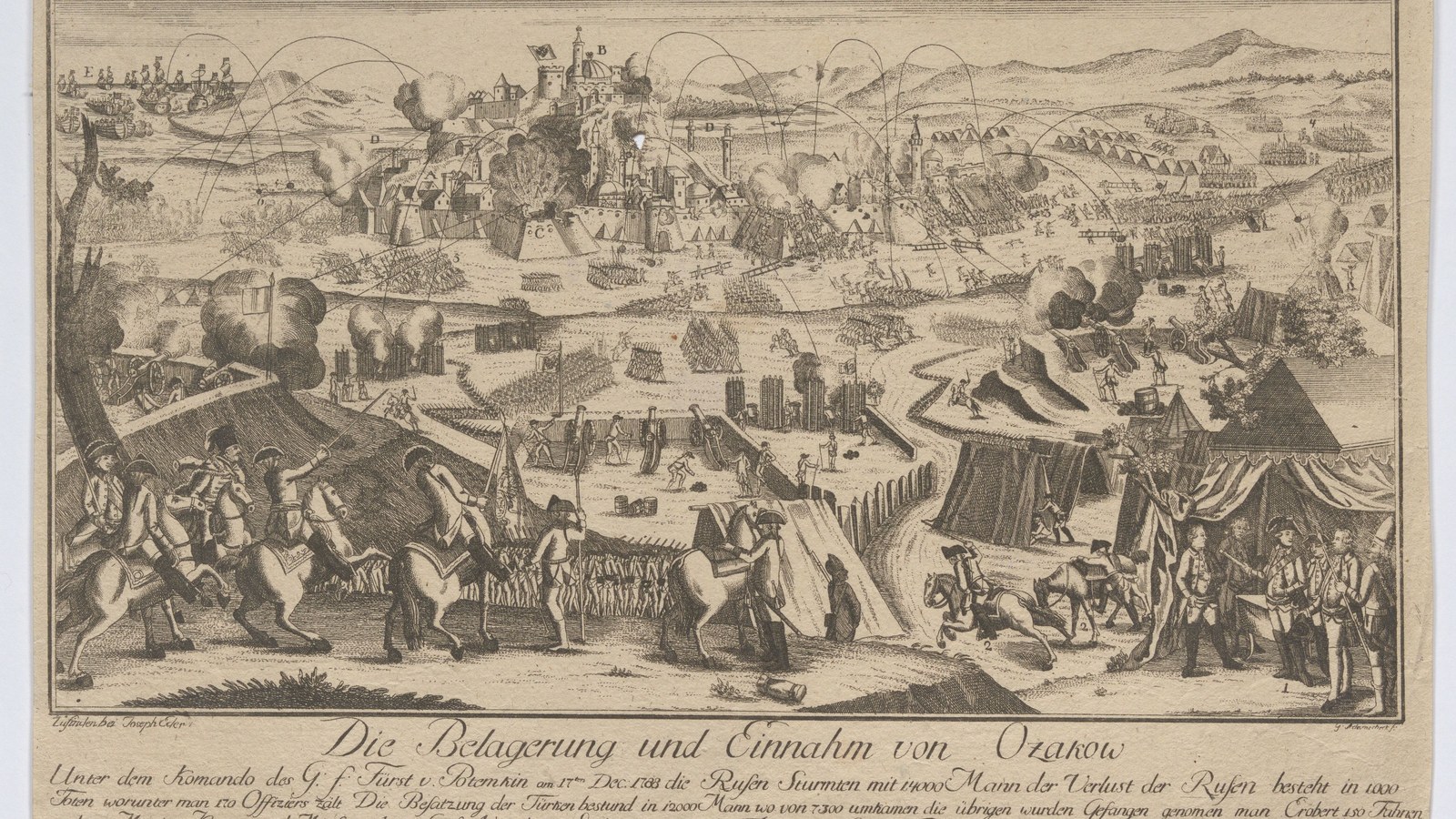
In the land taken, Russia will found Odessa, in 1794, on the site of Khadjibey. Ochakov, besieged by Potemkin and fallen in December 1788, is the key to the coast. For Iași the peace table is an episode of occupation: the Russian army is in the town, the diplomats speak over the hospodar’s head.
The Dniester frontier lasts until 1812, when, after another war, the Treaty of Bucharest gives Russia the right bank as well, Bessarabia. The Treaty of Jassy is the end of one war and the beginning of a neighbourhood.
Image: G. Adamscheck / Joseph Eder, siege of Ochakov, engraving, 1789, public domain, Wien Museum / Wikimedia Commons. Cropped to 16:9.
Source consulted: Treaty of Jassy. Treaty text: Treaty of Peace of Jassy, 29 December 1791 / 9 January 1792 (Russian text).











0 Comments
No comments on this article yet. Be the first!