


The European Constitution, signed in Rome on 29 October 2004, fell after 55% of French voters rejected it on 29 May 2005 and 61% of Dutch voters on 1 June. Germany closed the “period of reflection” with the Berlin Declaration in March 2007. The European Council of 21–23 June issued a 16-page mandate for an intergovernmental conference: keep the existing treaties, strip out constitutional symbols, leave the Charter of Fundamental Rights outside the text, with a reference that makes it binding. Poland pressed for square-root voting; Balkenende secured a larger role for national parliaments. The IGC opened in Lisbon on 23 July. On 18–19 October Sócrates closed the last concessions: the Ioannina formula and an extra Advocate General at the Court of Justice.
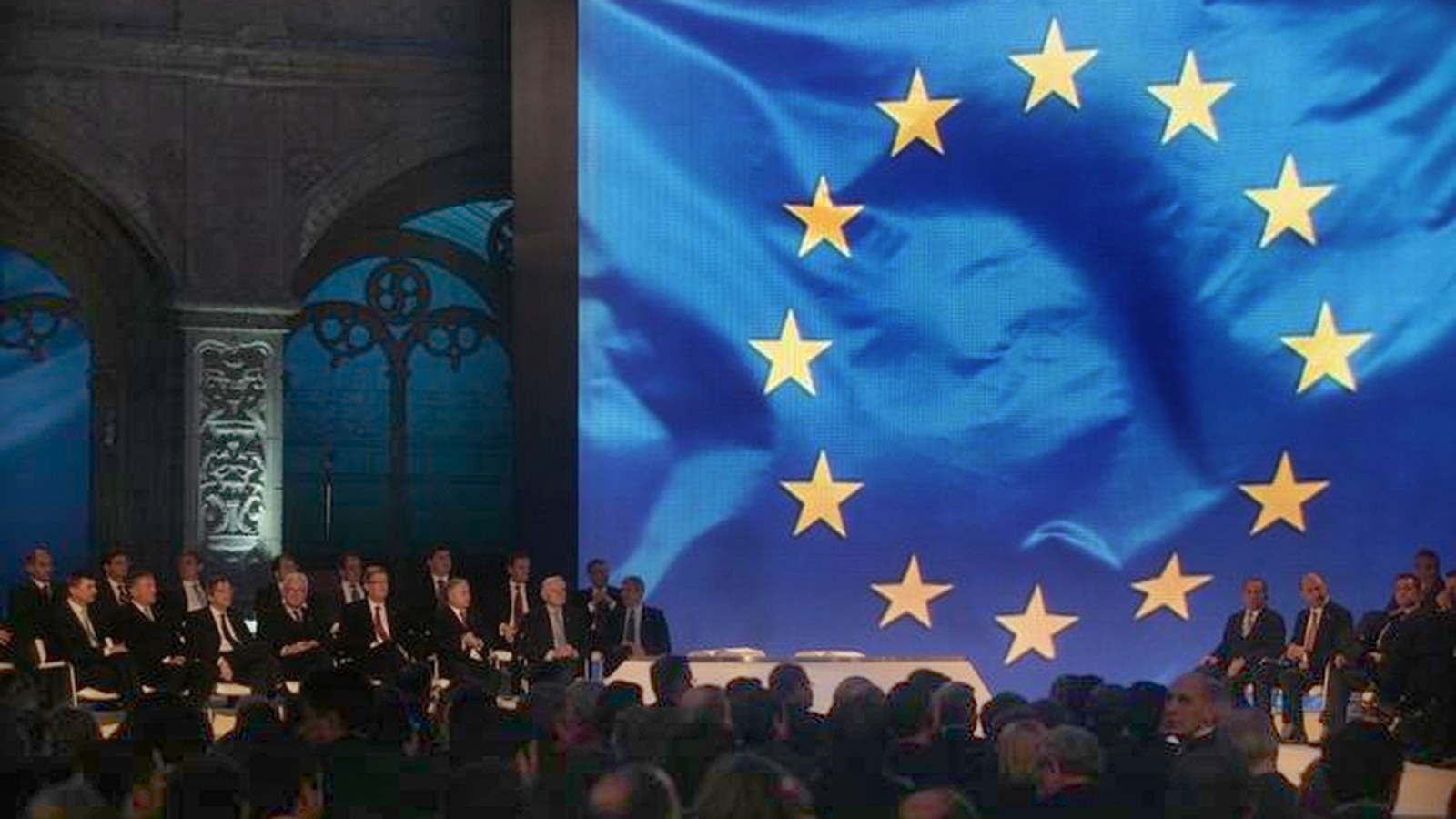
The Treaty of Lisbon amending the Treaty on European Union and the Treaty establishing the European Community was signed on 13 December 2007, in the Jerónimos Monastery in Lisbon — the same place where Portugal signed its accession in 1985. The 27 plenipotentiaries signed together, for the first time, with the presidents of the Parliament, the Commission and the Council; Hans-Gert Pöttering was present after the proclamation of the Charter. Gordon Brown signed a few hours later, citing a hearing in the House of Commons. The depositary is the Government of Italy. The preamble states the aim: “to complete the process started by the Treaty of Amsterdam and by the Treaty of Nice with a view to enhancing the efficiency and democratic legitimacy of the Union”. Romania was represented by Traian Băsescu, Călin Popescu-Tăriceanu and Adrian Cioroianu.
Lisbon is not meant to be read as a stand-alone text: it amends the TEU (Maastricht) and the TEC (Rome), renamed the Treaty on the Functioning of the European Union, plus the protocols and Euratom. The Union acquires a consolidated legal personality. The ordinary legislative procedure puts Parliament on an equal footing with the Council, including the budget, agriculture and justice. Parliament elects the President of the Commission on a proposal from the European Council that takes account of the elections. The Council moves, in at least 45 policy areas, from unanimity to qualified majority. From 2014 the double majority means at least 55% of the states, representing at least 65% of the population; a blocking minority must include at least four countries.
The European Council becomes an institution, with a president appointed for two and a half years, renewable once. The High Representative of the Union for Foreign Affairs and Security Policy merges the former CFSP High Representative with the External Relations Commissioner, is a Vice-President of the Commission and directs the European External Action Service. The Charter of 7 December 2000 gains legal force equal to the treaties, without extending competences; a protocol limits its effect in British and Polish domestic law. National parliaments have eight weeks for a subsidiarity opinion. For the first time an article — 50 TEU — gives an explicit right to leave and the procedure for doing so.
The European Parliament voted, on 20 February 2008, a non-binding resolution, 525 to 115. Ireland, the only state to hold a referendum, rejected the treaty in June 2008 and accepted it in October 2009, after concessions, including keeping one commissioner per state. The Czech instrument was the last deposited in Rome, on 13 November 2009. The treaty entered into force on 1 December 2009, not on 1 January as first planned.
The photograph of 13 December, from the archive of the Chancellery of the President of Poland, shows the hall at Jerónimos. The signing closed the Reform Treaty; application waited two years of ratifications.
Sources: Treaty of Lisbon; Wikisource, Treaty of Lisbon amending the Treaty on European Union and the Treaty establishing the European Community.











0 Comments
No comments on this article yet. Be the first!