


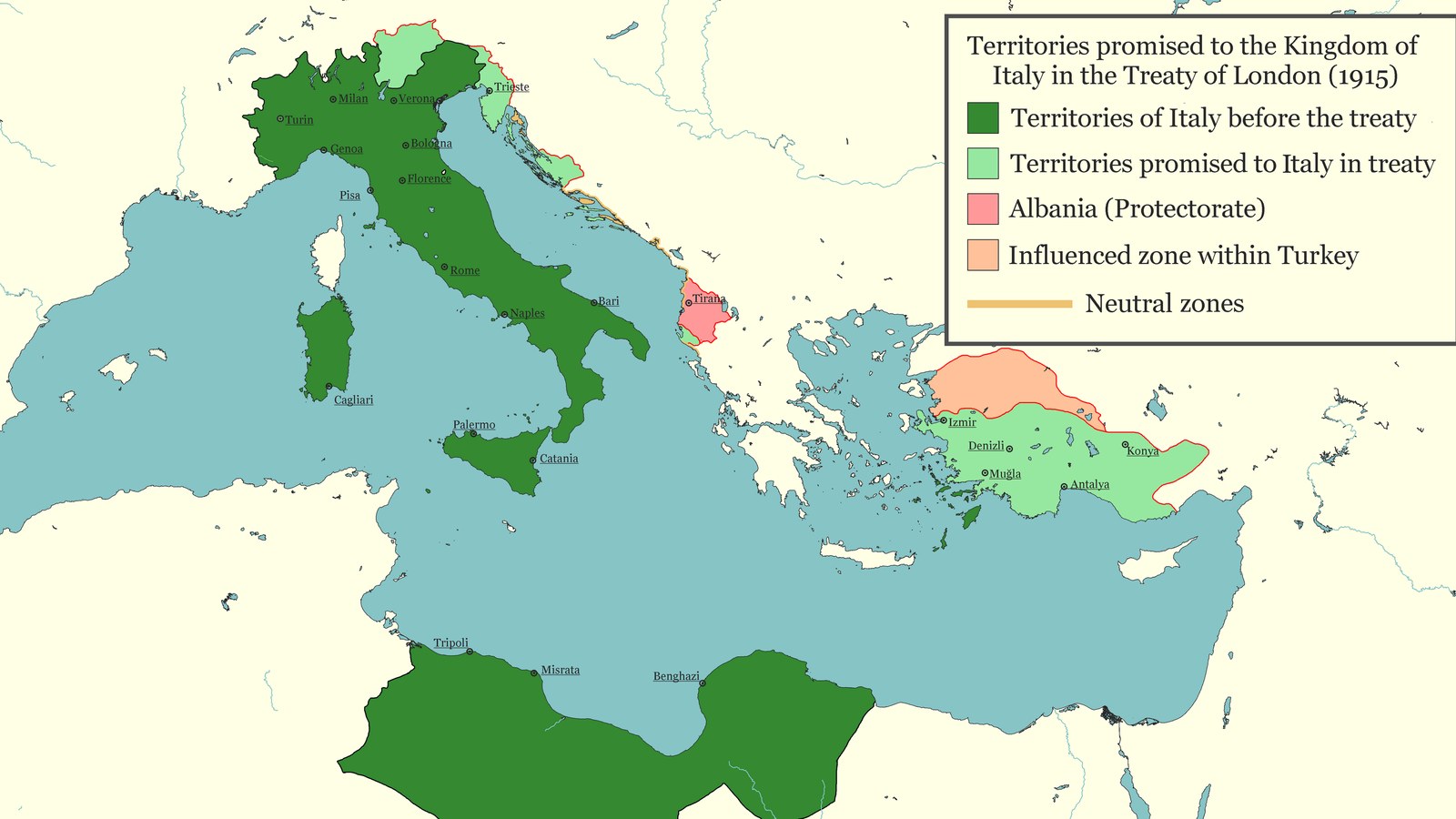
In London on 26 April 1915 the Marquis Imperiali presented to Edward Grey, Paul Cambon and Count Benckendorff a sixteen-article memorandum. The representatives of France, Great Britain and Russia, duly authorised, gave their full assent and signed, in quadruplicate, with seals: Grey, Imperiali, Benckendorff, Cambon. The same day they signed a declaration not to conclude a separate peace and a third declaration that this undertaking remain secret until, after a declaration of war by or against Italy, the four Powers should sign an identical text, then to be made public. Italy undertakes to take the field at the earliest possible date and within a period not exceeding one month from signature.
Article 1 requires an immediate military convention among the four general staffs, including the minimum Russian forces to be used against Austria-Hungary so that that Power cannot concentrate all its strength against Italy if Russia directs her principal effort against Germany. Article 2 binds Italy to use her entire resources to wage war jointly with France, Great Britain and Russia against all their enemies. Article 3 requires the French and British fleets to give Italy active and permanent assistance until the Austro-Hungarian fleet is destroyed or peace is concluded, and an immediate naval convention.
Article 4, under the treaty of peace, awards Italy the Trentino, Cisalpine Tyrol with its geographical and natural frontier (the Brenner), Trieste, the counties of Gorizia and Gradisca, all Istria as far as the Quarnero, including Volosca and the Istrian islands of Cherso and Lussin, plus Plavnik, Unie, Canidole and neighbouring islets. The note traces the crest of the Rhaetian Alps, Reschen, Brenner, Oetz and Ziller, then the Julian Alps to the Schneeberg, leaving the Save basin outside Italy. Article 5 adds Dalmatia, from Lisarica and Tribania to a line from Cape Planka leaving the valleys toward Sebenico in Italy, plus the islands from Premuda to Meleda, Lissa, Lesina, Curzola and Pelagosa, except Brazza, Solta, Bua and Zirona. The coast from Planka to Sabbioncello and from Ragusa Vecchia to the Voïussa, with Cattaro, Antivari, Dulcigno, Medua and Durazzo, is to be neutralized, without prejudice to Montenegro’s rights of 1909. Fiume, the Croatian shore and the islands of Veglia and Arbe are reserved for Croatia, Serbia and Montenegro; Durazzo, for the independent Moslem State of Albania.
Article 6 gives Italy full sovereignty over Valona, the island of Saseno and a defensive hinterland from the Voïussa nearly to Chimara. Article 7, if Italy obtains the Trentino, Istria, Dalmatia, the islands and the Bay of Valona, and if central Albania remains a small autonomous neutralized State, Italy shall not oppose the division of north and south between Montenegro, Serbia and Greece; shall represent Albania toward foreign Powers; and shall leave a Greece–Serbia frontier west of Lake Ochrida. Article 8 confirms sovereignty over the Dodecanese, already occupied. Article 9 recognizes an Italian interest at Adalia if Turkey in Asia is partitioned. Article 10 transfers to Italy the Sultan’s rights in Libya under the Treaty of Lausanne. Article 11 reserves Italy a share of any war indemnity. Article 12 associates Italy with the declaration that Arabia and the Moslem Holy Places remain under an independent Moslem Power. Article 13, if France and Great Britain enlarge their African colonies at Germany’s expense, Italy may claim equitable compensation on the frontiers of Eritrea, Somaliland and Libya. Article 14: Great Britain undertakes to facilitate at once, on equitable terms, a loan of at least £50,000,000 on the London market. Article 15: the three Powers will support Italy’s opposition to a representative of the Holy See in peace negotiations. Article 16 holds the arrangement secret; only Italy’s adherence to the Declaration of 5 September 1914 shall be made public as soon as war is declared by or against Italy.
The treaty is not the Treaty of London of 1839, on Belgian neutrality, and not the Peace of London of 1913 after the Balkan Wars. It is not the Treaty of Rapallo of 1920, which later settled the frontier with the Kingdom of Serbs, Croats and Slovenes. The April 1915 signatories are not Sonnino or Salandra in person: the instrument names Grey, Imperiali, Benckendorff and Cambon.
Image: territories promised to Italy in the 1915 Treaty of London; map by Smol2204, CC BY-SA 4.0, Wikimedia Commons. Cropped to 16:9.
Source consulted: Treaty of London (1915). Treaty text: Wikisource: Treaty of London (1915), Cmd. 671.











0 Comments
No comments on this article yet. Be the first!