


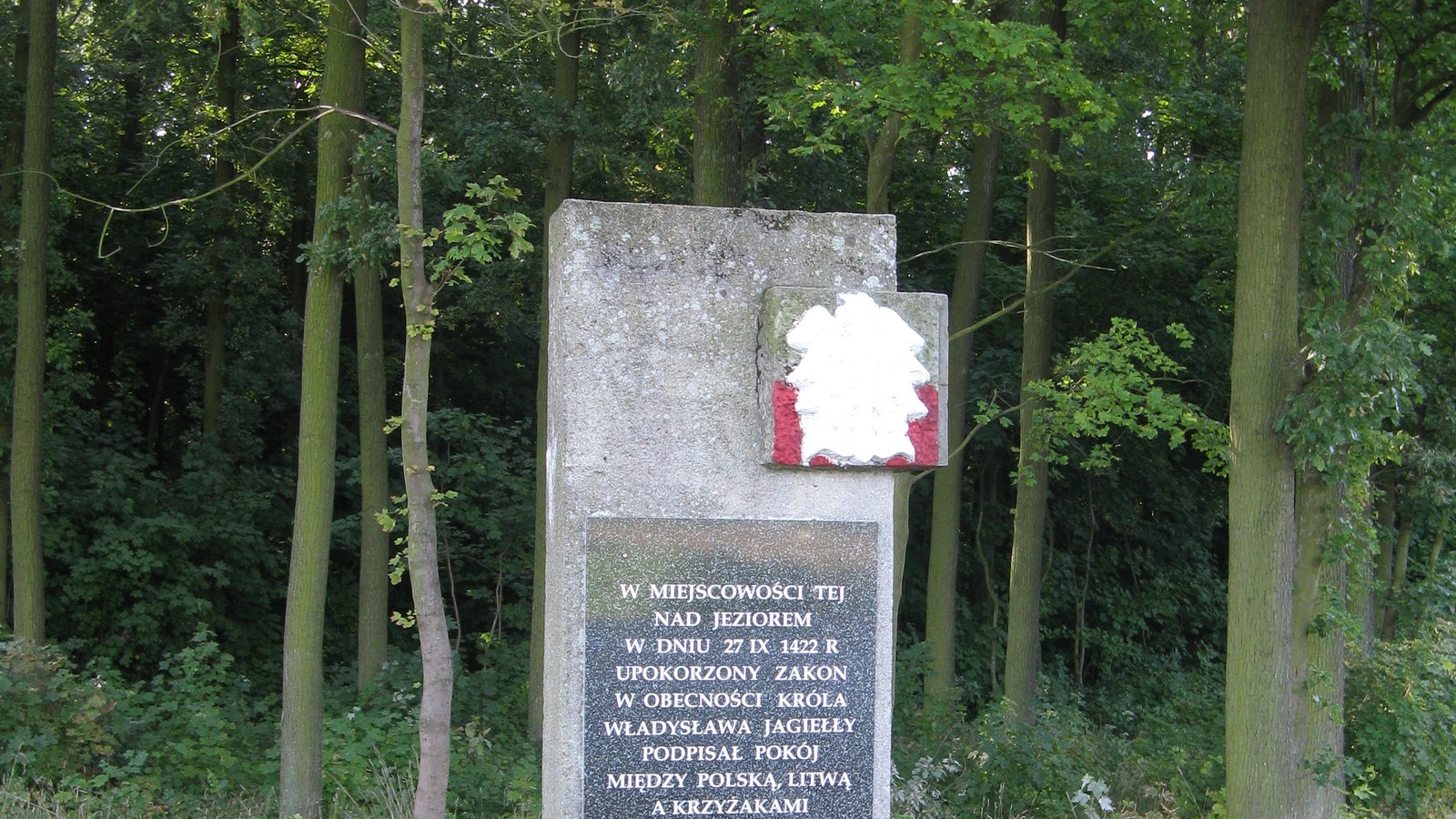
On 27 September 1422, in the camp on the Osa river and by Lake Melno, east of Grudziądz, Grand Master Paul von Rusdorf and Livonian Master Siegfried Lander von Spanheim concluded peace with King Władysław Jagiełło and Grand Duke Alexander Vytautas, together with their allies. Eight plenipotentiaries from each side had spoken the preliminaries after the truce of 17 September. It is not the First Peace of Thorn of 1411 and not the Second of 1466.
The Teutonic-side parchment, now in the Central Archives of Historical Records in Warsaw under sygn. 5629, is issued by Rusdorf and Lander von Spanheim. The inventory places it in the camp on the Osa and by Lake Melno. Forty-three seals remain, with further empty parchment strips. Weise edited it from Adam Wolff’s transcript, the original being torn from the upper left toward the middle. Exchange of the principal instruments, still dated that day, took place at Veliuona between 9 and 18 May 1423; Martin V approved the peace on 10 July.
Poland’s gain is narrow: Nieszawa, Orłowo, Murzynno and Nowa Wieś, with half the Vistula channel from the mouth of the Drwęca. In return the king renounces claims to Pomerelia, Culmerland and the Michelauer Land. The commander’s castle at Mała Nieszawka is to be slighted; the demolition followed in 1423–1424. For Polish contemporaries the balance was a disappointment beside the claims after Grunwald.
For Lithuania the Order renounces Samogitia in perpetuity, not merely for the lives of Jagiełło and Vytautas as in 1411. The Prussian–Lithuanian border runs from the wilderness of Suvalkija, through the triangle north of the Neman, to Nemirseta on the Baltic. The castle of Memel stays with the Order; the text also names it “castrum Memel in Samogitico Cleupeda appellatum”. Lithuania keeps a strip of shore between Palanga and Šventoji, some fifteen kilometres, which separates Prussia from the Livonian branch. No harbour grew there, between Memel and Libau.
The parties did not have their majesty seals at the lake, so ratification lagged. Rusdorf tried to reopen the treaty, hoping for help from Sigismund. The meeting at Kežmarok on 30 March 1423 cut off imperial support: Poland–Lithuania would stop aid to the Hussites, and Vytautas would leave Bohemia. At Veliuona the Polish–Lithuanian side affixed some 120 seals; the first Lithuanian guarantors were voivode of Vilnius Albertas Manvydas, starosta Kristinas Astikas, voivode of Trakai Jonas Jaunius and elder of Samogitia Mykolas Skirgaila.
It is not the battle of Grunwald of 1410, not the Thirteen Years’ War and not the Treaty of Riga of 1921, by which the parchment came from Petersburg to AGAD. The Masovian dukes Janusz I the Elder and Siemowit IV are parties, as is Deutschmeister Eberhard von Saunsheim. A dispute just after the peace, over the mill at Lubicz, went to the Order; Vytautas then threatened to yield Palanga if Poland did not give way.
Monument of the peace at Mełno, on the lake shore. Photo: Margoz, Wikimedia Commons, CC BY-SA 3.0.
For context: Treaty of Melno. The document: Pokój mełneński (AGAD, sygn. 5629).











0 Comments
No comments on this article yet. Be the first!