


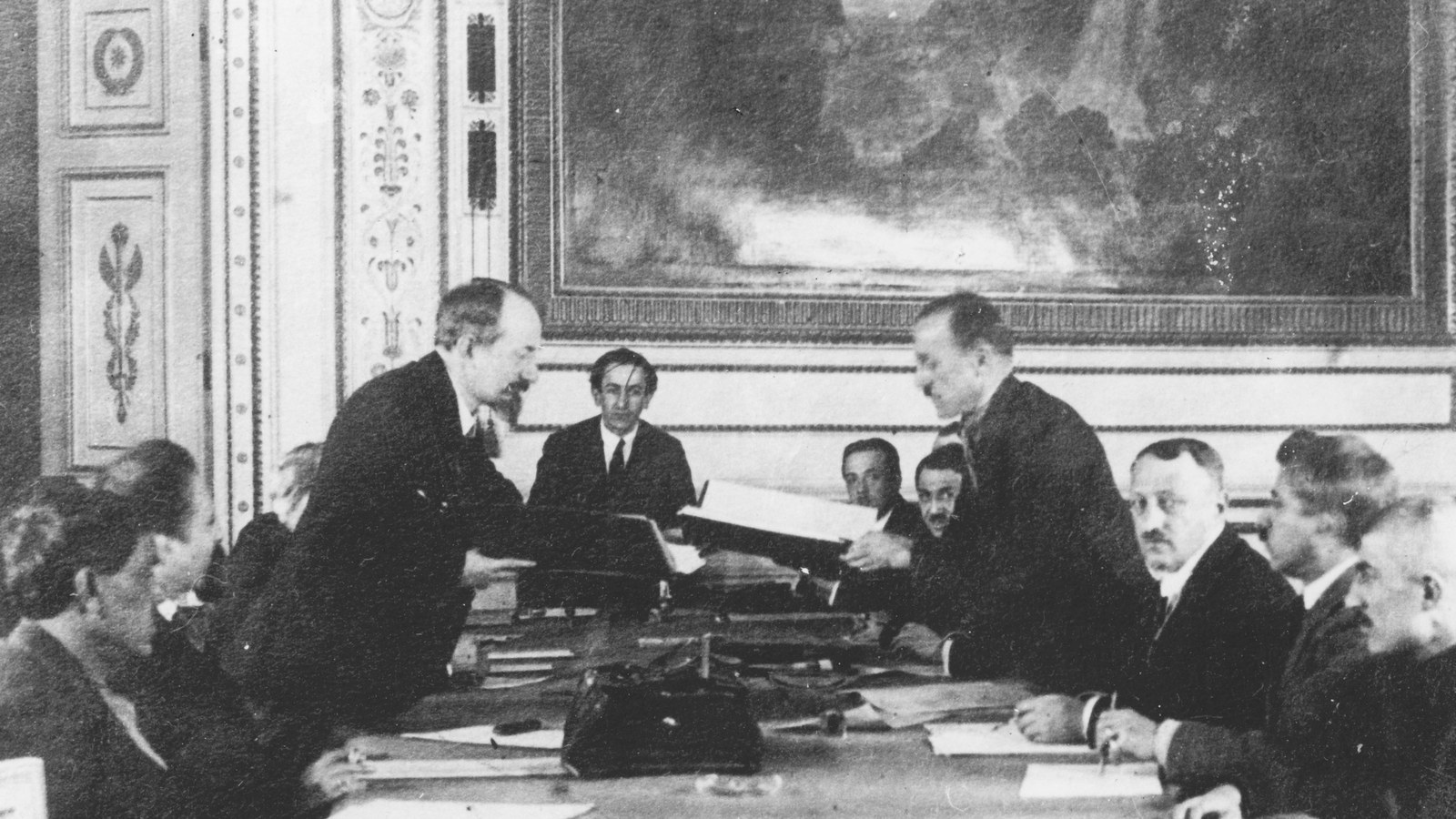
Georgy Chicherin and Dzhelal Korkmasov, for the Russian SFSR, and Yusuf Kemal, Rıza Nur and Ali Fuad, for the Grand National Assembly of Turkey, signed in Moscow, on 16 March 1921, the Treaty of Friendship and Brotherhood. Two copies. Neither the Republic of Turkey nor the USSR had yet been proclaimed; the Sultan’s government, which had signed Sèvres, is not a party. The Russian MFA still lists it in force. The RSFSR ratified on 20 March; instruments were exchanged at Kars on 22 September 1921, when, except for Article 13, it entered into force.
Article I: neither recognises treaties forced on the other; Moscow will not recognise international acts concerning Turkey that the Assembly does not recognise. “Turkey” means the territories in the National Oath of 28 January 1920. The north-eastern frontier runs from Sarp on the Black Sea along watersheds and the Arpaçay and Aras, detailed in annexes, not as a coordinate gazetteer. Article II: Turkey cedes to Georgia suzerainty over Batumi, with local autonomy and duty-free Turkish transit through the port.
Article III: Nakhichevan is an autonomous territory under Azerbaijan’s protectorate, which may not cede it to a third state. Article IV: the right of the peoples of the East to independence and to choose their form of government. Article V: the status of the Black Sea and the Straits is left to a conference of littoral states, without injury to Turkey’s sovereignty and the security of Constantinople. This is not an operations handbook.
Article VI: earlier Russo-Turkish treaties fall; Turkey is free of obligations toward the old Tsarist regime. Article VII: the capitulations are annulled. Article VIII: neither hosts organisations claiming to be the government of the other; the same rule, reciprocally, toward the Caucasian Soviet republics. Article IX: railways, telegraph, and the movement of persons and goods, under each country’s internal rules.
Article X: nationals of each party are under the law of the place, exempt from national defence; family, succession and capacity await a separate agreement. Article XI: most-favoured-nation treatment, without extending the rights of Soviet republics allied to Russia or of Muslim countries allied to Turkey. Article XII: the right to leave, with property, the territories recognised as Turkish and Batumi. Article XIII: repatriation of prisoners, at Russia’s expense toward Turkey, within three months from European Russia and the Caucasus, six months from Asia; it takes effect from signature.
Article XIV: a consular convention and economic agreements to follow. Article XV: Russia will take steps so that the Transcaucasian republics recognise, in their treaties with Turkey, the articles that concern them — done later by the Treaty of Kars of 13 October 1921, a distinct instrument. Article XVI: ratification; exchange at Kars.
Cover: the signing photograph in Moscow, not a generic Kremlin view. Wikimedia Commons, free licence.
Sources consulted: Treaty of Moscow (1921); Treaty of Friendship and Brotherhood between the RSFSR and Turkey.











0 Comments
No comments on this article yet. Be the first!