


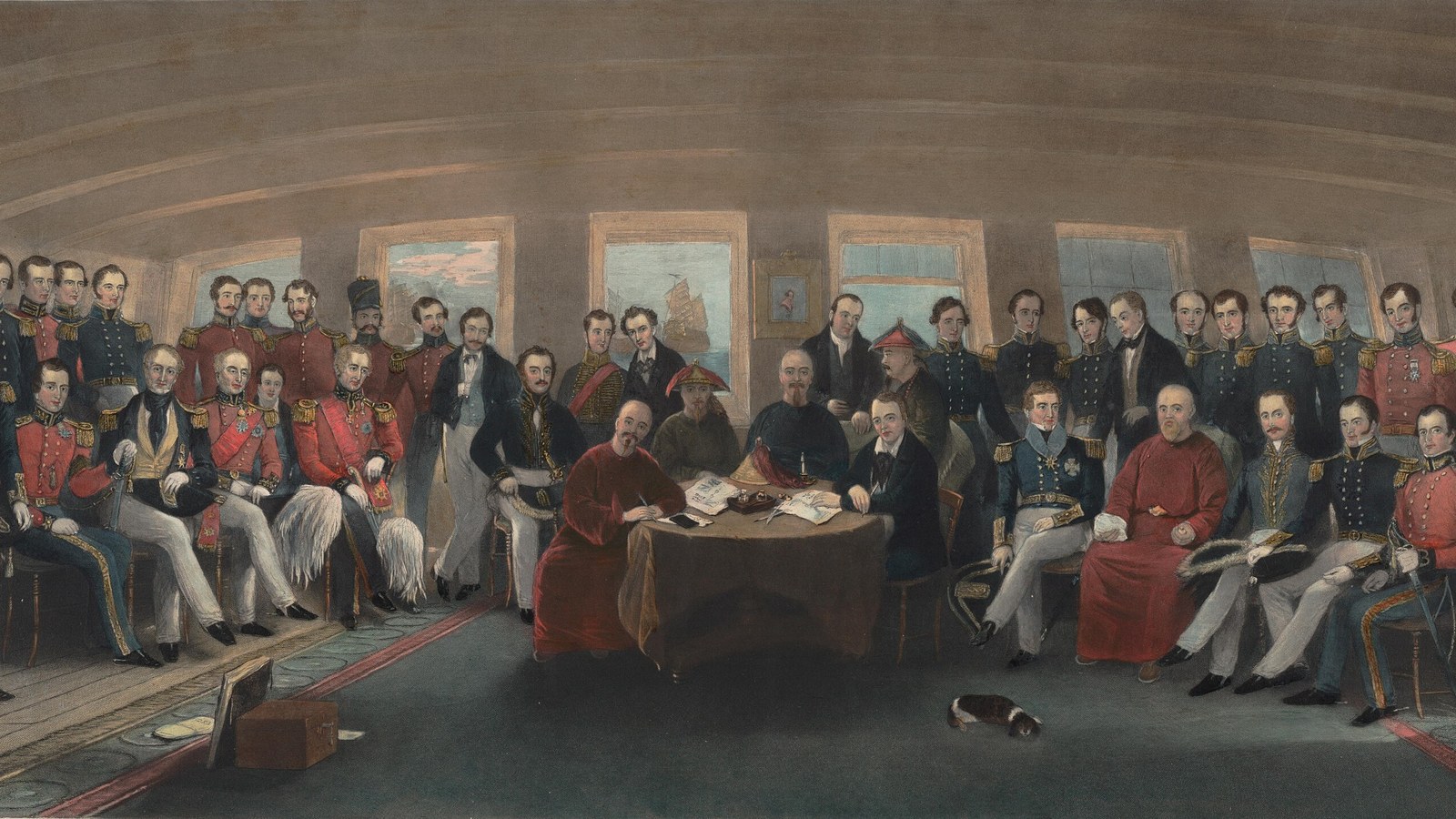
On 29 August 1842, in the state cabin of HMS Cornwallis, anchored in the Yangtze off Nanking, Sir Henry Pottinger signed, with the Qing commissioners Qiying, Yilibu and Niu Jian, the Treaty of Peace, Friendship and Commerce between Queen Victoria and the Daoguang Emperor. The instrument, in thirteen articles, closed the First Opium War, with British warships poised to attack the provincial capital.
The war had grown out of Britain’s trade deficit and out of Lin Zexu’s seizure of opium smuggled into China. A first draft of articles had been prepared at the Foreign Office in London as early as February 1840: R. Derek Wood, in his study of the treaty’s form, shows that a six-month round trip and two writing systems forced an unusual procedure. The 1841 Convention of Chuenpi, initialled by Charles Elliot and Qishan, had been rejected; the Nanking text drew largely on that draft, with the island of Hong Kong written into Article III.
The Qing ceded Hong Kong Island to the British Crown “in perpetuity,” as a harbour where merchants could careen ships and keep stores. The Canton System, which had confined foreign trade to one port and to the cohong monopoly, fell: besides Canton, Amoy (Xiamen), Fuzhou, Ningbo and Shanghai were opened, with British consuls entitled to deal directly with local officials. Duties were to be fixed by agreement.
The indemnity ran to 27 million silver dollars, in instalments over three years, at 5 per cent interest on arrears: six million for the opium Lin had confiscated, six for the 1841 ransom of Canton, three for debts owed by Canton merchants, and twelve for the cost of the war. British prisoners of war were to be released, and Chinese subjects who had cooperated with the British received an amnesty. Troops would leave Nanking and the Grand Canal after the emperor’s assent and the first instalment; Gulangyu and Zhaobaoshan stayed occupied until payment in full.
The Daoguang Emperor gave his assent on 8 September; he ratified on 27 October, Queen Victoria on 28 December, and the instruments were exchanged in Hong Kong on 26 June 1843. The treaty did not legalise opium: Palmerston had asked his negotiators to obtain legalisation outside the text, and the Chinese side refused. Extraterritoriality and most-favoured-nation treatment came only with the Treaty of the Bogue in 1843.
For later Chinese nationalists, Nanking opened the “century of humiliation” and the series of “unequal treaties”: one-sided concessions, with no British reciprocity. At the time of signing, Joanna Waley-Cohen writes, the Qing court did not treat it as an unprecedented disaster, likening its form to a recent arrangement with Kokand. Pottinger became the first governor of Hong Kong. Copies are held at The National Archives in London and at the National Palace Museum in Taipei.
Source consulted: Treaty of Nanking. Study: The Treaty of Nanking: Form and the Foreign Office, 1842–43.











0 Comments
No comments on this article yet. Be the first!