


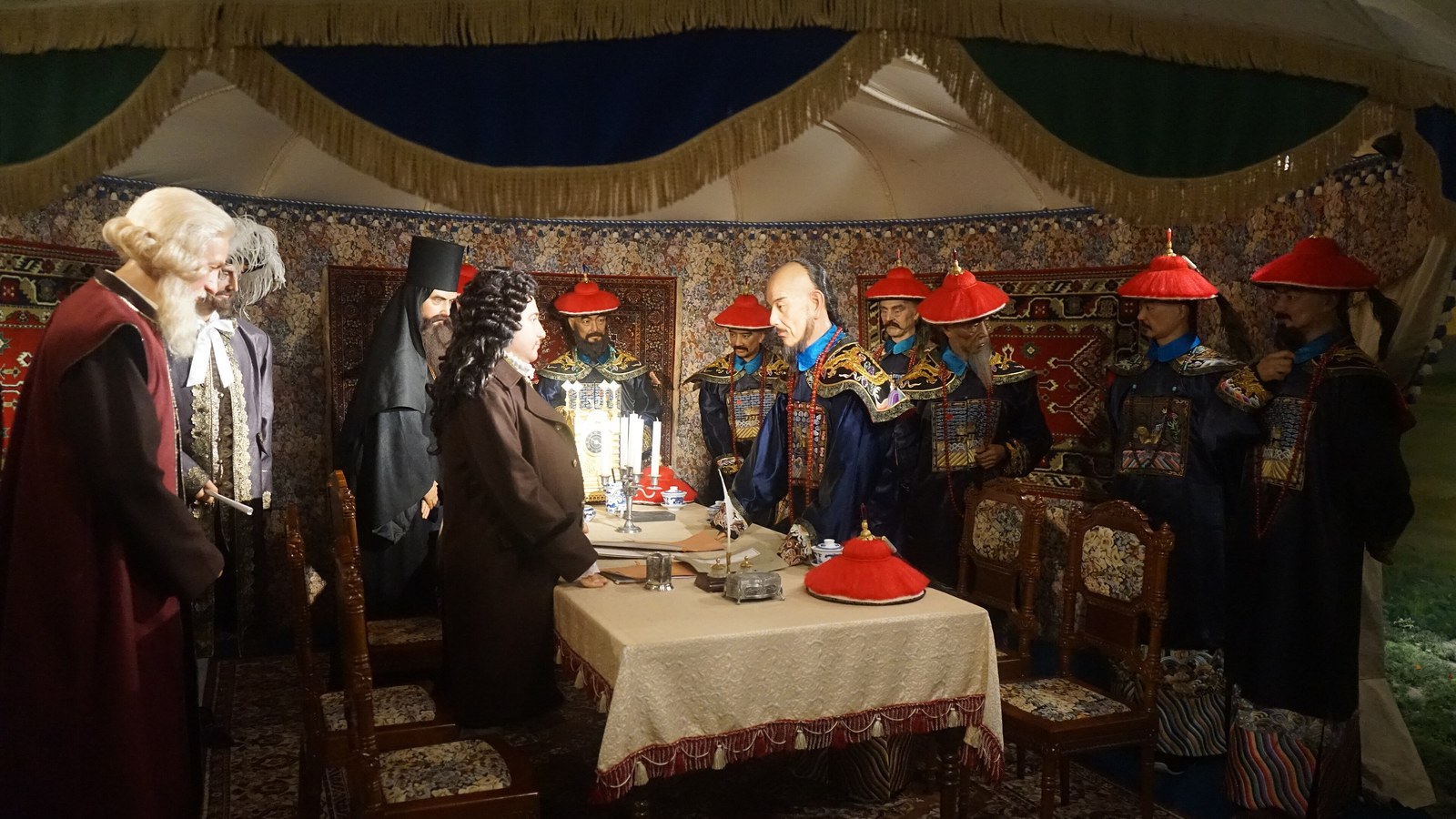
On 27 August 1689, near the town of Nipchou (Nerchinsk), the articles of Pactum Nertschiae were set down, the Latin being the authoritative text. The Manchu date: Kangxi year 28, the yellow serpent, the 24th day of the seventh moon. By mandate of the Qing emperor: Som Go Tu (Songgotu), prefect of the palace guard; Tum Que Cam (Tong Guogang), the emperor’s uncle; Lam Tan; Pam Tarcha; Sap so (Sabsu), general on the Sagalien Vla; Ma La; Wen Ta. For Tsars Ivan Alexeyevich and Peter Alexeyevich: Fyodor Alexeyevich Golovin, Ivan Yevstafyevich Vlasov, Simeon Kornitsky. Interpreters: the Jesuits Jean-François Gerbillon and Thomas Pereira for the Qing; the Pole Andrzej Bielobocki for the Russians. The purpose: hunters and raiders beyond the limits, a clear border, perpetual peace.
Article I: the stream Kerbichi (Gorbitsa), next to the Chorna/Vrum, which flows into the Sagalien Vla (Amur), shall be the boundary. From the stone mountain above the Kerbichi’s source, along the crests to the sea: all that drains south into the Amur is Qing; all that falls north is Russia. Rivers that enter the sea and the lands between the Vdi (Uda) and the mountain chain remain, for now, undetermined; they shall be settled by envoys or letters. The river Ergon (Argun), also into the Amur: south Qing, north Russia. Houses on the south bank at the mouth of the Meyrelke are to be moved to the north bank.
Article II: the fort at Yagsa (Albazin), built by the Russians, is to be razed; its people, with all their goods, taken into Russian territory. Hunters shall not cross the line. One or two who wander to hunt or steal: chains, to the prefects, punishment. Ten or fifteen armed, hunting, killing, plundering: report to the emperors, capital penalty; private excesses shall not make war. Article III: all that went before is put to eternal oblivion; from the day the peace is sworn, a fugitive is not to be received, but returned in chains. Article IV: Russian subjects already in the Sinic empire and Sinic subjects already in Russia remain as they are.
Article V: by the friendship now made, anyone bearing letters patent of travel may enter both realms, sell and buy. Article VI: if the terms are kept, there shall be no further disturbance. The conditions, in duplicate sealed copies, are exchanged. The same conditions, in Chinese, Russian and Latin, shall be cut in stone on the border, an everlasting monument. Datum apud Nipchou, Kangxi 28, seventh moon, day 24.
This is not Kyakhta 1727, which opened the caravan and drew the line west of the Argun. It is not Aigun 1858, which passed the north of the Amur to Russia. It is not the Convention of Peking 1860, the coast down to Vladivostok. The cover is a reconstruction of the signing of Pactum Nertschiae.
Sources: Treaty of Nerchinsk; Pactum Nertschiae (Wikisource; Cordier).











0 Comments
No comments on this article yet. Be the first!