


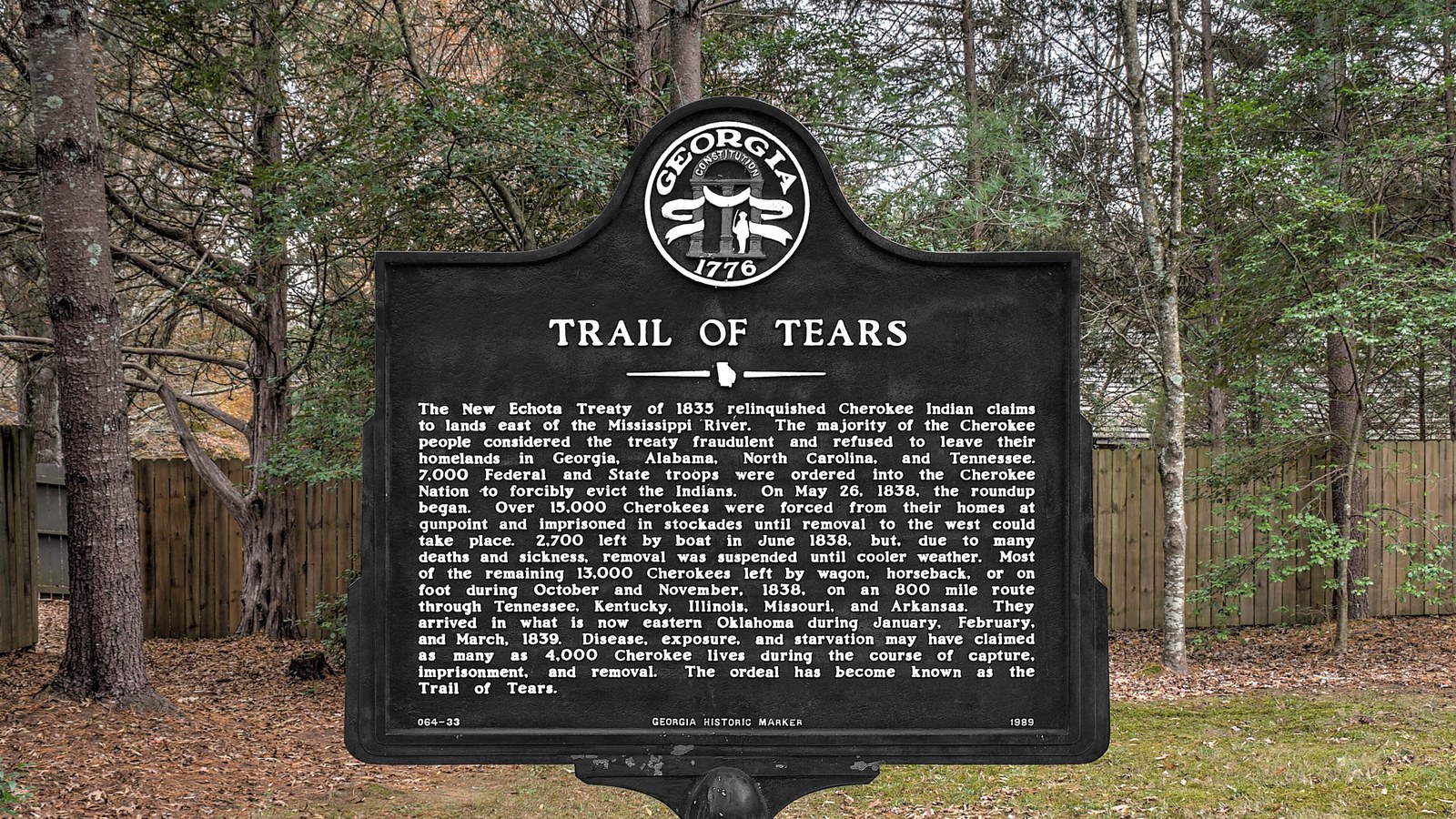
After 1828 Georgia abolished the Cherokee government, forbade the National Council to meet and barred Indian witnesses from cases involving whites. The discovery of gold in late 1829 hurried the 1832 land lottery. Worcester v. Georgia, in 1832, struck down the state’s laws; Georgia enforced them anyway. Andrew Jackson told John Ridge he would not use federal force. Lewis Cass offered western titles, self-government and relocation aid, all conditioned on total removal. The National Council cancelled the 1832 elections and moved an emergency government to Tennessee. About 16,000 Cherokee then lived in northwestern Georgia, with strips in Tennessee, Alabama and North Carolina.
The Treaty with the Cherokee, 1835, 7 Stat. 478, was concluded on 29 December 1835, at New Echota, Georgia, by commissioners William Carroll and John F. Schermerhorn with a minority — the Treaty Party, around Major Ridge, John Ridge, Elias Boudinot and Stand Watie. The National Council, with Principal Chief John Ross, did not sign. The preamble claims that those who did not come to the council convened on 21 December gave their assent. Signatories include Major Ridge, Boudinot, Andrew Ross, James Starr, John Gunter; John Ridge and Watie added their names in Washington. Proclamation followed on 23 May 1836. The supplementary articles are dated 1 March 1836, 7 Stat. 488.
Article 1 cedes all lands east of the Mississippi for five million dollars, plus $300,000 if the Senate recognises spoliations. Article 2 takes up the treaties of 6 May 1828 and 14 February 1833: seven million acres in Indian Territory, a western “outlet” and another 800,000 acres next to Missouri, for $500,000. Article 5 says those lands shall not, without consent, be included in any State or Territory. Article 7 reserves a delegate in the House of Representatives, “whenever Congress shall make provision for the same”. Article 8 puts removal and one year’s subsistence on the United States, with a physician on each detachment. Article 12 leaves a pre-emption of 160 acres, at the minimum Congress price, to families in North Carolina, Tennessee and Alabama who wish to remain under state law. Article 16 gives two years from ratification to leave.
The Senate ratified by a single vote. Ross carried, in the spring of 1838, a petition with nearly 16,000 signatures. Van Buren sent General Winfield Scott. The forced removal of 1838–1839 became the Trail of Tears. On 22 June 1839 parties killed Major Ridge, John Ridge and Boudinot, citing the Cherokee law — written by Major Ridge — that made it a capital crime to cede national land. Watie escaped. The Cherokee civil war lasted until after the American Civil War.
The CC0 photograph from New Echota shows the capital where the treaty was signed. In 2019 Principal Chief Chuck Hoskin Jr. cited Article 7 and proposed Kimberly Teehee as delegate; the United Keetoowah Band named Victoria Holland in 2021, as successor of the signatories.
The treaty became the legal basis of the removal, although the National Council rejected it. The absence of the majority was read, in Washington, as consent by silence.
Sources: Treaty of New Echota; Oklahoma State University, Kappler, Treaty with the Cherokee, 1835.











0 Comments
No comments on this article yet. Be the first!