


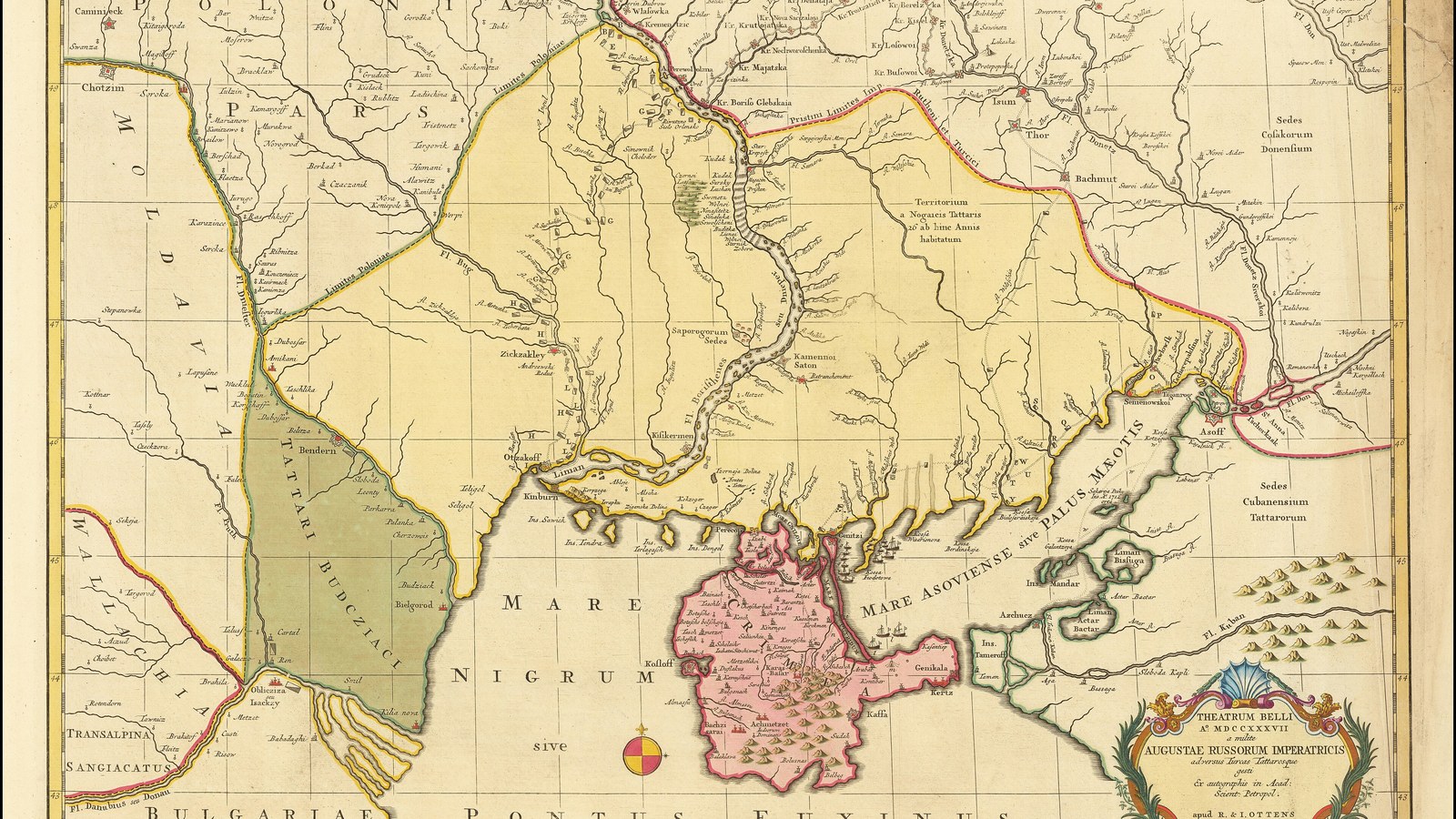
On 3 October 1739, in the camp below Niš, the Russian Empire and the Ottoman Porte concluded, through the mediation of the French court, the boundary convention that follows the Russo-Ottoman treaty signed, also by Villeneuve, on 18 September, likewise under Belgrade. It is not the Habsburg Peace of Belgrade of the same September day, another instrument, with Neipperg and the vizier, about Serbia and Oltenia.
The preliminary treaty of 18 September, the copy in the Moscow Main Archive, binds Villeneuve, counsellor of state of His Most Christian Majesty and ambassador at the Porte, to Grand Vizier Hacı Mehmet Pasha. The empress is Anna, the sultan Mahmud, son of Mustafa. Article 3 demolishes the fortress of Azov entirely; its land, according to the frontiers of 1700, remains empty, a barrier between the empires. Russia may build a new fortress near Cherkassk island on the Don, a long-standing Russian border; the Porte, one on the Kuban frontiers toward Azov. Taganrog, already razed, is not to be renewed. Russia may neither keep nor build a war fleet, nor other ships, on the Sea of Azov or the Black Sea.
The Niš convention, “in consequence of the Belgrade peace treaty,” draws the line. Article 2: on the other side of the Dnieper, that is eastward, from the eastern source of the Konskie Vody arm a straight line runs to the western source of the Great Berda; all lands and waters inside the Dnieper, Konskie Vody, that line and the Great Berda remain to the Ottoman Empire; what lies beyond remains to Russia, except as the next article provides. Article 3: between the Great Berda and the Mius, the frontiers stay as they were set by the treaty of 1700.
Article 6 of the September instrument leaves both Kabardas, Great and Little, free, under neither empire, as a barrier; Turks and Tatars are not to enter, Russia is to leave them in peace; yet by ancient custom both sides take hostages, and if the Kabardians give cause of complaint, each may punish them. Article 9 allows free trade, with the same duties as other powers; Russian commerce on the Black Sea is to be carried on Ottoman subjects’ ships. Article 7 frees prisoners without exchange and without ransom, except those who have taken the Christian law in Russia or the Muslim law at the Porte.
Münnich, who had taken Moldavia, was not at the talks. Ratifications, by article 15, are to be exchanged within three months through the French ambassador; the Constantinople convention of 28 December and Anna’s manifesto of February 1740 close the file. It is not the Peace of the Pruth of 1711, not Küçük Kaynarca of 1774 and not the instrument at the Great Ingul of 1740, which later drew the line between the Bug and the Dnieper.
Map of the theatre of the Russo-Turkish war of 1735–1739, Ottens edition, 1744. Image: Wikimedia Commons, public domain.
For context: Treaty of Niš (1739). The text: Convention in the camp below Niš, 3 October 1739.











0 Comments
No comments on this article yet. Be the first!