


After Mohács, neither Ferdinand of Habsburg nor John Zápolya could take the whole kingdom. In 1536–37 Zápolya held Transylvania and seized Košice; the Habsburg offensive stalled at Tokaj, and Hans Katzianer’s army was beaten on the Drava by a smaller Ottoman force. Talks began at the end of 1537 at Sárospatak, then at Oradea. Zápolya was spoken for mainly by György Fráter, a Pauline friar, bishop of Várad and treasurer, together with Ferenc Frangepán, archbishop of Kalocsa, Giovanni Statileo, bishop of Transylvania, István Brodarics, bishop of Vác, the crown-guardian Péter Perényi and István Werbőczy.
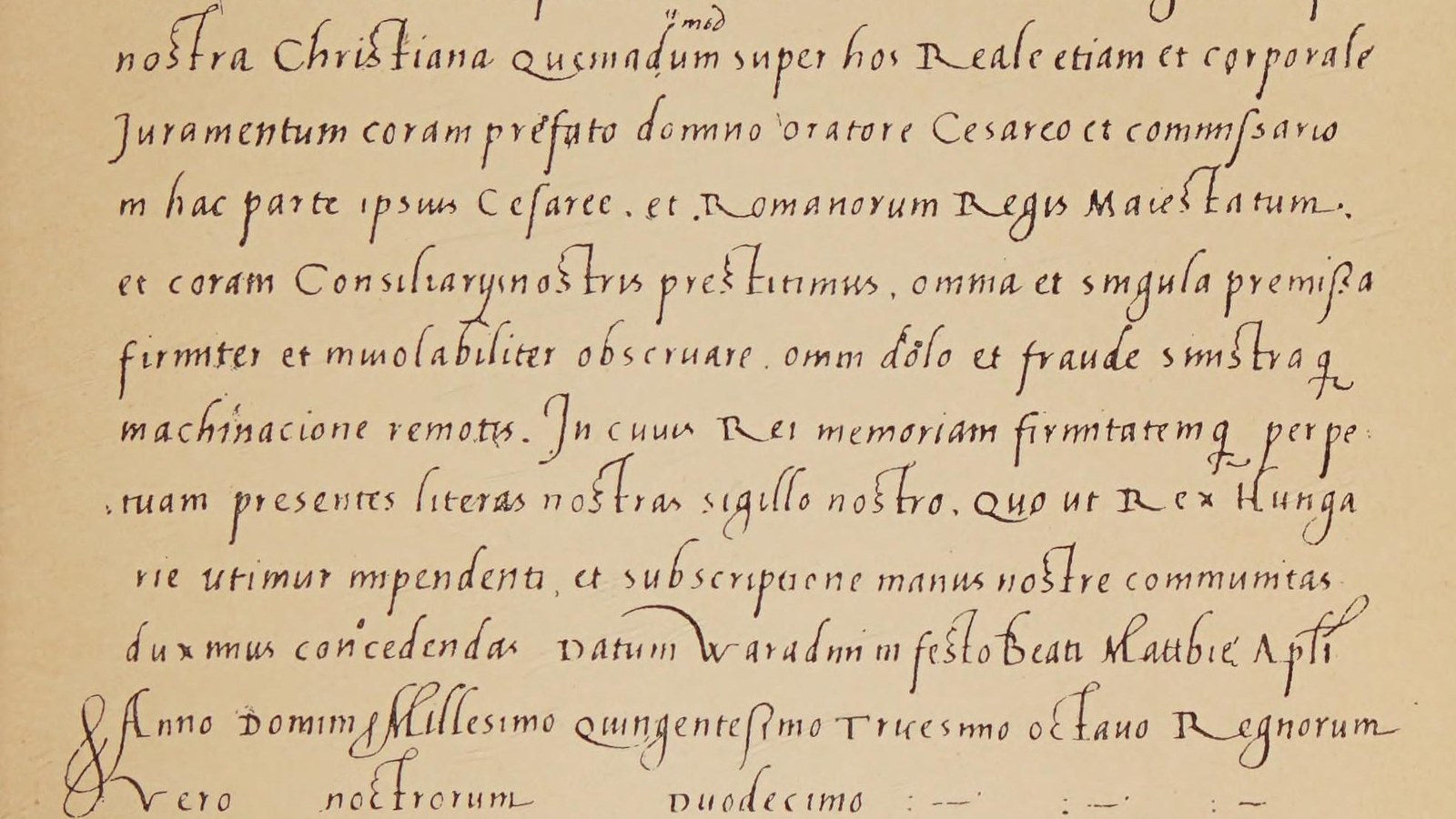
A secret treaty of succession, peace and alliance, in Latin. For Ferdinand the signatory was General Leonhard von Fels, commander in northern Hungary. For Charles V, Johannes von Weeze, archbishop of Lund. The treaty was signed on 24 February 1538, at Oradea, then Nagyvárad, in Bihar county. The original is in the Vienna State Archives.
The two kings recognised each other’s hold on the land they already ruled: the east, about two-thirds, to John I; the west, to Ferdinand. On Zápolya’s death, if he had no son, the whole kingdom would pass to the House of Habsburg. If an heir were born, Ferdinand would grant him a principality in the Szepes region and its neighbourhood. On paper the merit was later reunification. Sceptics said one side was ceding what it did not hold, and the other offering a principality that did not exist.
The treaty stayed secret. The signatories feared Sultan Suleiman’s anger. They counted on Charles V; the emperor, freshly at peace with France, faced the Ottomans in the Mediterranean, not on the Danube. In the autumn of 1538 the sultan’s offensive frightened Hungary, but the target was Petru Rareș: suzerainty over Wallachia and Moldavia. The Habsburg allies sent, after delay, a few thousand mercenaries. Zápolya drew the lesson and broke the bargain.
In early 1539 Ferdinand demanded publication. Fráter refused and stopped the king’s men from swearing the terms. Werbőczy still hoped for union and protested in council. On 2 March 1539, at Székesfehérvár, John, past fifty, married Isabella, younger daughter of Sigismund I of Poland. Had he taken Nagyvárad in earnest, he would have stayed unmarried. He calculated a son in whose name the treaty could be challenged.
Isabella gave birth in Buda on 7 July 1540. The news reached the king three days later, in camp at Orăștie. He died after nearly two weeks of agony. His last will, Hungarian Wikipedia records, told Fráter not to keep the Nagyvárad articles but to raise John Sigismund. The diet at Buda elected him king as John II. Magnates who held to the treaty — Ferenc Frangepán, Péter Perényi, the voivode István Maylád — looked to Vienna.
Werbőczy asked the sultan for recognition. Then Hieronym Łaski, Ferdinand’s envoy, disclosed the Nagyvárad talks in Istanbul. Suleiman had Łaski arrested. In 1541, after the Habsburg siege of Buda, janissaries occupied the castle on 29 August. The sultan left the child, against a tribute of ten thousand forints a year, Transylvania and the land east of the Tisza. From the secret peace of Oradea there came, by degrees, the Transylvanian principality, not a Hungary reunited under the Habsburgs.
Sources: Treaty of Nagyvárad; History of Transylvania, The Prelude to Transylvanian Statehood.











0 Comments
No comments on this article yet. Be the first!