


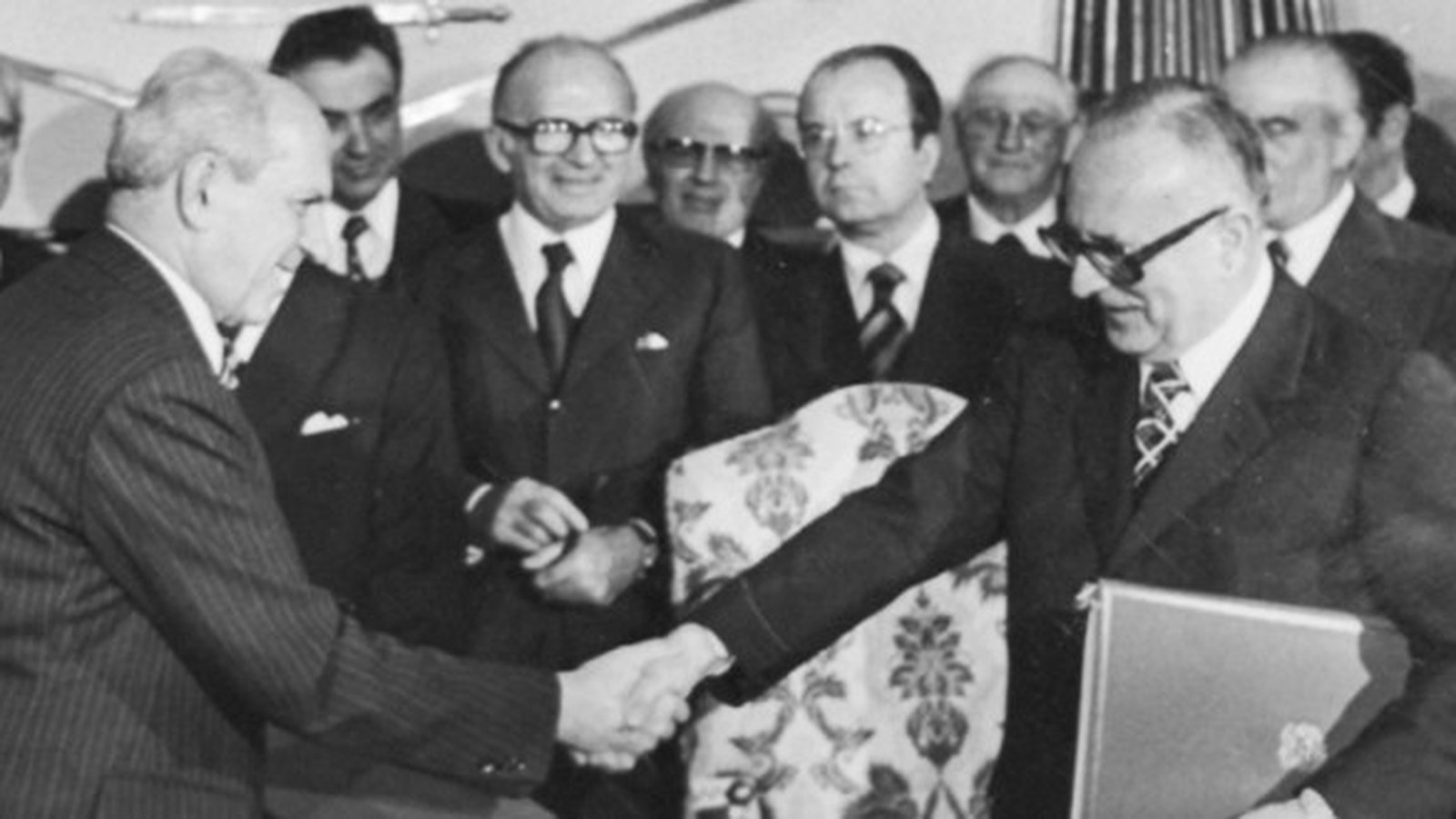
The peace treaty with Italy of 10 February 1947 provided for a Free Territory of Trieste that was never fully set up. The London Memorandum of 5 October 1954 split the area de facto: Zone A — the port city of Trieste and a coastal strip to the north-west — under Italian administration; Zone B — the north-west of Istria — under Yugoslav administration. Special statutes for minorities remained annexed to the memorandum. The land frontier in article 21 of the 1947 peace was not drawn as a state border.
The Treaty on the delimitation of the frontier for the part not indicated as such in the Peace Treaty of 10 February 1947 was signed on 10 November 1975 at Osimo, in the province of Ancona. For Italy the signatory was Foreign Minister Mariano Rumor; for the Socialist Federal Republic of Yugoslavia, Federal Secretary Miloš Minić. The authentic text is in French, in two originals. It entered into force on 3 April 1977, by the exchange of instruments of ratification at Belgrade, together with the agreement on economic co-operation signed the same day. Italy registered it with the United Nations on 9 July 1987 (UNTS 24848).
Article 1 describes the land frontier in Annex I and plots it on the map in Annex II; if they differ, the text is authentic. Article 2 does the same for the Gulf of Trieste, Annexes III–IV. Article 3 ties the nationality of persons who on 10 June 1940 were Italian nationals resident in the territory of article 21, and of descendants born after that date, to the law of the Party in whose territory they reside at entry into force. The Italian and Yugoslav minorities have the option of moving, under the exchange of letters in Annex VI.
Article 4 binds the two governments to negotiate, within two months of entry into force, a global lump-sum compensation, equitable and acceptable, for the property, rights and interests of Italian natural and juridical persons in the Yugoslav part of the article 21 territory, nationalised or expropriated after the Yugoslav Armed Forces entered it. Article 5 leaves pensions and social security to a further agreement. Article 6 points to the economic agreement signed at the same time, for the frontier populations.
Article 7 ends, on the date of entry into force, the London Memorandum of 1954 and its annexes in relations between Italy and Yugoslavia. Each Party notifies within 30 days the British government, the American government and the Security Council. Article 8 declares that, once the Special Statute expires, each Party will keep the internal measures already taken and will ensure, under its domestic law, the level of protection the Statute stipulated for the ethnic groups.
The talks were held off the usual diplomatic channels; Italian nationalists called for the prime minister and the foreign minister to be prosecuted for treason under article 241 of the Criminal Code. Slovenia, recognised in 1992, declared on 31 July 1992 that it recognised the treaty. Croatia accepted, on 25 June 1991, the borders as part of Yugoslavia. In 1994 the Berlusconi government blocked Slovenia’s accession to the EU until, in March 1995, the Dini cabinet withdrew the demand for extra compensation.
Sources: Treaty of Osimo; United Nations Treaty Series, No. 24848.











0 Comments
No comments on this article yet. Be the first!