


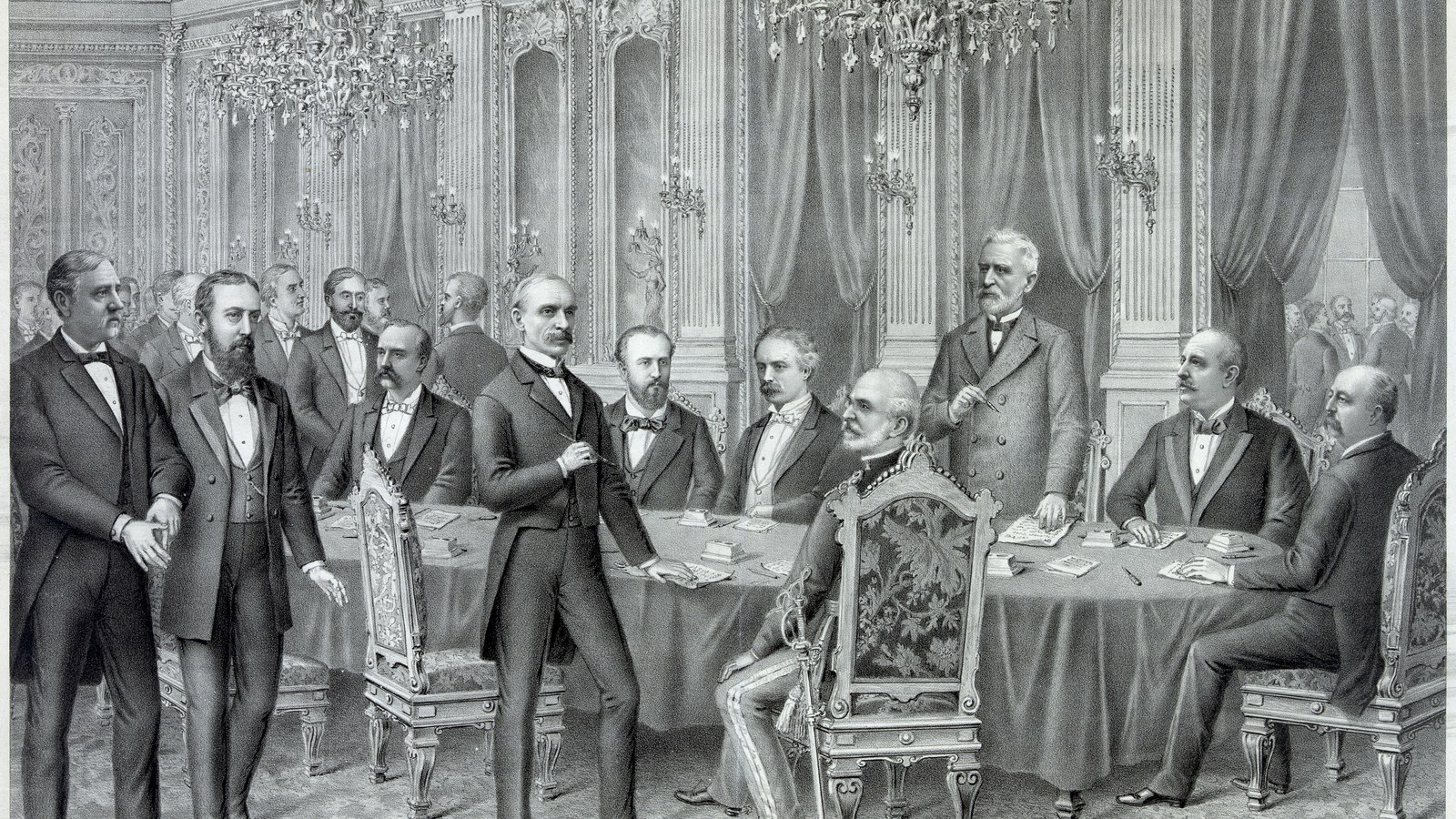
On 10 December 1898, in Paris, five American plenipotentiaries and five Spanish ones sign the Treaty of Peace between the United States of America and Spain. For Washington: William R. Day, Cushman K. Davis, William P. Frye, George Gray, Whitelaw Reid. For the Queen Regent Maria Christina, in the name of her son Alfonso XIII: Eugenio Montero Ríos, Buenaventura de Abarzuza, José de Garnica, Wenceslao Ramírez de Villa-Urrutia, Rafael Cerero. Two copies. The armistice protocol of 12 August, from Washington, remains in force until executed.
Article I: Spain relinquishes all claim of sovereignty over and title to Cuba. The island, upon evacuation, is occupied by the United States, which assumes, so long as the occupation lasts, the obligations under international law for life and property. Article II: Spain cedes Puerto Rico and the other Spanish islands in the West Indies, plus Guam, in the Marianas or Ladrones. Article III: it cedes the Philippine archipelago, along a line of meridians and parallels. The United States pays twenty million dollars within three months of the exchange of ratifications.
Article IV: for ten years, Spanish ships and merchandise enter Philippine ports on the same terms as American ones. Article V: Spanish soldiers taken at Manila go back to Spain, at American cost, with their arms. Evacuation of the Philippines and Guam, on the Puerto Rico model. Colours, uncaptured vessels, ammunition remain Spain’s. Heavy guns in the fortifications stay six months; Washington may buy them. Article VI: release of prisoners of war and of persons held for political offences in the Cuban and Philippine insurrections. Reciprocally.
Article VII: mutual relinquishment of indemnity, national and individual, from the beginning of the Cuban insurrection to the exchange of ratifications, including the cost of the war. The United States adjudicates the claims of its own citizens. Article VIII: buildings, wharves, barracks, forts, public highways of the Crown pass with the sovereignty; private, municipal and ecclesiastical property does not. Article IX: Spaniards of the Peninsula may remain or leave, with their property; within a year, a declaration of allegiance to the Crown, or the nationality of the territory. Civil rights and political status of the native inhabitants, by Congress.
Article X: free exercise of religion. Article XIV: Spanish consuls in the ceded ports. Article XV: for ten years, equal treatment for merchant vessels, except the coastwise trade. Article XVI: American obligations as to Cuba last for the occupation; at the end, Washington will advise any government established on the island to assume them. Article XVII: ratification by the American President, by and with the advice and consent of the Senate, and by the Queen Regent; exchange at Washington within six months.
Felipe Agoncillo, lawyer of the First Philippine Republic, is not admitted to the table. The Cortes rejects the text; Maria Christina signs it, under the Constitution. On 4 February 1899 fighting breaks out in Manila. The Senate ratifies on 6 February, 57–27, two votes over two-thirds. Two Republicans vote no: George Frisbie Hoar and Eugene Hale. The exchange is on 11 April 1899. The Philippine–American War follows. In Spain, the Generation of ’98. In the United States, the Teller Amendment had kept Cuba from annexation; the Platt Amendment will bind the island another way.
Image: Kurz and Allison, Spanish-American Treaty of Peace, Paris, 10 December 1898, public domain, Library of Congress / Wikimedia Commons. Cropped to 16:9.
Source consulted: Treaty of Paris (1898). Treaty text: Treaty of Peace Between the United States and Spain; December 10, 1898.











0 Comments
No comments on this article yet. Be the first!