


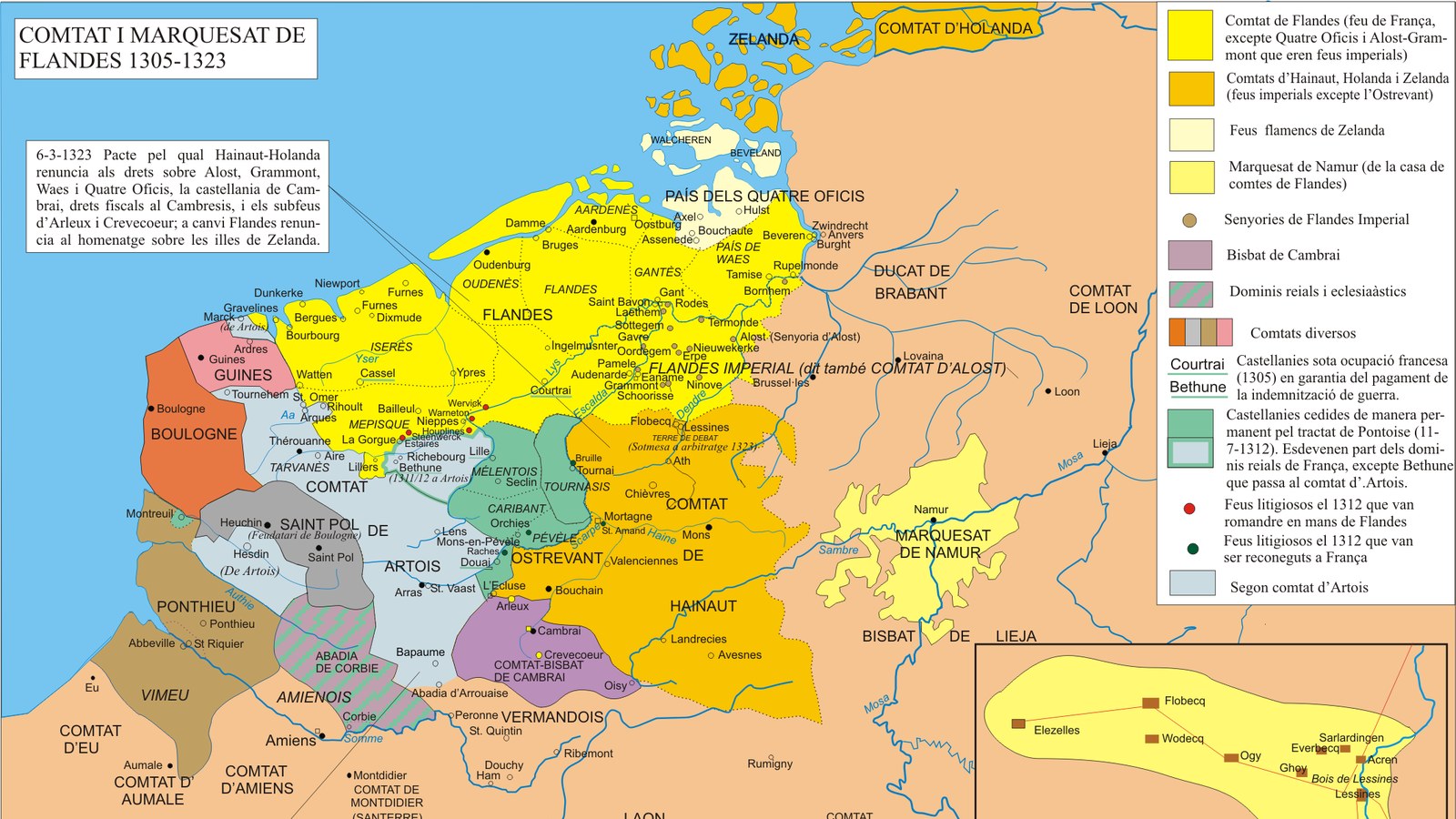
The houses of Avesnes and Dampierre, both sprung from Margaret of Constantinople, had torn each other for a century over the mouths of the Scheldt. After the Battle of the Golden Spurs, in July 1302, the Flemings pushed in 1303 as far as Haarlem and took Utrecht; Dordrecht and Zierikzee held. Guy of Namur, son of the count of Flanders, styled himself seigneur, then comte de Zélande. In 1304 the Dutch-French fleet of the Genoese Rainier Grimaldi smashed the siege on the Gouwe, before Zierikzee. The title count of Zeeland, with no Carolingian root, was still a claim, not a recognised fief.
Talks began at Tournai, in 1322, under the French king’s mediation. An attempt in 1311, also with Philip IV, had failed; in 1315 the king and the count of Hainaut-Holland made a treaty against Flanders. In December 1322 they reached a settlement; the definitive charter, in Old Picard, was sealed on 6 March 1323, in Paris. The incipit: “A Tous chiaus qui ches presentes lettres verront et oiront… Guillaumes Cuens de Haynnau, de Hollande, de Zeelande et Sires de Frize… Et Loys Cuens de Flandres et de Nevers.”
Louis I of Flanders, count of Nevers, gave up all feudal rights over Zeeland, islands and waters, and recognised William III of Holland, also count of Hainaut, as count of Zeeland. William dropped his claims on Imperial Flanders: the Four Ambachten, the land of Waas, Aalst, Geraardsbergen and the terres des débats stay with Flanders. Zeeland east of the Scheldt (Schouwen, Duiveland, Tholen) and west of it (Walcheren, with Middelburg) become one undivided county, held directly of the king of the Romans, not as a Flemish sub-fief.
Wax seals, on silk cords: the two counts; from Hainaut, Valenciennes, Mons, Maubeuge, Binche; from Holland and Zeeland, Dordrecht, Zierikzee, Middelburg, Delft, Leiden, Haarlem. On the right, six holes for Ghent, Bruges and Ypres; the holes are clean, the Flemish seals seem never to have been attached. The original, 63 by 58 centimetres, is at the Archives Départementales du Nord, Lille, Musée 12. Because the lands belong to the Empire, the parties appeared before King of the Romans Louis IV; confirmation, on 4 March 1324.
The treaty does not mention religion. It mentions lordship, free passage for trade and, where the border is unsure, surveyors. For Zeeland, the day of sealing is the birthday of the county as an entity recognised by Flanders, by France and by the Empire. Arjan van Dixhoorn read the charter as the point at which the title, for a time a “fiction” (Gosses), became fact: from a split viscounty to a graafschap held wholly by the Avesnes.
The map of Flanders for 1305–1323, on Commons, shows the county on the eve of the peace, not the sealed page at Lille. Seven centuries later the Lille archive lent the act to the Zeeuws Museum in Middelburg. The Picard text, transcribed by Jurian Bazen, is published by the Koninklijk Zeeuwsch Genootschap der Wetenschappen.
Sources: Treaty of Paris (1323); Arjan van Dixhoorn, Het verdrag van Parijs en de wording van het graafschap Zeeland.











0 Comments
No comments on this article yet. Be the first!