


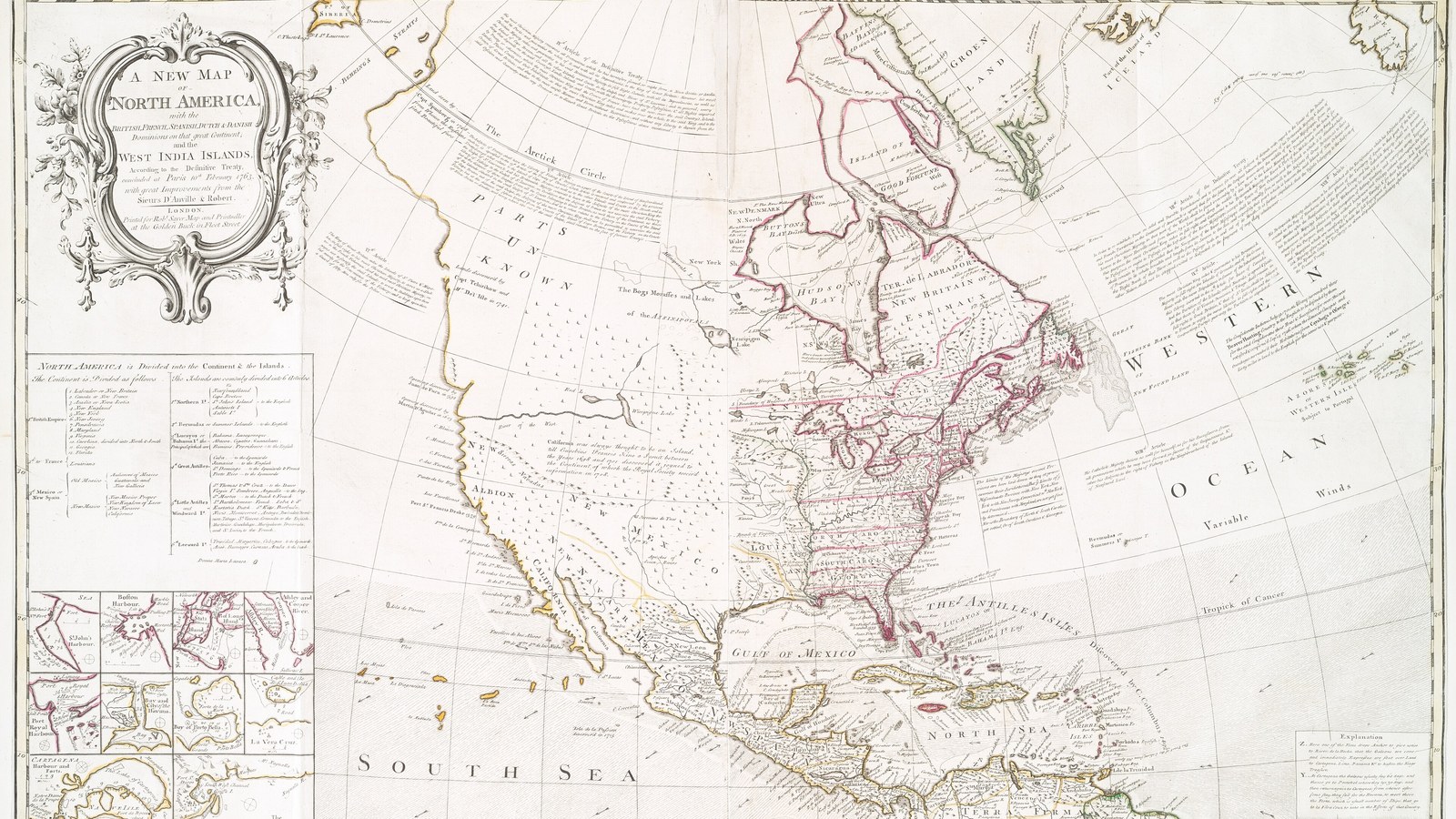
The Seven Years’ War, begun under George II, spread over four continents and drew in Spain and Portugal. The preliminaries were signed at Fontainebleau, on 3 November 1762. The secret treaty there had given Spain Louisiana west of the Mississippi; Madrid did not take possession until 1769. Hubertusburg, between Prussia, Austria and Saxony, came five days after Paris and closed the German theatre separately.
The definitive treaty of peace and friendship was signed on 10 February 1763, in Paris. For George III: John Russell, Duke of Bedford, keeper of the privy seal. For Louis XV: César Gabriel de Choiseul, Duke of Praslin. For Charles III: Jerónimo Grimaldi. Joseph I of Portugal acceded the same day, through Martinho de Melo e Castro. Ratifications, in Paris, within a month.
Article IV: France renounces Acadia and cedes Canada, Cape Breton and the whole gulf of the St Lawrence. Catholics in Canada keep their rite, so far as British law permits; inhabitants may emigrate for eighteen months, selling estates only to British subjects. Article V renews the Utrecht fishery on part of Newfoundland, three leagues from British shores in the gulf and fifteen from Cape Breton. Article VI gives France Saint Pierre and Miquelon, without fortifications, with a guard of fifty men.
Article VII draws the limit along the middle of the Mississippi, to the Iberville, lakes Maurepas and Pontchartrain. Everything on the left of the river, with Mobile, passes to Britain, except New Orleans and its island, which remain to France; navigation is free, without visit and without duty. Article VIII restores Guadeloupe, Marie-Galante, Désirade, Martinique and Belle-Île. Article IX cedes Grenada; of the “neutral” islands, Saint Vincent, Dominica and Tobago stay British, Saint Lucia French.
Gorée returns to France; the Senegal river, with Saint-Louis, Podor and Galam, passes to Britain. In India the factories of 1749 are restored, with no troops in Bengal; Muhammad Ali Khan is recognised in the Carnatic and Salabat Jang in the Deccan. Minorca, with Fort St Philip, returns to Britain. Dunkirk goes back to the Aix-la-Chapelle state, with the Cunette destroyed. Havana is restored to Spain; Florida, with St Augustine and Pensacola, passes to Britain, with the same Catholic liberty. British fortifications in the bay of Honduras come down; the logwood cutters stay.
Bute wanted a peace that would not push France into a second war. Pitt told Parliament the peace was insecure and no equivalent; it passed 319 votes to 65. Choiseul kept the Antillean sugar, not Canada. Voltaire had spoken of “a few acres of snow”. Sayer’s 1763 map, public domain, shows the continent after the cessions, not the signed page.
Paris made Britain the dominant colonial power and left the Thirteen Colonies without a French counterweight on the continent. The Proclamation of the same year stopped settlement beyond the Appalachians; Pontiac opened war in the spring.
Sources: Treaty of Paris (1763); Avalon Project, Treaty of Paris 1763.











0 Comments
No comments on this article yet. Be the first!