


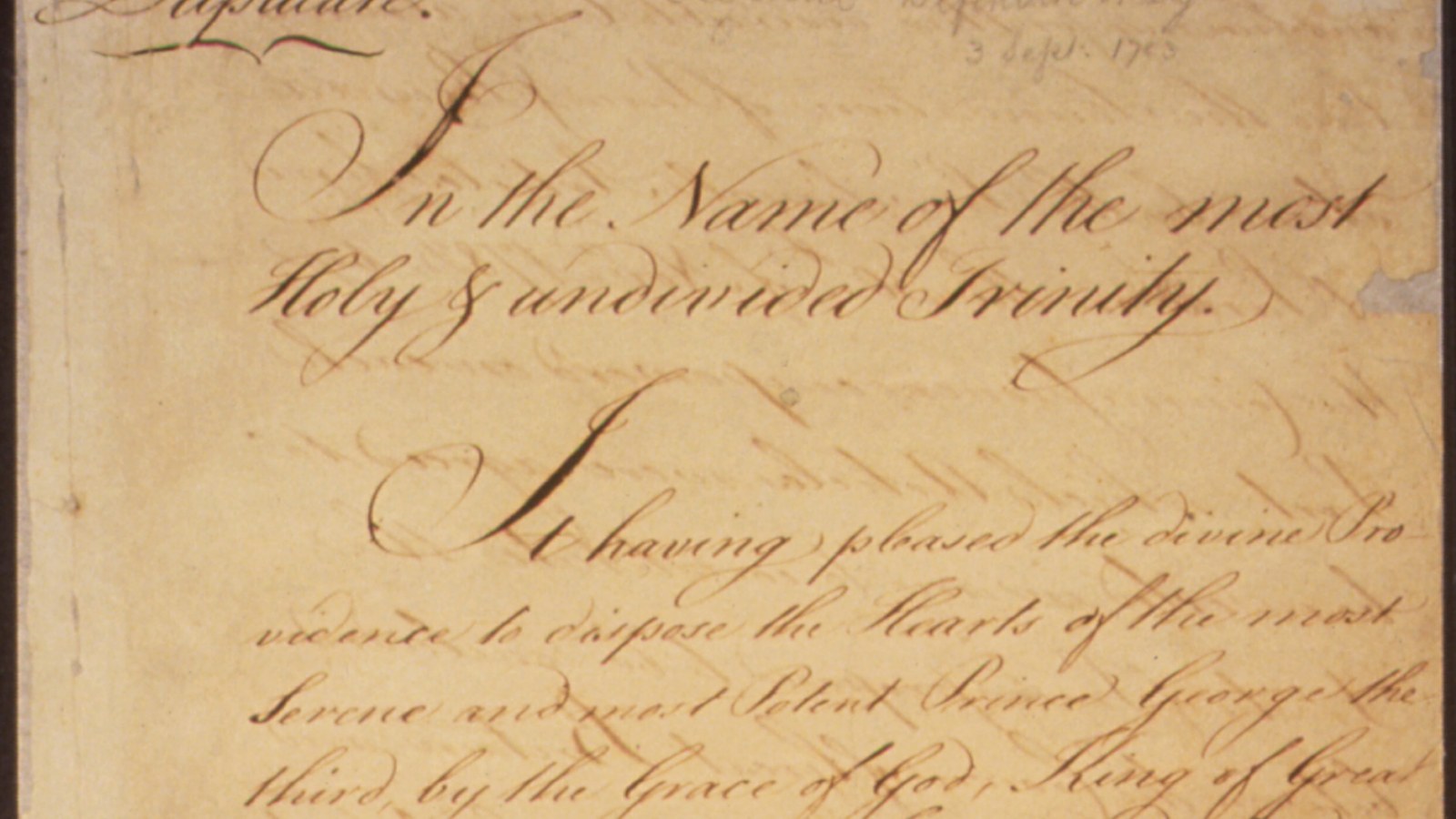
On 3 September 1783, at the Hôtel d'York on what is now rue Jacob in Paris, David Hartley, representing King George III, and the American plenipotentiaries John Adams, Benjamin Franklin and John Jay signed the Definitive Treaty of Peace between Great Britain and the United States. Article 1 acknowledges the thirteen former colonies — from New Hampshire to Georgia, Delaware included — as free, sovereign and independent states, and the British Crown, for itself and its successors, relinquishes all claim to their government and territory.
Talks had opened in Paris in April 1782, after Frederick North’s ministry fell on 20 March in the wake of Yorktown. The provisional articles were initialled on 30 November 1782. France’s foreign minister, Vergennes, exhausted by the war, had floated a settlement that would have kept the United States east of the Appalachians, with Britain holding north of the Ohio; Spain wanted the fighting to go on until Gibraltar fell. The American commissioners judged they could do better in London. John Jay bypassed France and Spain, and Lord Shelburne, the British prime minister, agreed, seeing the new republic as a trading partner rather than a colony to garrison.
The text held by the National Archives draws the boundary down the middle of the Mississippi to the thirty-first parallel, and it keeps American fishermen on the Grand Banks, off Newfoundland and in the Gulf of Saint Lawrence. The Mississippi itself is to remain open to British subjects and to citizens of the United States. Prisoners of war were to be freed, and British troops were to withdraw “with all convenient speed,” without destroying or carrying off enslaved people or other property of American inhabitants.
The Confederation Congress undertook only to “earnestly recommend” that state legislatures restore confiscated estates to loyal British subjects. That was not a hard obligation, and Virginia, among others, went on blocking payment of debts to British creditors. Historians have long noted how generous the borders looked from London: Shelburne was betting on trade with a growing republic and on avoiding the cost of forts. Vergennes later put it that the English bought peace rather than made it.
Congress ratified the treaty on 14 January 1784 in Annapolis. Britain ratified on 9 April 1784, and the instruments were exchanged in Paris on 12 May. In the wider Peace of Paris, London also signed with France and Spain: East and West Florida went to Spain without a clear northern line, and Madrid later used control of the river to shut out American traffic, contrary to Article 8.
Only Article 1, the recognition of the United States, remains in force. The real geography did not match the map: a line drawn due west from the Lake of the Woods never meets the Mississippi, and Britain held forts in the Great Lakes country until the Jay Treaty of 1794, citing American failure on the loyalist clauses. The signed originals, with the seals of Hartley, Adams, Franklin and Jay, are in the National Archives in Washington.
Source consulted: Treaty of Paris (1783). Treaty text: Treaty of Paris (1783).











0 Comments
No comments on this article yet. Be the first!