


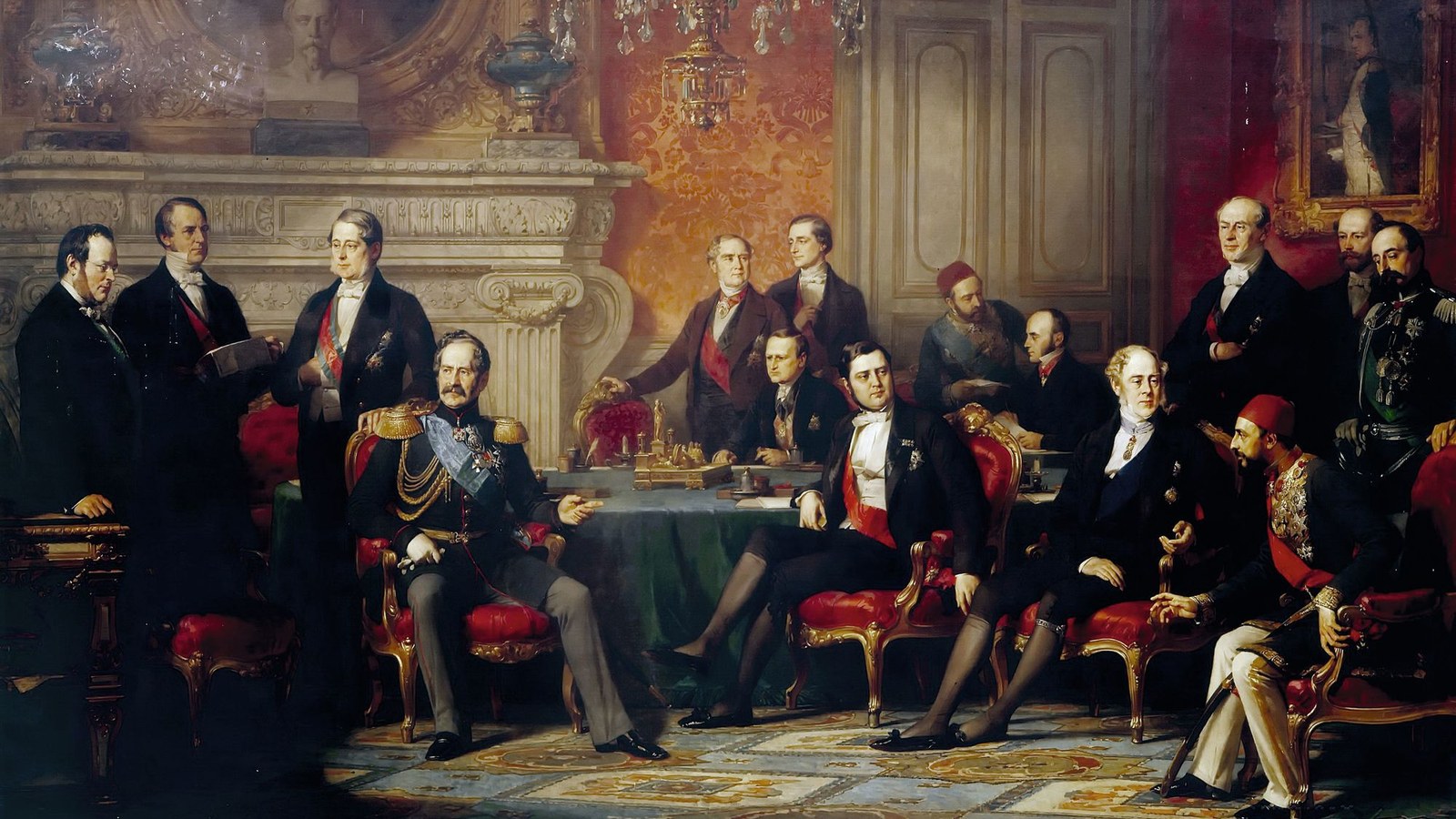
On 30 March 1856, at the Congress of Paris, the plenipotentiaries of Russia, France, Great Britain, the Ottoman Empire, Sardinia, Austria and Prussia signed the treaty that ended the Crimean War. Alexandre Walewski, the French foreign minister, presided; Russia’s signature was Count Alexey Orlov’s, the same diplomat who had closed the war of Adrianople in 1829. The fighting had begun on 23 October 1853, when the Porte declared war after the occupation of the Danubian Principalities; Sevastopol fell on 8 September 1855.
Charles Downer Hazen, in Three Peace Congresses of the Nineteenth Century, restates the “Four Points” of the Austrian ultimatum, drawn up with French backing: the Russian protectorate over the principalities, freedom of the Danube, neutralization of the Black Sea, and the rights of Christians in the Ottoman Empire. The congress opened in Paris on 25 February 1856. Napoleon III wanted peace after a war dearer than he had expected; in London, Palmerston and the Court would have gone on, to salvage British reputation. Russia, under the new tsar Alexander II, consented reluctantly, to stop the army’s haemorrhage.
The Black Sea became neutral territory: closed to warships, with no arsenals or fortifications on its shores. That ban lasted until the Treaty of London in 1871. Navigation on the Danube passed under a European Commission. Russia restored to Moldavia southern Bessarabia — the districts of Cahul, Bolgrad and Ismail, and with them control of the river mouths — land annexed in 1812. Sevastopol and the towns of southern Crimea went back to Russia, but without a Black Sea fleet.
Article 7 admitted the Ottoman Empire to the Concert of Europe and bound the powers to respect its independence and integrity. Russia dropped its claim to protect Christians in the sultan’s domains. Moldavia and Wallachia remained under Ottoman suzerainty, but with their own constitutions and national assemblies, watched by the victorious powers; Turkey could intervene in the principalities only with their consent. Article 24 provided for ad-hoc assemblies to state the inhabitants’ will on how they should be organised — the path that led, in 1859, to the union of the principalities, not the union itself.
The Åland Islands, in the Baltic, belonging to the Grand Duchy of Finland, were demilitarised; the fortress of Bomarsund had been destroyed by Franco-British forces in 1854. On 16 April, still in Paris, the powers issued the Declaration of Paris on wartime maritime law: privateering became illegal, a neutral flag covered enemy goods except contraband, and a blockade had to be effective to be lawful. Those were not articles of the 30 March treaty, but a separate act of the same congress.
The peace weakened Russian influence on the Danube and opened the Porte, on paper, to the European concert, without settling the Eastern Question. Austria, neutral in the war but aligned diplomatically against her ally of 1848, remained badly viewed in St Petersburg. In 1877 Russia and the Porte were at war again. For the Romanian principalities, the immediate stake was the shift of the Danube mouths and the ad-hoc assemblies, not a victory monument.
Source consulted: Treaty of Paris (1856). Historical study: Three Peace Congresses of the Nineteenth Century.











0 Comments
No comments on this article yet. Be the first!