


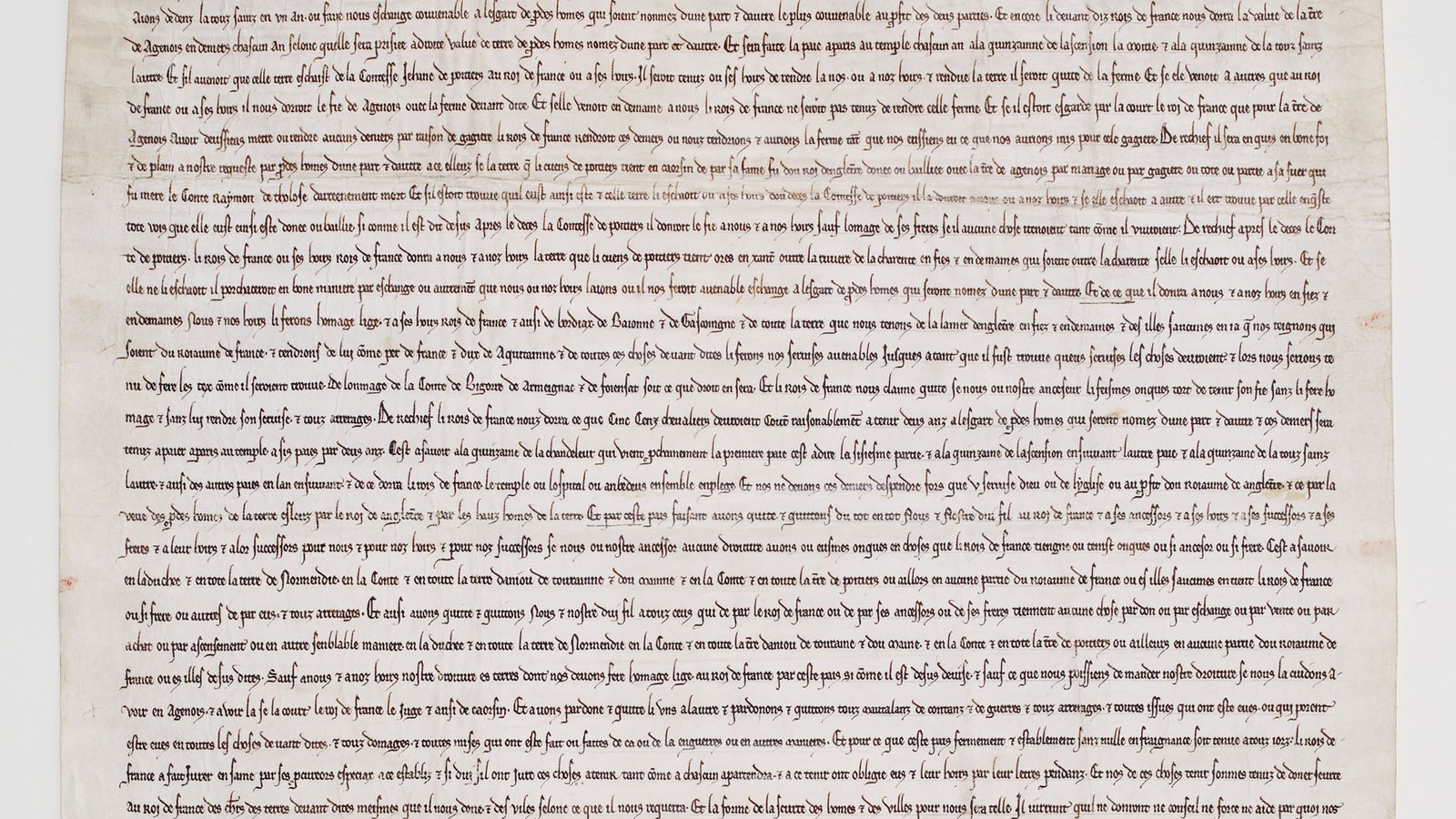
On 4 December 1259, in Paris, Henry III of England does liege homage to Louis IX of France. The peace, written in French, had been framed since May 1258. Henry comes with the Earl of Gloucester, knights and prelates. Guillaume de Nangis notes: the king of England is enrolled among the barons of France, peer and Duke of Aquitaine. The act sealed by Henry in London, on 13 October, with a green seal on red and green silk cords, is at the Archives nationales, AE III/3.
Foedera keeps the form: the King of France shall give the King of England all the right he has and holds in the three bishoprics and cities of Limoges, Cahors and Périgueux, in fiefs and demesnes, saving the homage of the French king’s brothers. What he cannot put out of his hand by letters of his own or of his ancestors, he shall seek in good faith so that the English king has it by All Saints within a year, or a fitting exchange, at the award of worthy men named on both sides.
For the Agenais, an annual farm in money, at the true value of the land, paid at the Temple in Paris: half a fortnight after Ascension, half a fortnight after All Saints. If the land escheats, from Countess Jeanne of Poitiers, to the King of France, it is given to Henry and the farm ceases. After the countess’s death, Saintonge beyond the Charente, if it escheats; if not, an exchange. An inquiry, again by worthy men, into the Quercy held by the Count of Poitiers in his wife’s right.
For all he receives, and for Bordeaux, Bayonne, Gascony and all the land this side of the English sea, plus the islands of the Kingdom of France, if he holds any, Henry and his heirs do liege homage. They hold of the King of France as peer of France and Duke of Aquitaine. The services, until it is found which are due. Homage for Bigorre, Armagnac and Fézensac, as right shall be. Louis also gives what five hundred knights would reasonably cost for two years, in six payments at the Temple. The money, only in the service of God, of the Church, or of the profit of England, under the eye of worthy men.
Henry and his two sons quit every right in the duchy and all the land of Normandy, in Anjou, Touraine, Maine, Poitou, and in the islands held by the King of France. Mutual pardon for wars, damages, outlays. Henry, his sons, and his sister the Countess of Leicester swear. Sureties, knights and towns: if the King of England breaks the peace and will not amend within three months after demand, they stand with the King of France until amendment, at the award of his court. The surety is renewed every ten years.
The islands held by Henry, if they are of the Kingdom of France, remain his as peer and duke. From this, later, the special case of the Channel Islands. In Guyenne, vassalage opens the way to appeals to the Parlement of Paris. Édouard Perroy put the treaty “at the very root of the Hundred Years’ War”. In 1264 Louis gives the Mise of Amiens for Henry, against the Provisions of Oxford. The barons will not submit. The Second Barons’ War follows.
Image: Archives nationales (France) / Wikimédia France, ratification of 13 October 1259 (AE III/3), public domain, Wikimedia Commons. Cropped to 16:9.
Source consulted: Treaty of Paris (1259). Treaty text: Forma Pacis inter Henricum 3. Anglie Regem, & Lodovicum 9., Regem Francia..











0 Comments
No comments on this article yet. Be the first!