


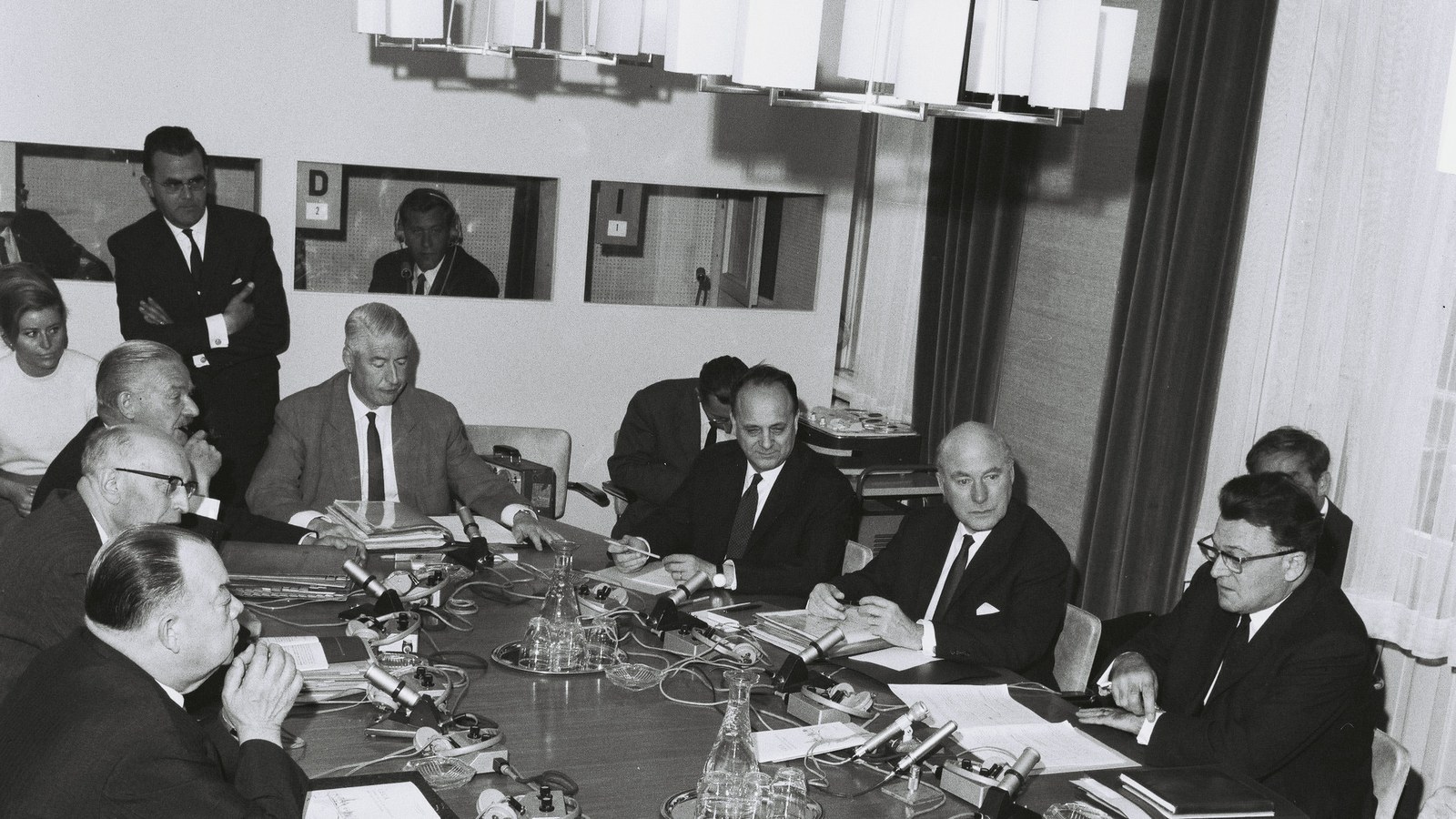
On 18 April 1951, in Paris, Belgium, France, Italy, Luxembourg, the Netherlands and West Germany sign the Treaty establishing the European Coal and Steel Community (ECSC) — the Treaty of Paris.
The idea, launched by the Schuman Declaration of 9 May 1950, places coal and steel production — key resources of the war effort — under a common High Authority, to make another Franco-German conflict “not merely unthinkable, but materially impossible”.
Signatories include Robert Schuman, Joseph Meurice, Paul van Zeeland, Konrad Adenauer, Carlo Sforza, Joseph Bech, Dirk Stikker and Jan van den Brink. The Europe Declaration proclaimed that the treaty had given birth to Europe on the supranational principle.
Entry into force: 23 July 1952. The treaty expired exactly fifty years later, on 23 July 2002; ECSC competences passed to the European Community / EU.
The ECSC was the first of the European Communities, followed by the EEC and Euratom (Rome, 1957). It created a common market in coal and steel, with customs duties abolished and institutions with real regulatory powers.
The full text is available on EUR-Lex and Wikisource. The supranational model was later contested by Charles de Gaulle, yet remained the matrix of European integration.
The Treaty of Paris of 18 April 1951 remains the founding act of the Community Europe of “the Six”.
Image: Paris / Quai d'Orsay; Wikimedia Commons. Cropped to 16:9.
Source consulted: Treaty of Paris (1951). Treaty text: Treaty establishing the ECSC (EUR-Lex).











0 Comments
No comments on this article yet. Be the first!