


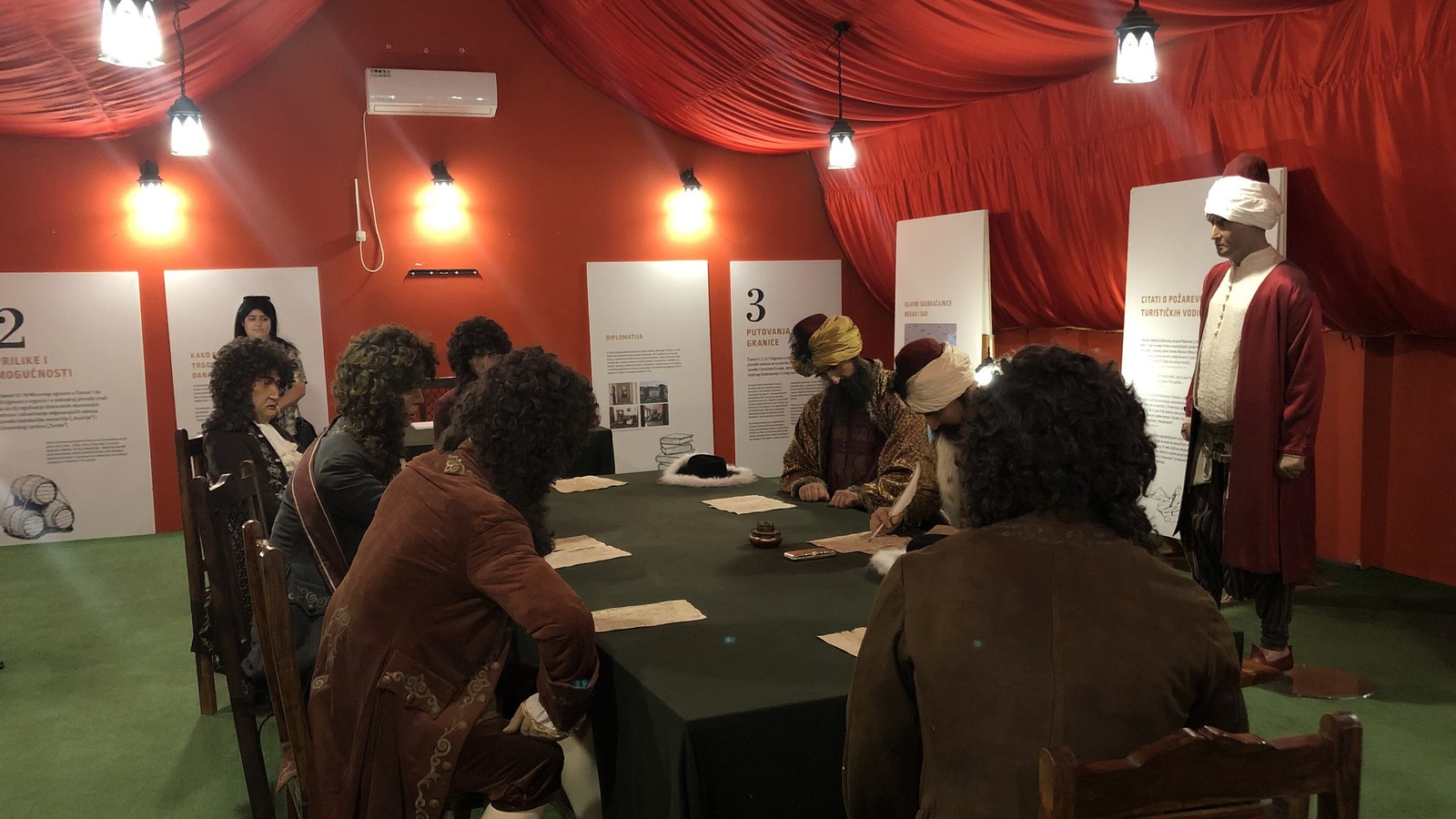
Charles VI, Emperor of the Romans, and Sultan Ahmed-Khan (Ahmed III) made peace at Passarowitz (Požarevac), in Serbia, on 21 July 1718, under tents, after conferences begun in early May. Basis: uti possidetis. Duration: twenty-four lunar years. It is not a single tripartite act: the same place and day yield an imperial–Ottoman treaty of twenty articles, a Venetian–Ottoman treaty of twenty-six, and a commercial treaty. Latin text: Dumont, Corps universel diplomatique, vol. VIII, part I, p. 520; French résumé: Testa, Recueil des traités de la Porte ottomane, vol. IX, p. 73. Imperial plenipotentiaries: Damian Hugo, Count of Wirmond (Virmont), privy councillor; Michel de Talman (Talmann), war councillor. Ottomans: Ibrahim-aga, second defterdar; Mohammed-efendi, third defterdar. Mediators: Robert Sutton, for George I of Great Britain; Jacob Count Colyer, for the States General of the United Provinces. Venice: Carlo Ruzzini, with secretary Vendramino Bianchi. Ratification: the Sultan at the beginning of August; the Emperor on 12 August 1718.
Article 1: Moldavia and Wallachia keep the old mountain limits toward Poland and Transylvania. The part of Wallachia on this side of the Aluta (Olt), with the fortress of Temesvár and its dependencies, remains the Emperor’s. West bank of the Olt, imperial; east bank, Ottoman. Frontier: the Olt from its exit from Transylvania to the Danube, then to the mouth of the Timok, the banks toward Orșova. Waters of the Olt in common; German cargo boats from Transylvania on the Danube; mill-boats not to hinder navigation. Refugee boyars may return. Article 2: the line about ten hours from the Timok’s mouth; Isperlek-Bania Ottoman, Ressova imperial; through the mountains toward Parackin (imperial) and Rasna (Ottoman), to Istolaz, the little Morava, Schahak, Bedka, Zokol, Bellina on the Drin. Belgrade, Parackin, Istolaz, Schahak, Bedka, Bellina, with their old territories, remain the Emperor’s; Zokol and Rasna, the Ottoman’s. The Timok, in common. Article 3: castles and palankas on both banks of the Sava, from the Drin to the Una, and the whole Sava, remain the Emperor’s.
Article 4: Jessenawitz, Dubitza, towers and islands on the eastern bank of the Una as far as the territory of Old Novi held by the Porte, remain the Emperor’s. Article 5: the territory of New Novi, on the western bank of the Una toward Croatia, is restored to the Emperor (it had been yielded to the Ottomans after Carlowitz, at the demarcation). Article 6: places in Croatia held far from the Sava remain with each side; commissioners decide; existing fortresses may be repaired and strengthened, and open villages may be built at the edge of the confines, but not new fortresses. Article 7: expert commissioners, within two months or sooner, plant clear boundary marks.
Articles 8–11 and 14 resume, with small additions, articles of the Peace of Carlowitz (1699), including churches and Catholic priests. Article 12: prisoners in public prisons free within 61 days; Voivode Nicolas Scarlati, his sons and servants, exchanged within 31 days on the Wallachian frontier against Barons de Petrasch and de Stein from the Seven Towers. Article 13: free trade; consuls and interpreters; the privileges of other tribute-exempt Christian nations; Algiers, Tunis, Tripoli and Dulcigno restrained from corsairing. Article 15: Rákóczi, Bercsényi, Antoine Esterházy, Forgács, Adam Vay, Michel Czaky and the other Hungarians in revolt, placed far from the frontier.
Article 16: Poland is not included; her peace with the Porte is held inviolable; Khotyn and other matters, by ambassadors. Article 17: embassies at the winter equinox, in March, not in June as in 1699. Articles 18–19 as 17 and 19 of Carlowitz. Article 20: as Article 20 of 1699, with a term of 24 lunar years. Signatures: Wirmond, Talman; attestation Sutton, Colyer.
The Venetian treaty, unlimited in time, confirms the loss of the Morea, retaken by the Ottomans in 1715, and of the last posts in Crete, Aegina and Tinos. Venice keeps the Ionian Islands, with Cerigo (Kythira), and on the mainland Butrint, Preveza, Vonitsa; in Dalmatia it takes Imotski, Strmnica, Cista, Čačvina. This is not the Peace of Carlowitz of 1699, and not the Peace of Belgrade of 1739, when the Ottomans recovered Belgrade, northern Serbia, northern Bosnia and Oltenia. Eugene of Savoy won Petrovaradin and Belgrade; he does not sign. The cover is a representation of the Peace of Passarowitz.
Sources: Treaty of Passarowitz; Treaty of Peace between the Emperor and Turkey, Dumont / Testa.











0 Comments
No comments on this article yet. Be the first!