


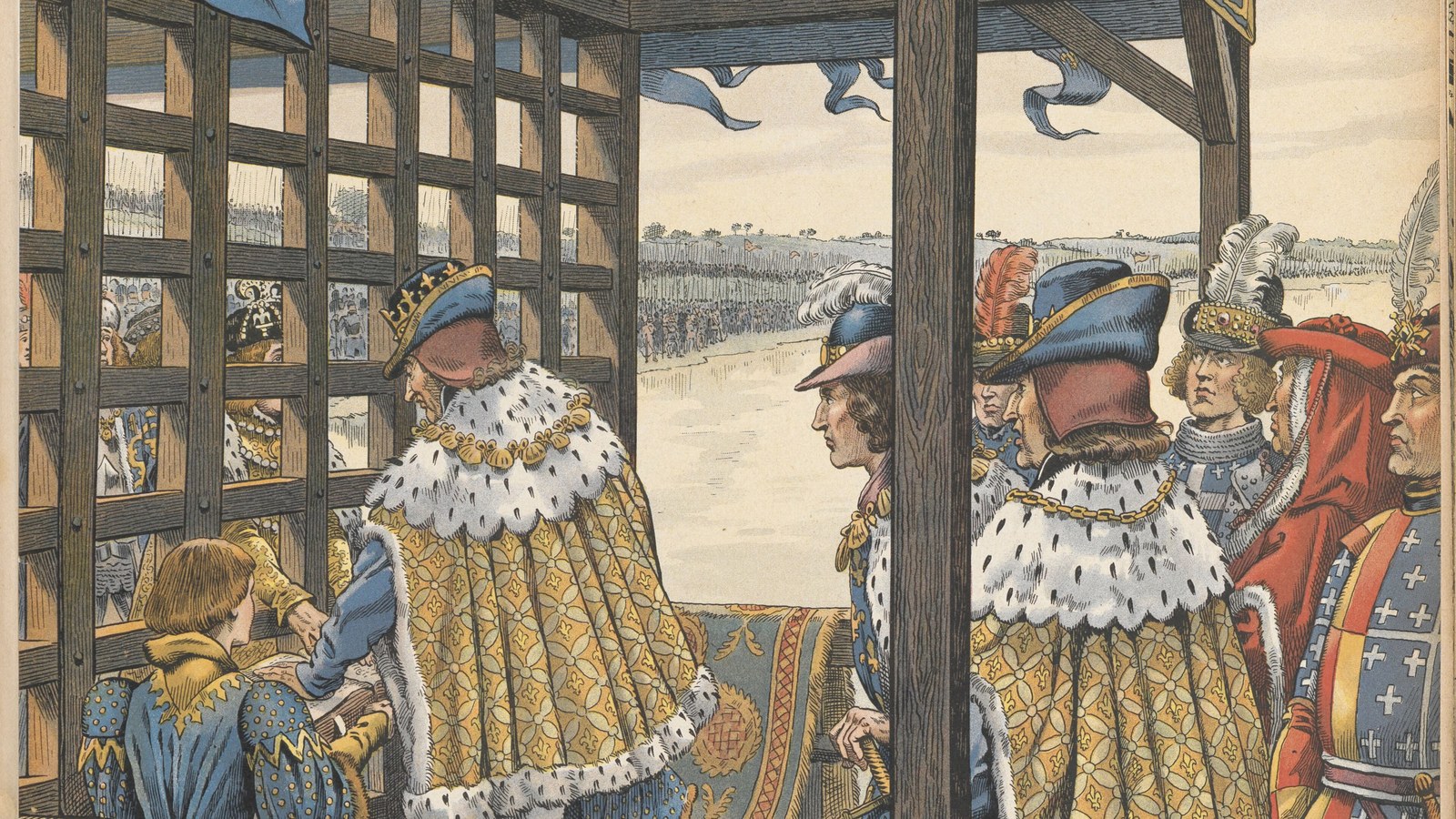
On a wooden bridge over the Somme, at Picquigny near Amiens, Edward IV of England and Louis XI of France meet divided by a grille, each with twelve nobles. The instruments are dated 29 August 1475. It is not the Treaty of Troyes of 1420, and it is not the battle of Castillon of 1453.
In 1474 the Treaty of London had bound Edward to Charles the Bold, duke of Burgundy. In June 1475 the English king lands with some eleven thousand men and Breton archers, meaning to pass through Burgundian country towards Reims. Charles does not open the towns and does not bring the promised army; Francis II of Brittany gives little help. Louis, who wants his hands free against Burgundy, sends word that he can offer more than the allies.
On 13 August, in the camp at Seyntre near Péronne, Edward, with his brothers Clarence and Gloucester present, charges Lord Howard, the master of the rolls, the dean of the chapel and Thomas St Leger to conclude: 75,000 scutes within fifteen days, then 25,000 at Easter and 25,000 at Michaelmas, that is 50,000 a year for both their lives; the Dauphin to marry Edward’s first or second daughter, with 60,000 livres of rent; the army to withdraw, with hostages until the landing in England; a seven-year truce and free trade.
The Latin patents of 29 August, given in the camp near Amiens, record the receipt of 75,000 gold scutes, each of thirty-three gros blancs. Edward binds himself to draw his host back to England without fraud, taking no French town. The hostages remain Lord Howard and John Cheyne, esquire of the king’s body, until the greater part of the army is home. The claims, including the French title Edward still bears in the acts, go to three years’ arbitration: Cardinal Thomas Bourchier of Canterbury and the duke of Clarence for England; Archbishop Charles of Lyons and Count Jean de Dunois for France. Whoever will not stand by the award pays three million scutes.
A good truce, until sundown on 29 August 1482: cessation of war by land, sea and fresh waters; free trade, without the tolls laid in the last twelve years; merchants may go armed, but not more than a hundred together. English conservators include, among others, Clarence, Gloucester, the chancellor, the keeper of the privy seal, the Warden of the Cinque Ports and the lieutenant of Calais.
A third instrument binds a friendship for the two kings’ lives: mutual aid against rebellion; no new league with the other’s ally without notice. When they come of marriageable age, the Dauphin Charles takes Elizabeth of York, brought to France at Louis’s cost and dowered with 60,000 livres a year after the custom of France; if Elizabeth dies before the contract, her sister Mary takes her place.
Louis binds himself, still on 29 August, at Amiens, to pay in London, at Easter and Michaelmas, 50,000 gold scutes a year, for both their lives, with security from the Medici bank or, failing that, a papal bull of interdict on the realm. Margaret of Anjou, widow of Henry VI, held in England, is to be given to Louis; the order to deliver her to Sir Thomas Montgomery is of November.
Philippe de Commynes writes that the duke of Gloucester thought the bargain dishonourable and stayed out of the talks, but came to the feasts at Amiens. It is not the Treaty of Étaples of 1492; it is the truce and pension agreed at Picquigny, on the Somme.
Image: Job (Jacques Onfroy de Bréville) and Georges Montorgueil, Treaty of Picquigny, 1905; public domain, Gallica / Wikimedia Commons. Cropped to 16:9.
Source consulted: Treaty of Picquigny. Treaty text: Rymer, Foedera, vol. 12: the instruments of 29 August 1475 (British History Online).











0 Comments
No comments on this article yet. Be the first!