


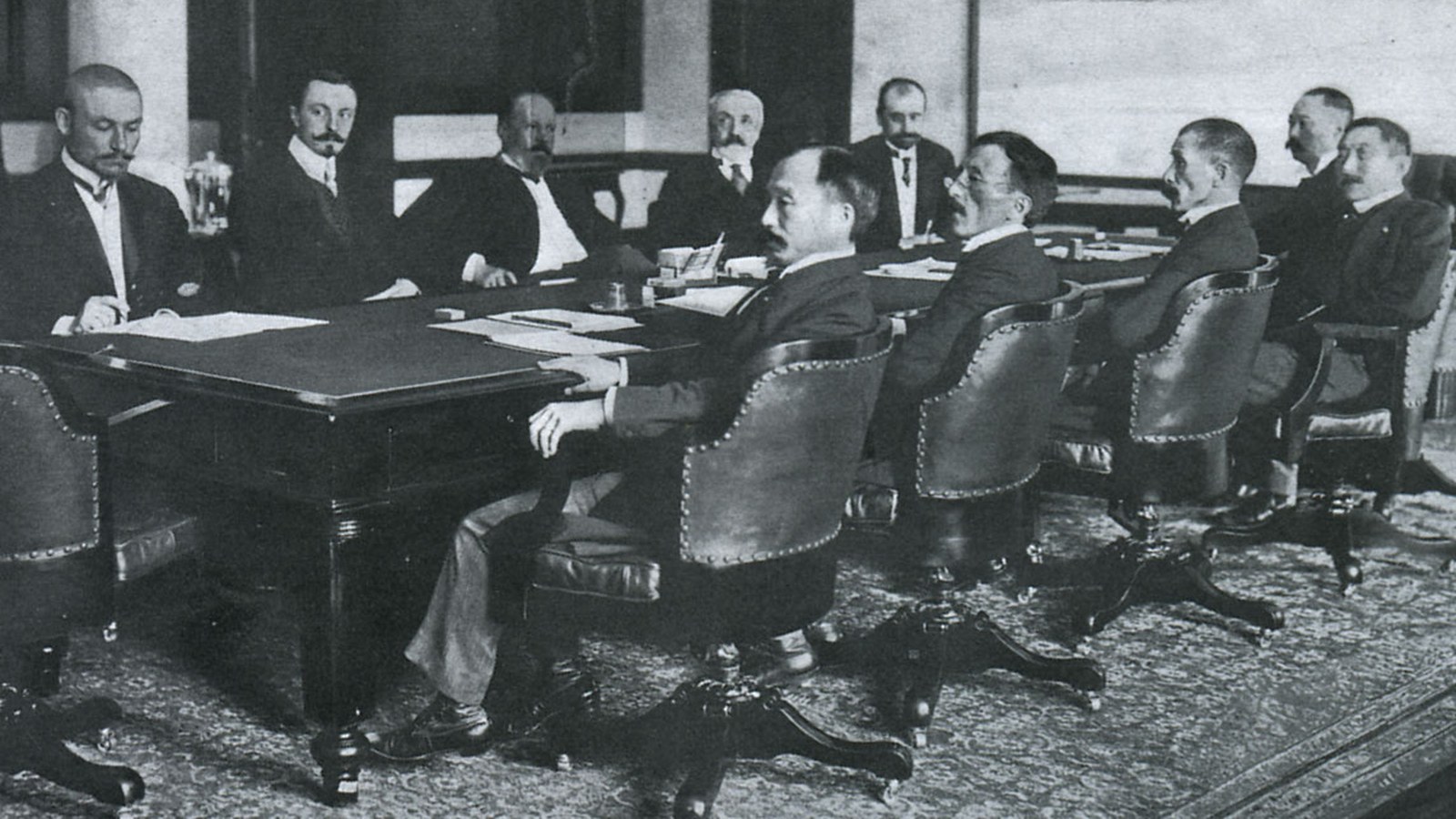
On 5 September 1905, at the Portsmouth Naval Shipyard in Kittery, Maine, Komura Jutarō and Takahira Kogorō, for Japan, and Sergei Witte and Roman Rosen, for Russia, signed the treaty that ended the Russo-Japanese War of 1904–1905. The text, in French and English, is recorded in Protocoles de la conférence de paix entre le Japon et la Russie, issued by the Japanese Foreign Office. President Theodore Roosevelt mediated from a distance — he never came to Portsmouth — and received the Nobel Peace Prize in 1906, the first American so honoured.
The talks, twelve sessions from 9 to 30 August, were held in the General Stores Building; the delegations lodged at the Hotel Wentworth in New Castle and crossed the Piscataqua each day. After Mukden and Tsushima, the Japanese army was overstretched and the economy deep in foreign debt; in Russia the war was unpopular, and Tsar Nicholas II had reluctantly agreed to discuss peace. Roosevelt chose Portsmouth to spare the parties Washington’s August heat.
Article II recognised that Japan possessed in Korea “paramount” political, military and economic interests, and bound Russia not to obstruct measures of guidance, protection and control that Tokyo might find necessary. Both sides undertook to evacuate Manchuria, except the Liaodong leased territory, and to restore it to Chinese administration. Russia transferred to Japan the Liaodong lease — Port Arthur and Talien — and the South Manchuria Railway, with its mining concessions; it kept the Chinese Eastern Railway in the north.
The hard points were indemnity and Sakhalin, which Japanese forces had seized in July 1905. The tsar had forbidden territorial concessions, reparations or limits on Russian forces in the Far East. On 18 August Roosevelt proposed splitting the island; on the 23rd Witte offered the whole of Sakhalin if Japan dropped the money. Komura refused; Witte threatened to resume the war as four new Russian divisions arrived in Manchuria. Outmanoeuvred, Komura yielded: Japan kept the southern half of Sakhalin and dropped the indemnity.
The treaty was ratified by Japan’s Privy Council on 10 October and by Russia on 14 October; it took effect on 16 October. In Japan, an unbroken string of battlefield victories had led the public to expect more than the text delivered. Anger broke in the Hibiya riots, and the Katsura cabinet fell on 7 January 1906. Korea became a Japanese protectorate soon after Article II; annexation followed in 1910. Korean historians have argued that recognising Japan’s interests cut against the spirit of the 1882 Korean–American treaty, which Seoul had read as a de facto defence.
The peace confirmed Japan as the leading power in East Asia and halted, for three decades, Russia’s Pacific advance. It was not a victory monument without remainder: Witte used the press and the threat of renewed fighting, and Roosevelt stayed off stage. The conference table is kept at the Meiji-mura museum in Inuyama.
Source consulted: Treaty of Portsmouth. Conference protocols: Protocoles de la conférence de paix entre le Japon et la Russie [à Portsmouth, N.H., août-septembre, 1905].











0 Comments
No comments on this article yet. Be the first!