


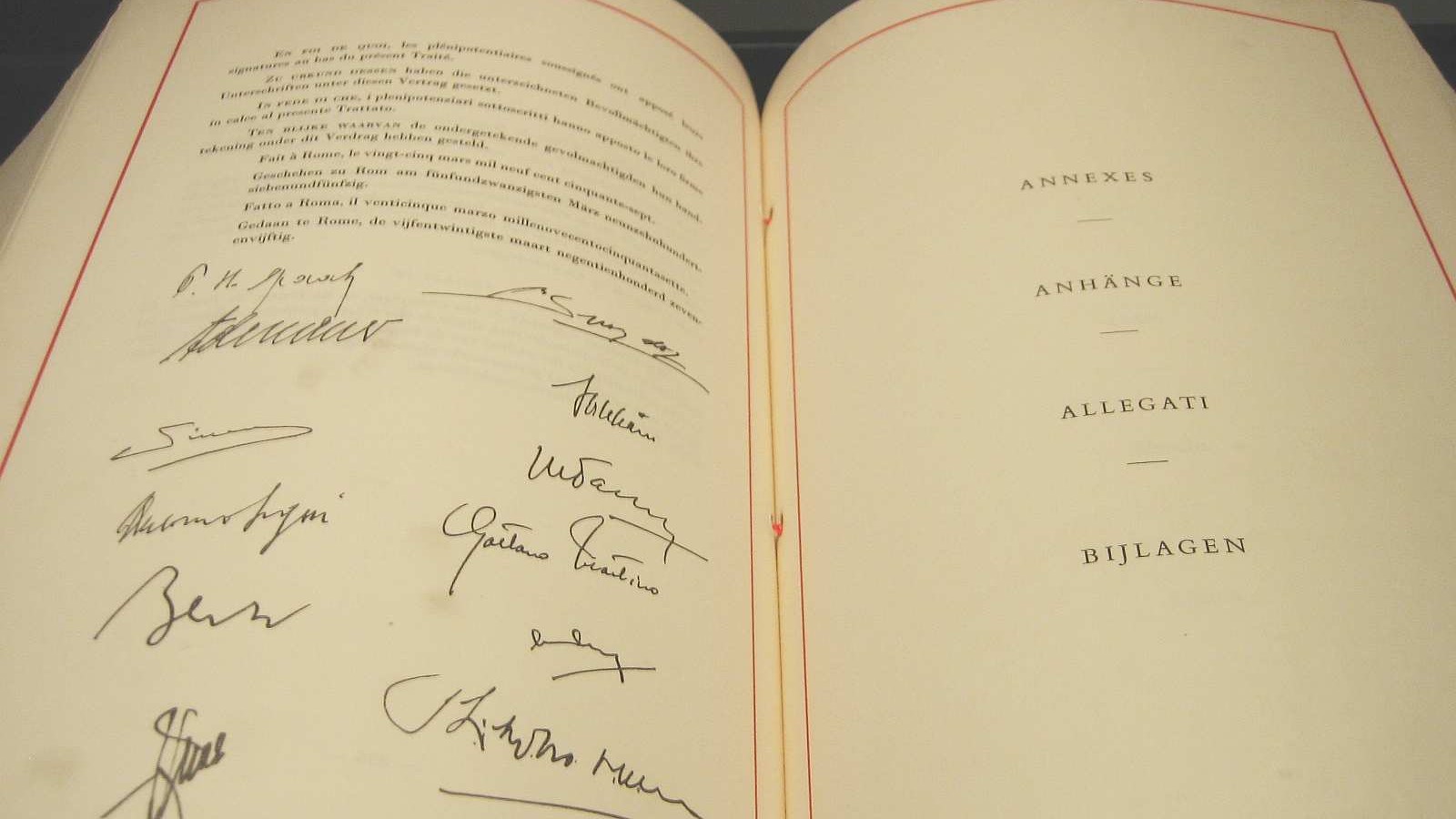
In Rome, on the Capitoline Hill (Palazzo dei Conservatori), on 25 March 1957, Belgium, France, Italy, Luxembourg, the Netherlands and West Germany sign the Treaty establishing the European Economic Community (Treaty of Rome / EEC Treaty) and, the same day, the Euratom Treaty. The depositary is the Government of Italy; entry into force is 1 January 1958.
The EEC Treaty creates the European Economic Community: a customs union, a common market for goods, labour, services and capital, a Common Agricultural Policy, a common transport policy, a European Social Fund and the European Commission. Signatories include Spaak and Snoy (Belgium), Adenauer and Hallstein (FRG), Pineau and Faure (France), Segni and Martino (Italy), Bech and Schaus (Luxembourg), Luns and Linthorst Homan (Netherlands).
Preparation runs through the Messina Conference (1955), the Spaak Report and the Val Duchesse intergovernmental conference. The Paris Treaty (ECSC, 1951) is the model; the failure of the European Defence Community pushes integration onto the economic track.
The Maastricht Treaty (1992) drops “economic” from the title; the Lisbon Treaty (2007/2009) renames the instrument the Treaty on the Functioning of the European Union (TFEU), one of the EU’s two founding treaties alongside the TEU.
At the 30th, 50th and 60th anniversaries Rome and Berlin mark the signature; the BBC later reported that printing delays meant some signed copies held blank pages between the frontispiece and the signature page.
The Treaty of Rome of 25 March 1957 — today the TFEU — remains the founding act of the European common market and the continuing legal base of the European Union.
Image: signing of the Treaty of Rome; Wikimedia Commons. Cropped to 16:9.
Source consulted: Treaty of Rome. Treaty text: Treaty establishing the European Economic Community (EUR-Lex).











0 Comments
No comments on this article yet. Be the first!