


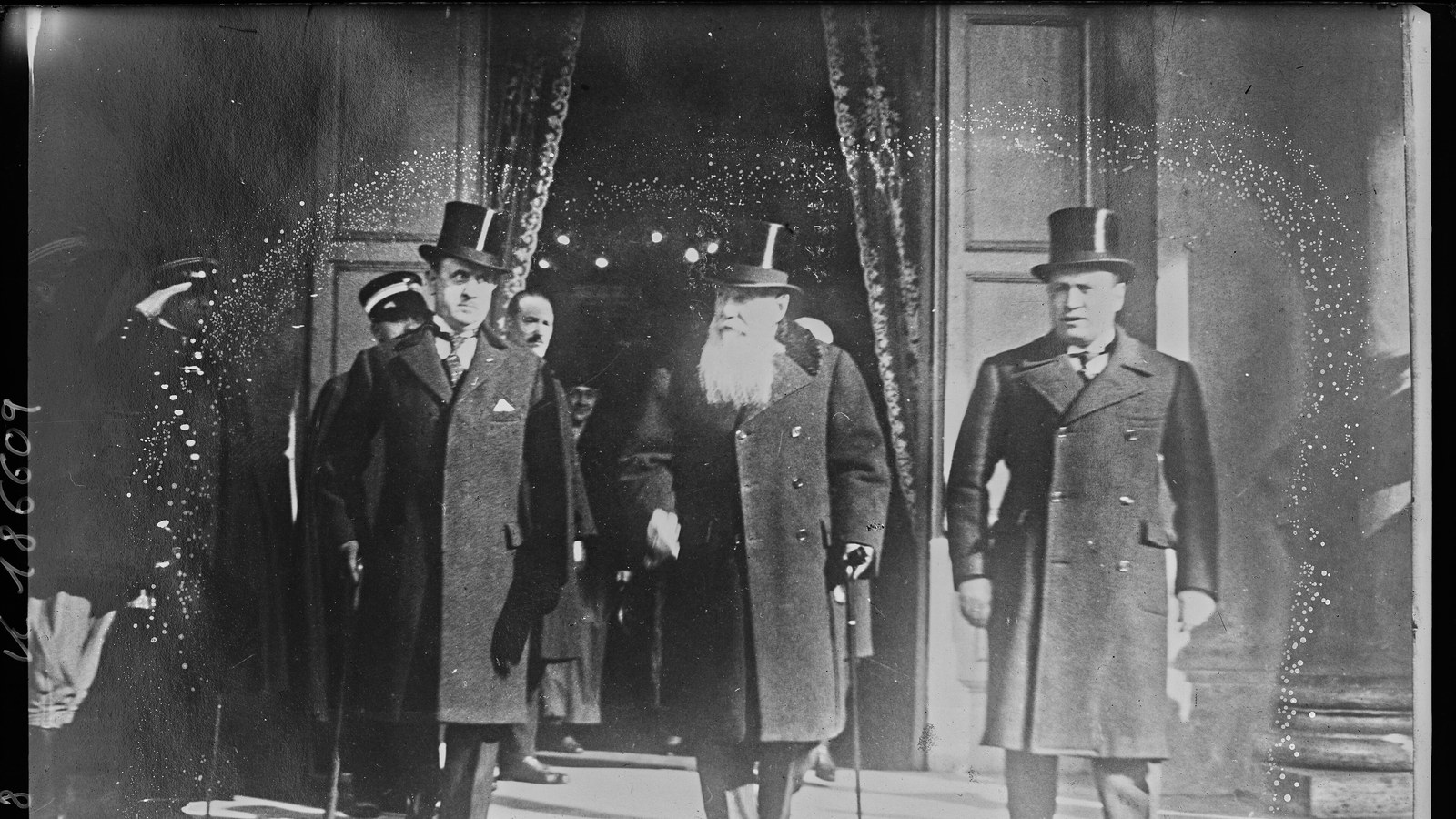
At Rome, the Kingdom of Italy and the Kingdom of the Serbs, Croats and Slovenes conclude on 27 January 1924 a package of agreements: the Pact of Friendship and Cordial Co-operation, a supplementary protocol and the Agreement concerning Fiume. For Italy, Benito Mussolini, Prime Minister and Minister for Foreign Affairs, signs; for the Kingdom of the Serbs, Croats and Slovenes, Nikola Pasic, Prime Minister, and Momcilo Nincic, Minister for Foreign Affairs. The instruments are done at Rome, in duplicate.
The Pact of Friendship commits the two Parties to afford each other support and cordial co-operation in order to maintain the position established by the peace treaties concluded at Trianon, Saint-Germain and Neuilly, and to ensure respect for the obligations laid down in those Treaties. In the event of an unprovoked attack upon one Party, the other undertakes to remain neutral throughout the conflict. If the safety or interests of one are threatened by forcible incursions from without, the other undertakes to afford political and diplomatic support to help remove the external cause of the threat. In the event of international complications, if the Parties agree that their common interests are or may be threatened, they undertake to consult one another on common steps. The Convention remains in force for five years and may be denounced or renewed one year before its expiration. Ratifications are exchanged at Rome; the treaty comes into force immediately upon that exchange.
The supplementary protocol requires the Parties to communicate to each other, after previous consultation, such agreements as affect their policy in Central Europe, and declares that the Pact signed on the same day contains nothing contrary to the treaties of alliance which the Kingdom of the Serbs, Croats and Slovenes has concluded with Czechoslovakia and with Romania. The Pact and the protocol are to be presented to the League of Nations for registration in conformity with the Covenant.
The Agreement concerning Fiume proceeds from the absolute impossibility of organising in any practical fashion the Free State of Fiume provided for in the Treaty of Rapallo, and from the general provisions of an earlier agreement concluded at Rome. Italy recognises the full sovereignty of the Kingdom of the Serbs, Croats and Slovenes over Port Baross and over the Delta, which are to be evacuated and handed over within two days following the exchange of ratifications. The Kingdom of the Serbs, Croats and Slovenes recognises the full sovereignty of Italy over the City and Port of Fiume and over the territory assigned by the new frontier line.
Article 3 of the Fiume Agreement requires the frontier near Fiume to be rectified by a special mixed commission, along a line which includes the Castua–Fiume road in Serb-Croat-Slovene territory and leaves Pekljn on that side, to a point on the Recina. The territory thus assigned is to be evacuated by Italy and handed over after delimitation, so that the handover can take place within five days following the exchange of ratifications. Article 4 leaves relations between the frontier zones and the Castua census area to a supplementary convention, pending a commercial treaty on frontier traffic.
Italy grants the Kingdom of the Serbs, Croats and Slovenes a fifty-year lease of the Thaon di Revel Basin in Porto Grande, without extraterritorial character, with the right to use warehouses and quays, for an annual rent of one gold lira. The central railway station at Fiume is organised as an international frontier station, with a Serb-Croat-Slovene railway delegation. The frontier between Fiume and Port Baross is drawn along the quay; Italy recognises the other Party's sovereignty over the waters of the Fiumara, with an annual rent of one gold dinar for rights of use on the Italian bank. Yugoslav minorities in Fiume are accorded the status granted to Italian minorities in Dalmatia by the international engagements in force.
The Fiume Agreement is to be ratified and the ratifications exchanged at Rome not later than twenty days after signature. The text is not the 1957 Treaty of Rome on the European Communities and is not the Treaty of Rapallo itself.
Image: arrival of Nikola Pasic in Rome for the signing of the Italo-Yugoslav treaty, 27 January 1924, with Mussolini; Agence Rol, public domain, Wikimedia Commons. Cropped to 16:9.
Source consulted: Treaty of Rome (1924). Treaty text: Agreements between Italy and the Kingdom of the Serbs, Croats and Slovenes, Rome, 27 January 1924, LNTS vol. 24.






0 Comments
No comments on this article yet. Be the first!