


At Saigon, on 5 June 1862 (the fifteenth year of Tự Đức, fifth month, ninth day), Rear-Admiral Louis-Adolphe Bonard, commander of the Franco-Spanish expeditionary corps and plenipotentiary of Napoleon III, Colonel Carlos Palanca Gutiérrez, plenipotentiary of Isabella II, and Phan Thanh Giản, vice-grand censor and president of the Tribunal of Rites, assisted by Lâm Duy Hiệp, president of the Tribunal of War, plenipotentiaries of Tự Đức, signed the treaty of peace and friendship between France and Spain, on the one part, and the kingdom of Annam, on the other. The instrument has twelve articles. The exchange of ratifications took place at Huế on 14 April 1863.
The Treaty of Saigon of 1862 is not the capture of Saigon on 18 February 1859, nor the landing at Tourane in 1858, nor the second Treaty of Saigon of 1874, nor the occupation of the three western provinces in 1867. The sovereigns did not sign; the envoys did.
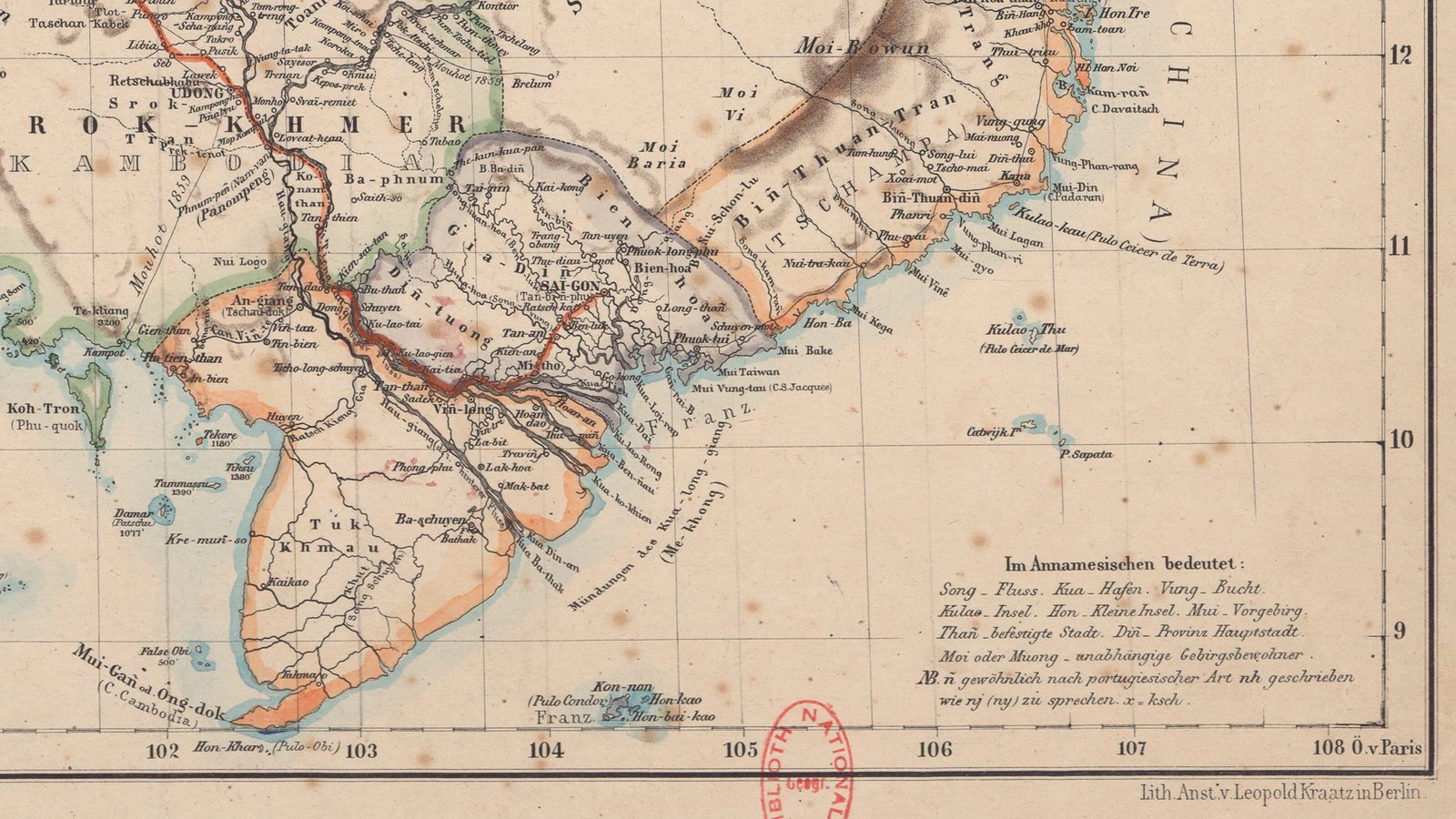
Article 1 proclaims perpetual peace between the Emperor of the French, the Queen of Spain and the King of Annam, and friendship among the subjects of the three nations. Article 2: the French and the Spanish may practise the Christian religion in Annam; Annamite subjects who wish to embrace it may do so freely, without constraint, and no one is forced. Article 3 cedes to France, in full sovereignty, the complete provinces of Biên Hòa, Gia Định and Định Tường (Mỹ Tho), and the island of Côn Đảo (Poulo Condor). French merchants may trade and circulate on the great river of Cambodia and all its arms; likewise French warships sent to watch that river.
Article 4: if a foreign nation seeks, by provocation or by treaty, a part of Annamite territory, the King notifies the Emperor of the French; any cession of territory requires his consent. Article 5 opens to the French and Spanish the ports of Tourane, Balat and Quảng An, and to Annamites the ports of France and Spain; no third country obtains greater protection or advantage. Article 6: French or Spanish envoys anchor at Tourane and go overland to Huế.
Article 7: a general amnesty on both sides, with restoration of sequestered property. Article 8: Annam pays four million dollars, over ten years, 400,000 a year, to the French representative at Saigon, to indemnify France and Spain for war expenses; the 100,000 ligatures already paid are deducted; the dollar is reckoned at seventy-two hundredths of a tael. Article 9: delivery of pirates and fugitives, either way.
Article 10: the inhabitants of Vĩnh Long, An Giang and Hà Tiên may trade in the French provinces; convoys of troops, arms, munitions and provisions go by sea, except through Cửa Tiểu with a permit. Article 11: the citadel of Vĩnh Long remains held by French troops until the rebellion in Gia Định and Định Tường, raised by the King’s orders, has ended. Article 12: ratifications, within a year, are exchanged in the capital of Annam. The Treaty of Saigon of 1862 is not that later occupation of the three western provinces.
Image: Cochinchina, extract from Adolf Bastian’s map of Indochina, 1867; BnF, public domain, Wikimedia Commons. Cropped to 16:9. The map is from 1867; the cession in the treaty is from 1862.
Source consulted: Treaty of Saigon (1862). Treaty text: Wikisource: Treaty of Saigon, 5 June 1862.











0 Comments
No comments on this article yet. Be the first!