


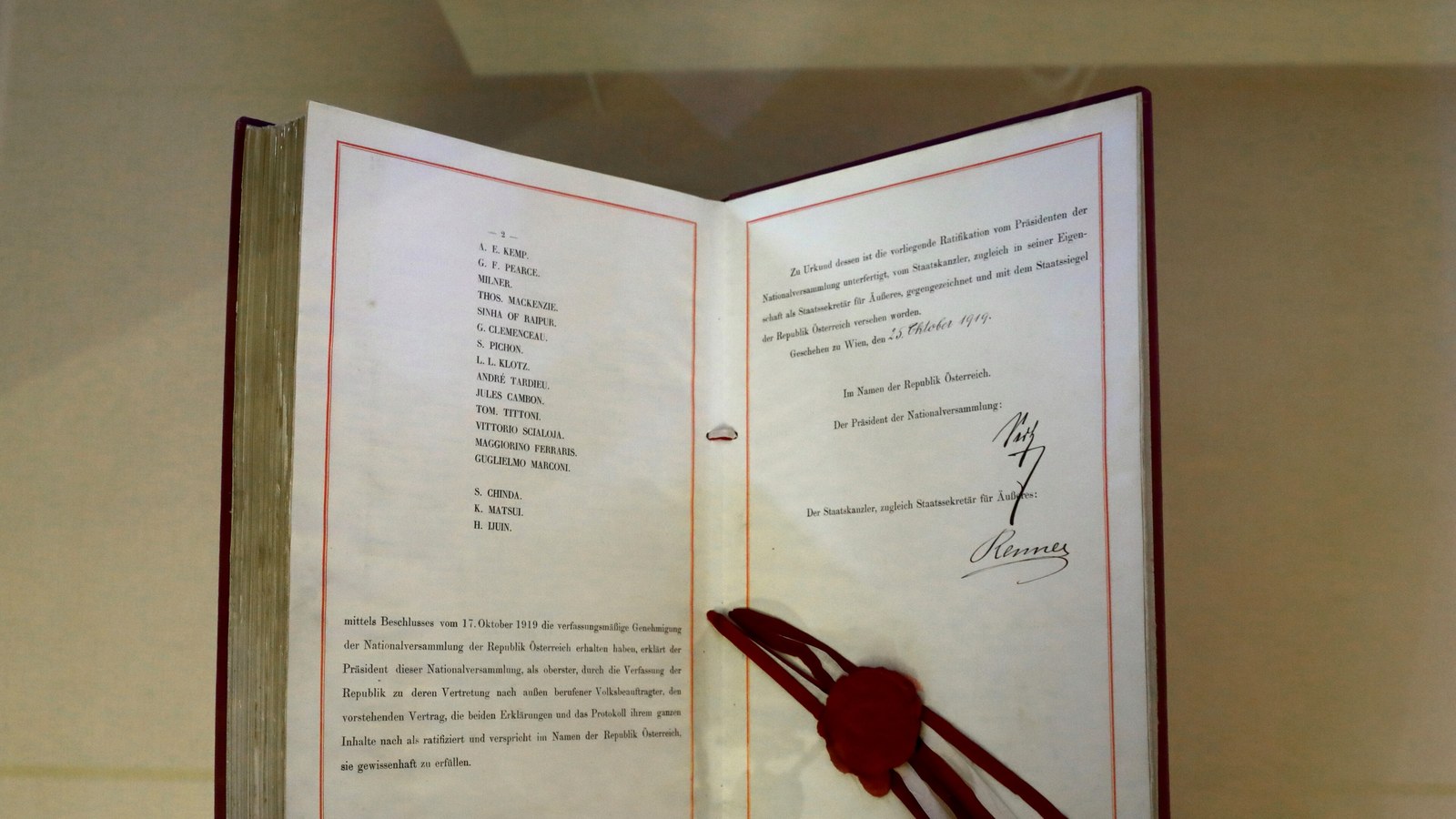
On 10 September 1919, at the Château de Saint-Germain-en-Laye, Karl Renner signed the Treaty of Peace between the Allied and Associated Powers and Austria. The text is in French, English and Italian; in case of divergence the French prevails, except Parts I (Covenant of the League of Nations) and XIII (Labour), where French and English are of equal force. It comes into force on 16 July 1920, once Austria and three Principal Powers have ratified. The depositary is the French Government.
Article 27 traces the frontiers of the new republic. With Italy the line follows the watershed between the Inn and the Adige, passes Dreiherrnspitze and drops toward Tarvis; Austria renounces in Italy’s favour all territory of the former monarchy beyond that line, down to the Adriatic. The Palazzo Venezia in Rome passes without payment. With Czechoslovakia, Gmünd remains Austrian; the Wolfshof station goes to Prague.
Austria recognises the complete independence of the Serb-Croat-Slovene State and of the Czecho-Slovak State, which includes the autonomous territory of the Ruthenians south of the Carpathians. Bukovina, within frontiers still to be fixed, passes to Romania. Article 49 calls the inhabitants of the Klagenfurt area to a plebiscite, in two zones. Article 88 makes Austria’s independence inalienable without the consent of the Council of the League; until admission, Vienna shall not take part in the affairs of another Power.
Article 89 recognises the frontiers of Bulgaria, Greece, Hungary, Poland, Romania, the Serb-Croat-Slovene State and Czechoslovakia as the Principal Powers may determine. Article 91 cedes rights over territories of the former monarchy outside the new frontiers not yet assigned. At Tientsin, Austria cedes to China the Austro-Hungarian concession.
Universal compulsory service is abolished. The army shall not exceed 30,000 men, including officers and depot troops, volunteers only, solely for internal order and the frontier. Mobilisation is forbidden. In the reparation clause Austria accepts the responsibility of Austria and her Allies for losses caused by the aggression of Austria-Hungary; the Powers recognise that her resources cannot make complete reparation and leave the amount to the Reparation Commission, the same as under the treaty with Germany.
This is not Versailles of 28 June, not Trianon of 4 June 1920 with Hungary and not the American peace signed at Vienna on 24 August 1921, after the United States Senate failed to ratify Saint-Germain. The Villa Giusti convention of 3 November 1918 is the armistice, not the peace.
The ratification certificate of the treaty. Photograph: C.Stadler/Bwag, Wikimedia Commons, licence CC BY-SA 4.0.
For context: Treaty of Saint-Germain-en-Laye (1919). The official text: Treaty of Peace with Austria (ATS 1920 No. 3).











0 Comments
No comments on this article yet. Be the first!