


On 23 September 1723, in Saint Petersburg, Ismail Beg, plenipotentiary of Shah Tahmasp II, concluded with the ministers of Peter I the treaty that closed Russia’s Caspian campaign. The text printed in Polnoe Sobranie Zakonov, volume VII, is dated 12 September Old Style. It is not the Peace of Nystad of 1721, not the Russo-Ottoman partition of Constantinople of 1724, and not the Treaty of Turkmenchay of 1828.
The preamble cites years of disorder in the Persian state, the killing and plunder of Russian merchants, and the then-reigning shah’s inability to punish the rebels. Peter says he took up arms so that the rising would not spread toward the Russian frontier, and that he occupied several places on the Caspian shore rescued from the rebels. Meanwhile other rebels seized the capital, captured the shah with his family and threw him from the throne; only the son Tahmasp remained, recognised in the tract as lawful Persian sovereign.
Article 1 binds Peter to constant friendship and strong aid against all the shah’s rebels: as soon as possible a needed number of horse and foot are to be sent into Persia, to overthrow the rebels and leave Tahmasp in quiet possession of the state. Ismail Beg had come with a sealed full power and with the request that the tsar keep him on the Persian throne.
Article 2 cedes to Russia in perpetual possession the towns of Derbent and Baku, with the lands belonging to them along the Caspian Sea, and the provinces of Gilan, Mazandaran and Astarabad. The same article gives the reason: those places are to maintain the troops sent in aid, so the emperor does not demand money from the shah for their upkeep. Article 3 puts the horses needed for cavalry, artillery, ammunition and baggage on the ceded provinces, at not more than 12 roubles; camels, within the shah’s borders, are to be given without hire. Bread, meat and salt on the march are paid for: a shah’s batman of wheat at one grivna, a batman of beef at 5 altyn and a kopeck, a ram of at least four batmans at one rouble, salt at 2 kopecks the batman. If market prices then exceed these figures, the shah’s treasury pays the excess.
Article 4 promises perpetual friendship and free passage, residence and trade for subjects of both states, with severe punishment for injury. Article 5 makes Peter a friend of the shah’s friends and an enemy of his enemies, with aid around the whole Persian state; Tahmasp undertakes the same toward Russia.
When Prince Boris Meshcherskii brought the text to Qazvin in April 1724, Tahmasp refused to ratify it. The Russian force on the shore was too thin to compel the signature, and Ismail Beg, on his return, had to flee; he died in exile in Astrakhan. The provinces were restored to Persia by the treaties of Resht, 1732, and Ganja, 1735, under Empress Anna. It is not the Treaty of Saint Petersburg of 1762 and not the later Russo-Persian peaces of 1813 or 1828.
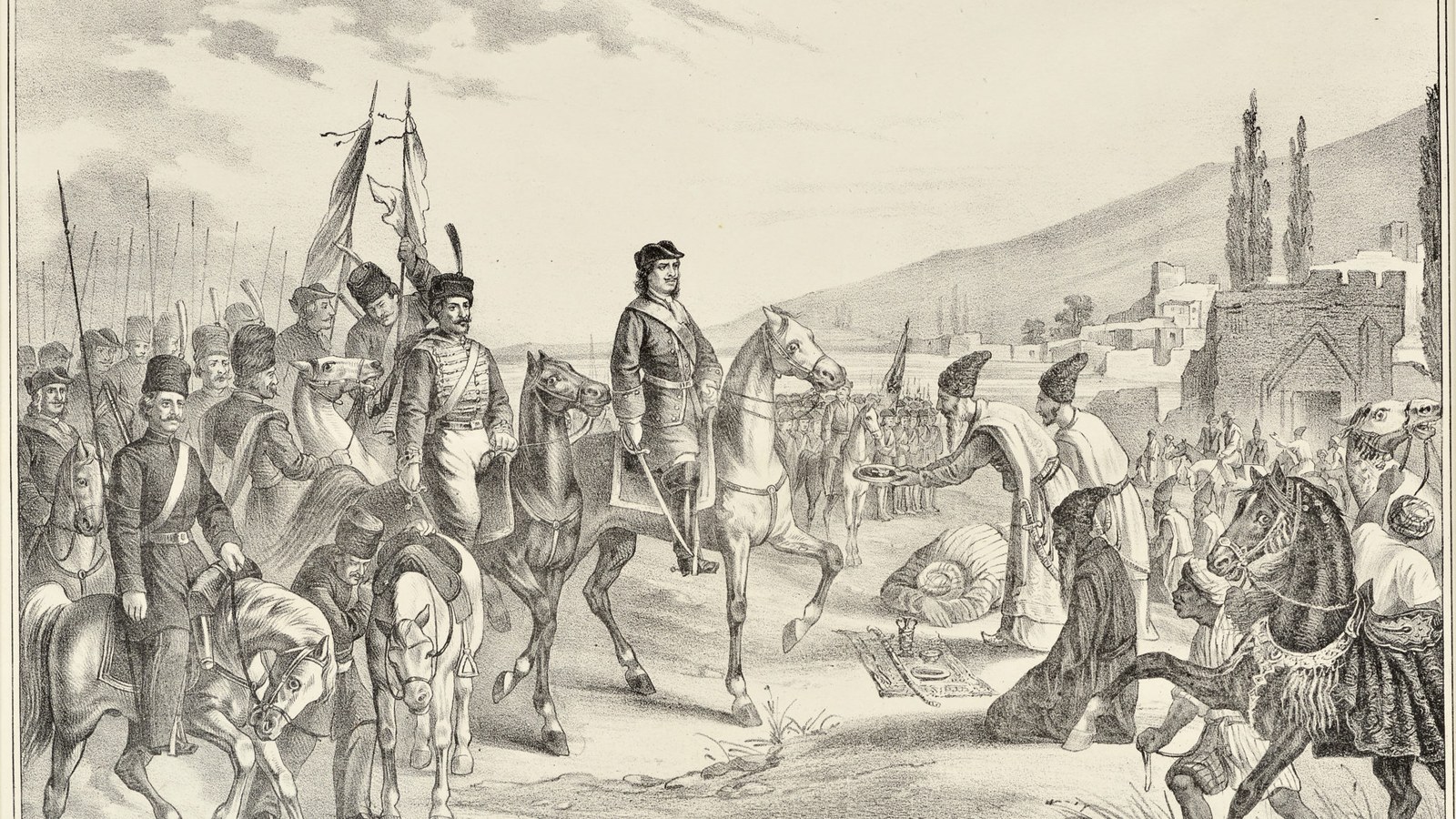
Peter I at Derbent, during the Caspian campaign. Painting by A. Abramov. Image: Wikimedia Commons, public domain.
For context: Treaty of Saint Petersburg (1723). The text: Treaty with Persia, 12 September 1723 (PSZ VII).











0 Comments
No comments on this article yet. Be the first!