


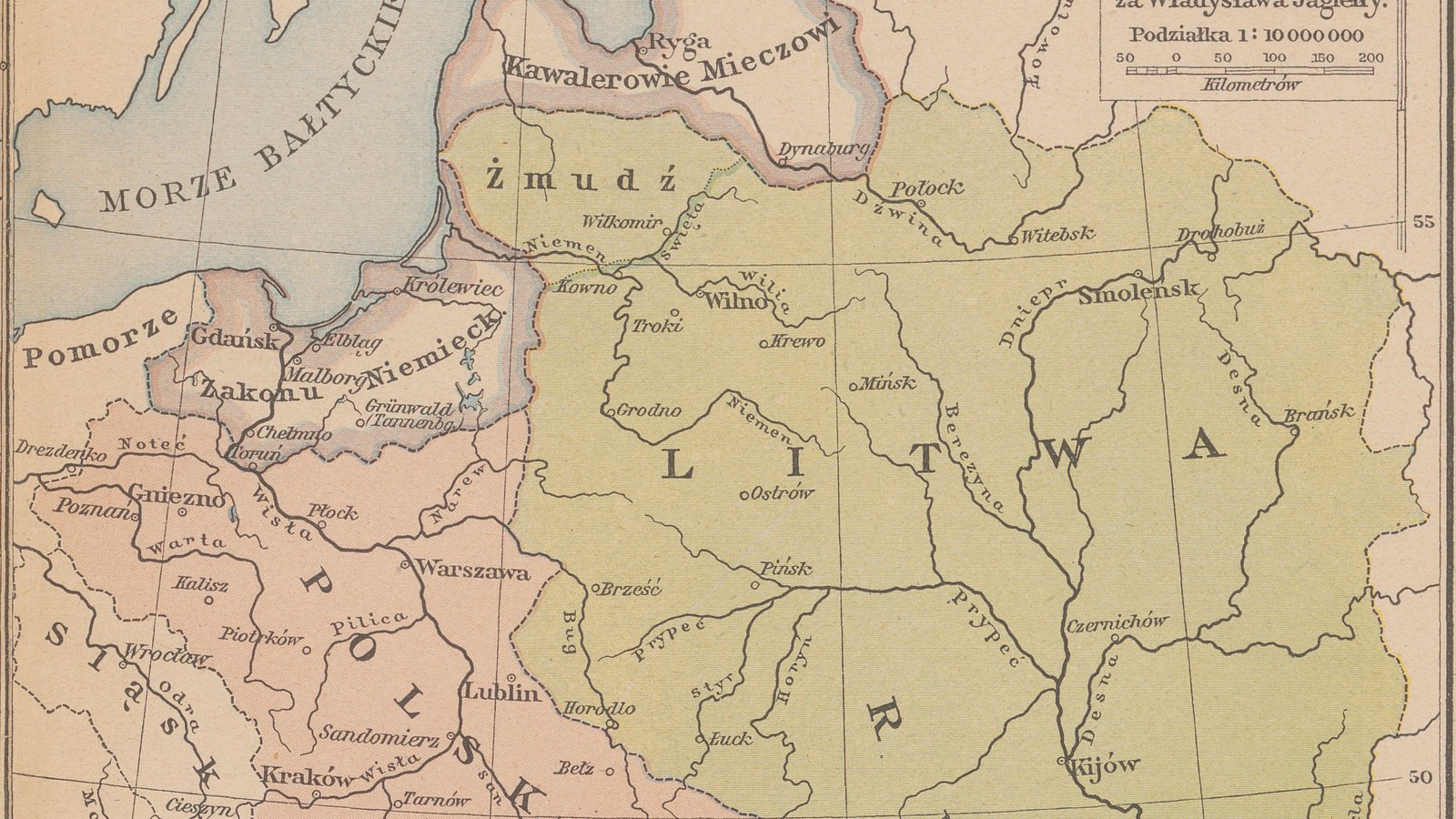
On 12 October 1398, on the islet of Sallin in the Neman, above Romeywerder, between the mouths of the Dubysa and the Nevėžis, Alexander otherwise Witowt, grand prince of Lithuania and of Russia, made perpetual peace with Konrad von Jungingen, grand master of the Order of the German House of Saint Mary of Jerusalem, and his commanders in Prussia, the German lands and Livonia. It is not Königsberg of 1384, not Lyck of 1390, not Melno of 1422 and not Raciąż of 1404. The preliminaries at Grodno, on 23 April, prepared the act; Jogaila, king of Poland, is not named and does not confirm it.
Article 1: Witowt, with the dukes and boyars, pledges to spread Christianity of the Roman rite in all his lands and to do for the Church and the Empire what other free Christian kings and princes are bound to do. Article 2: peace and concord with Konrad, with all his Order and its lands in Prussia and Livonia, held “feste und unvorruckt”. Article 3: no league against the Order, lay or clerical; all harm shown till then is forgiven from the heart.
Article 4 draws the line. From the upper end of the Sallin islet, the whole islet stays with the Order; from there straight to the Nevėžis, under the Holy Wood, along the midstream to Wisbiten, to the Rode stone in the A, to Smarden, the Apeytensee, the Brengel road, Nenemite, the spring in the heath, the Egloffe, to the Pskov border — these toward Livonia. Toward Prussia: from Sallin to the Šešupė, up to its source, then the Metenflis from the Mentense, the Biebrza for a mile, into the Narew. If Siemowit of Masovia redeems the house at Wizna, bounds shall be set after the old neighbours. All the lands beyond these lines, with all their uses, remain to the Order forever; Witowt renounces every right he had there. Samogitia thus falls, not at the head of the text.
Article 5: no claim to the land of Pskov; if it should come to him, it stays with the Order. Article 6: the Order’s people may trade freely in his lands, without new tolls, under the same commands, save ancient tolls. Article 7: he shall not take or settle the Order’s rent-bound people in his lands without the grand master’s will. Article 8: on joint campaigns, the Order’s captives remain theirs; crime is judged by the Order’s highest in the host, and what is common is judged by both sides. Articles 9–11: no host, even Christian, shall pass his lands to harm the Order; no shelter for those outlawed for slaughter, arson or treason; no army through the Order’s lands without its knowledge and will, and without damage.
Article 12 seals it all, in Latin and in German, with his great seal and those of the dukes and boyars: cousin Woldemir, brother Sigmund, the dukes of Pinsk, Salsa, Starodub, Goltscha, Druck, Jamund of Kletsk, the captains of Ashmyany, Vilnius, Kreva, Trakai, Kaunas and others. The grand master’s seal was later torn out, at the sealing of the Peace of Melno, to void the deed. It is not Grunwald of 1410. The Vorskla, in 1399, comes after; the Samogitian rising of 1401 breaks the bargain.
Map of Poland and Lithuania under Władysław Jagiełło, 1927 edition, showing the land between Prussia and Livonia. Image: Wikimedia Commons, public domain.
For context: Treaty of Salynas. The German text: PrUB JS 409, Salinwerder, 12 October 1398.











0 Comments
No comments on this article yet. Be the first!