


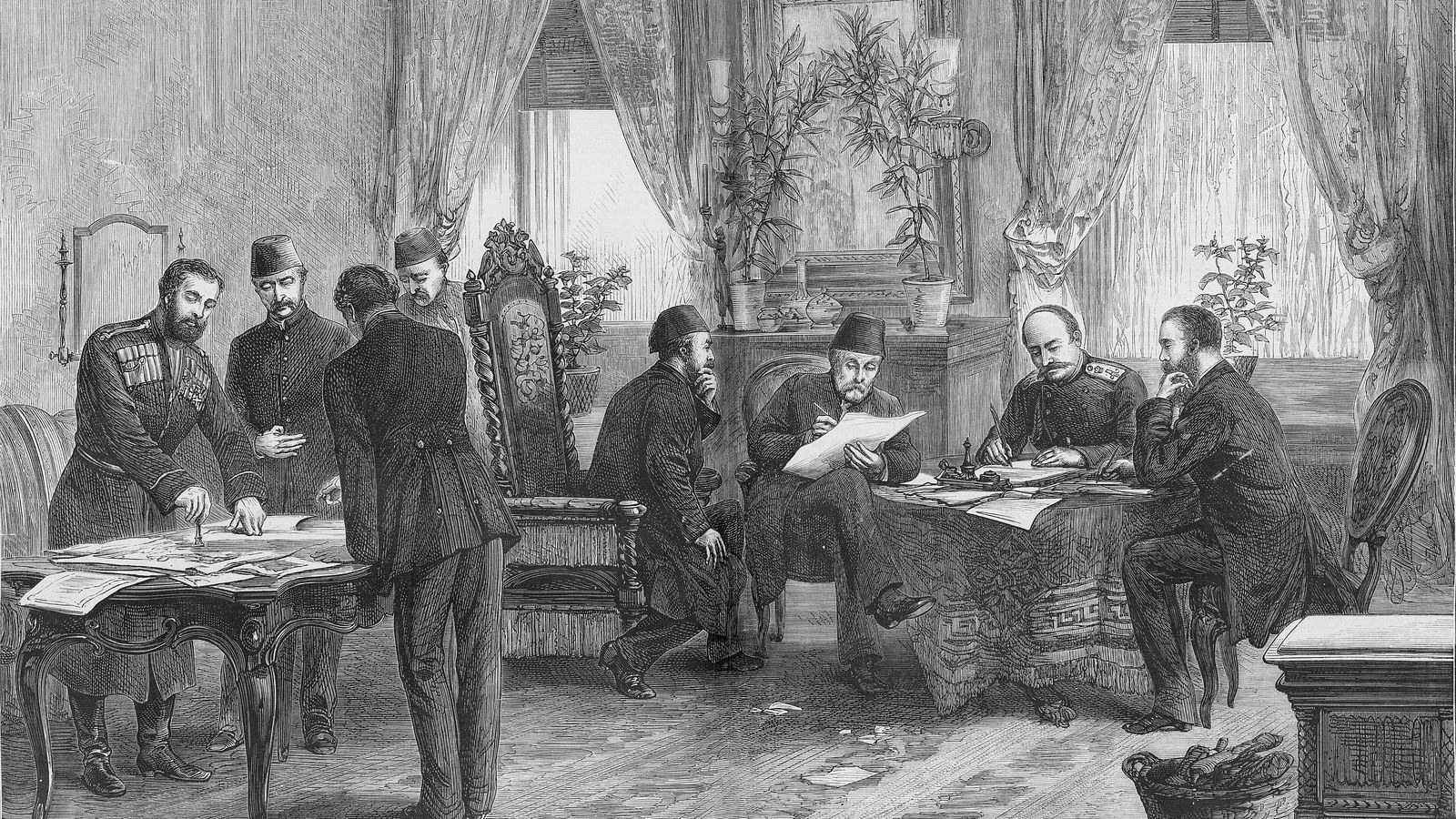
The Russo-Turkish war of 1877–78 closed with preliminaries, not a European peace. The Russian signatories were Count Nikolai Ignatiev and Aleksandr Nelidov. For the Porte: Foreign Minister Saffet Pasha and Sadullah Pasha, ambassador in Berlin. The house of the Simenoğlu family at San Stefano, a village west of Constantinople, now Yeşilköy. The preliminaries were signed on 3 March 1878, 19 February on the Julian calendar. Ratifications, in Petersburg, on 17 March. The French text is the instrument; the English rendering was made for the British government and published by the United States Department of State.
Article 6: Bulgaria is an autonomous tributary principality, with a Christian government and a national militia. The frontier, on the annexed map, drops from the Morava valley through Macedonia, reaches the Aegean near the mouths of the Vardar, climbs the Rhodope, leaves Adrianople to the south and strikes the Black Sea at Hakimtabiassi, then, from Mangalia, cuts the sandjak of Tulcea and comes out on the Danube above Rassova. Article 7: a prince elected by the people, confirmed by the Porte with the Powers’ assent; no member of the great reigning houses. An assembly of notables at Plovdiv or Tarnovo, under a Russian commissioner, writes the organisation. Article 8: the Ottoman army leaves, the old fortresses come down; Russian troops, up to 50,000, stay about two years, at the country’s expense, with depots at Varna and Burgas.
Article 2 recognises the independence of Montenegro; Nikšić, Gacko, Podgorica and Antivari remain with the principality. Article 3 recognises the independence of Serbia, with Niš on the new map; Ada Kale is evacuated and demolished. Article 5: the Porte recognises the independence of Romania, with a right to an indemnity to be discussed between the two countries. Article 19: Russia claims 1,410 million rubles; in place of the greater part it takes the sandjak of Tulcea — Kilia, Sulina, Mahmudiye, Isaccea, Tulcea, Măcin, Babadag, Hârșova, Constanța, Medgidia, the delta and Serpents’ Island — and exchanges it for southern Bessarabia, lost in 1856, as far as the Kilia thalweg. Ardahan, Kars, Batum, Bayazid and the land to the Soghanli make up the rest.
The Danube fortresses fall; there are to be no line-of-battle ships on the river, only police craft. The Lower Danube commission stands. Bosnia and Herzegovina receive the Constantinople conference reforms, with Austria-Hungary at the table. Crete returns to the organic law of 1868; Epirus and Thessaly, analogous reforms. Article 16: reforms in the Armenian districts, security against Kurds and Circassians. The Bosporus and the Dardanelles stay open, in peace and in war, to neutral merchantmen bound for Russian ports.
Bulgaria so drawn had an outlet to the Mediterranean. The Great Powers feared Russian use of Bulgarian ports. Disraeli would not take the extension. Salisbury, in the circular of 1 April 1878, broke the bargain. Serbia feared Greater Bulgaria. Romania, which had fought beside the Russians, read the Bessarabia-for-northern-Dobruja swap as a breach of the pre-war guarantees. Austria-Hungary did not get Bosnia. Albanians, cut between Serbia, Bulgaria and Montenegro, moved toward the League of Prizren.
The Congress of Berlin, three months later, replaced the preliminaries. Bulgaria shrank; Macedonia stayed Ottoman; Bosnia passed under Habsburg administration. 3 March is, in Bulgaria, Liberation Day. Ignatiev treated the text as a draft for Europe; the other cabinets treated it as a fait accompli to be corrected. The engraver in the Illustrated London News of 23 March 1878 showed the table at San Stefano, not the map from Berlin.
Sources: Treaty of San Stefano; Office of the Historian, The treaty of peace. Official text.











0 Comments
No comments on this article yet. Be the first!