


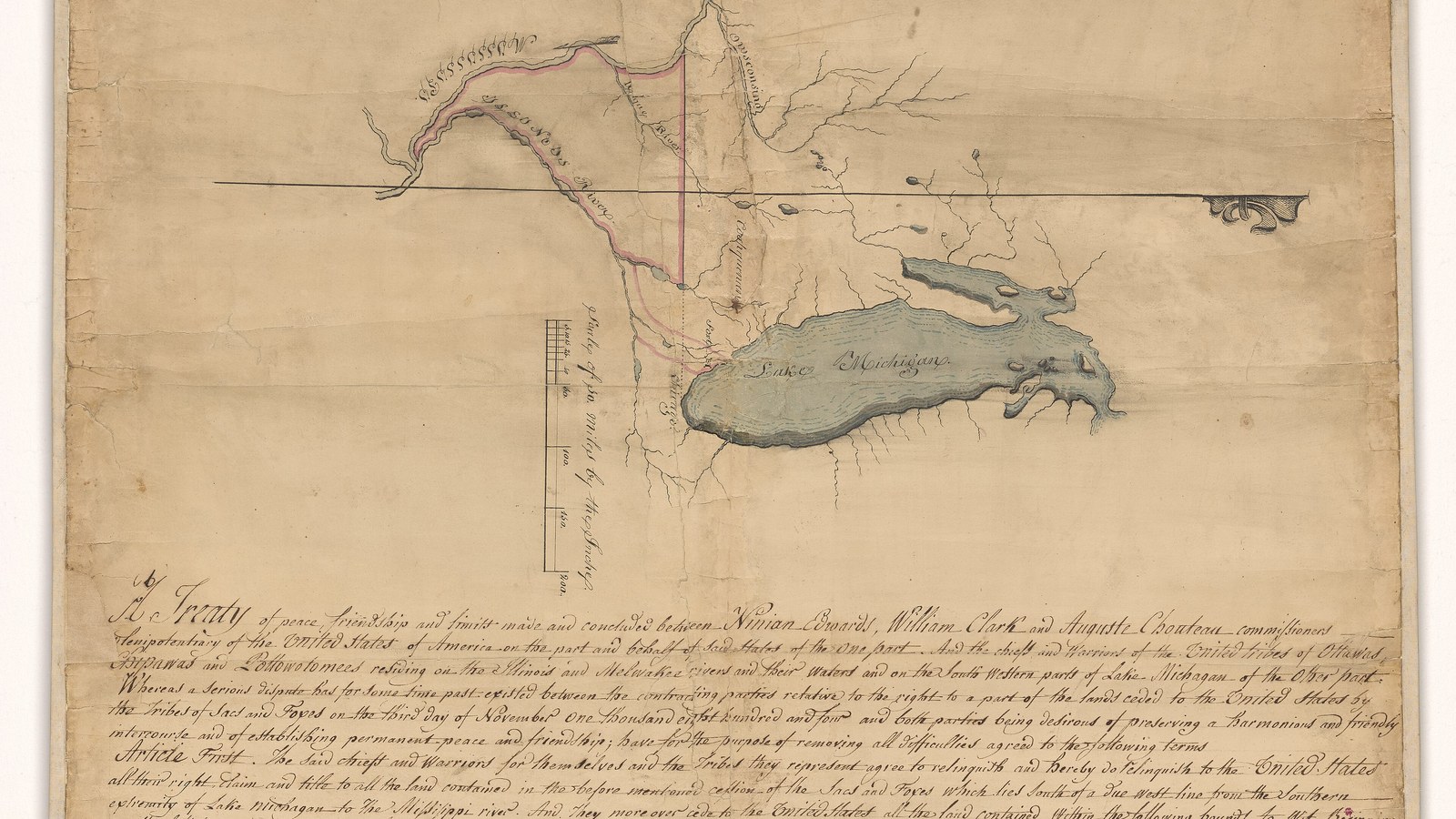
On 24 August 1816, at St. Louis, Ninian Edwards, William Clark and Auguste Chouteau, commissioners plenipotentiary of the United States, concluded a treaty of peace, friendship and limits with the chiefs and warriors of the united tribes of Ottawas, Chippewas and Potawatomis residing on the Illinois and Milwaukee rivers and on the southwestern parts of Lake Michigan. 7 Stat. 146. Proclamation, 30 December 1816. The closing formula is Done at St. Louis. The year of independence, the forty-first. The premise: a dispute over land ceded to the United States by the Sauk and Fox on 3 November 1804.
Article 1: the tribes relinquish all right, claim and title to that part of the Sauk–Fox cession which lies south of a due west line from the southern extremity of Lake Michigan to the Mississippi. They also cede a tract beginning on the left bank of the Fox river of Illinois, ten miles above its mouth; crossing Sandy creek ten miles above its mouth; a point ten miles north of the west end of the portage between Chicago creek and the Des Plaines; a point on Lake Michigan ten miles north of the mouth of Chicago creek; along the lake to ten miles south of that mouth; a point on the Kankakee ten miles above its mouth; then with the Kankakee and the Illinois to the mouth of the Fox. Proviso: hunting and fishing on the land relinquished and ceded, so long as it remains the property of the United States.
Article 2: in return, merchandise delivered that day and, for twelve years, goods worth one thousand dollars a year, at first cost, without carriage, to be delivered on the Illinois, not lower than Peoria. The United States relinquishes to the tribes that part of the 1804 cession lying north of the same west line, except three leagues square at the mouth of the Wisconsin, both banks, and other tracts on or near the Wisconsin and Mississippi reserved by the president, not in the whole exceeding five leagues square. Article 3: peace and friendship; good faith toward former treaties.
Signatories include Mucketeypokee (Black Partridge), Mucketepennese (Black Bird), Pemasaw (Walker), Nangesay (Stout), Chamblee, Mowais (Little Wolf). Witnesses: R. Wash, secretary to the commission; R. Graham, agent for the Illinois Territory; Thomas Forsyth; Lieutenant J. Maul, Eighth Infantry; P. Provenchere, interpreter. The Statutes at Large also list Kickapoo, Sauk and Fox chiefs present, among them Quashquammee and Acoqua (Kettle).
This is not the 1804 Treaty of St. Louis with the Sauk and Fox, which opened the dispute. It is not the Portage des Sioux series of 1815. It is not Chicago 1833, not Prairie du Chien 1825, not Fort Jackson 1814. The strip by Chicago was later used for the Illinois and Michigan Canal. The cover is the first page of the ratified instrument, Ottawa, Chippewa and Potawatomi, signed at St. Louis.
Sources: Treaty of St. Louis (1816); Treaty with the Ottawa, etc., 1816 (Kappler; 7 Stat. 146).











0 Comments
No comments on this article yet. Be the first!