


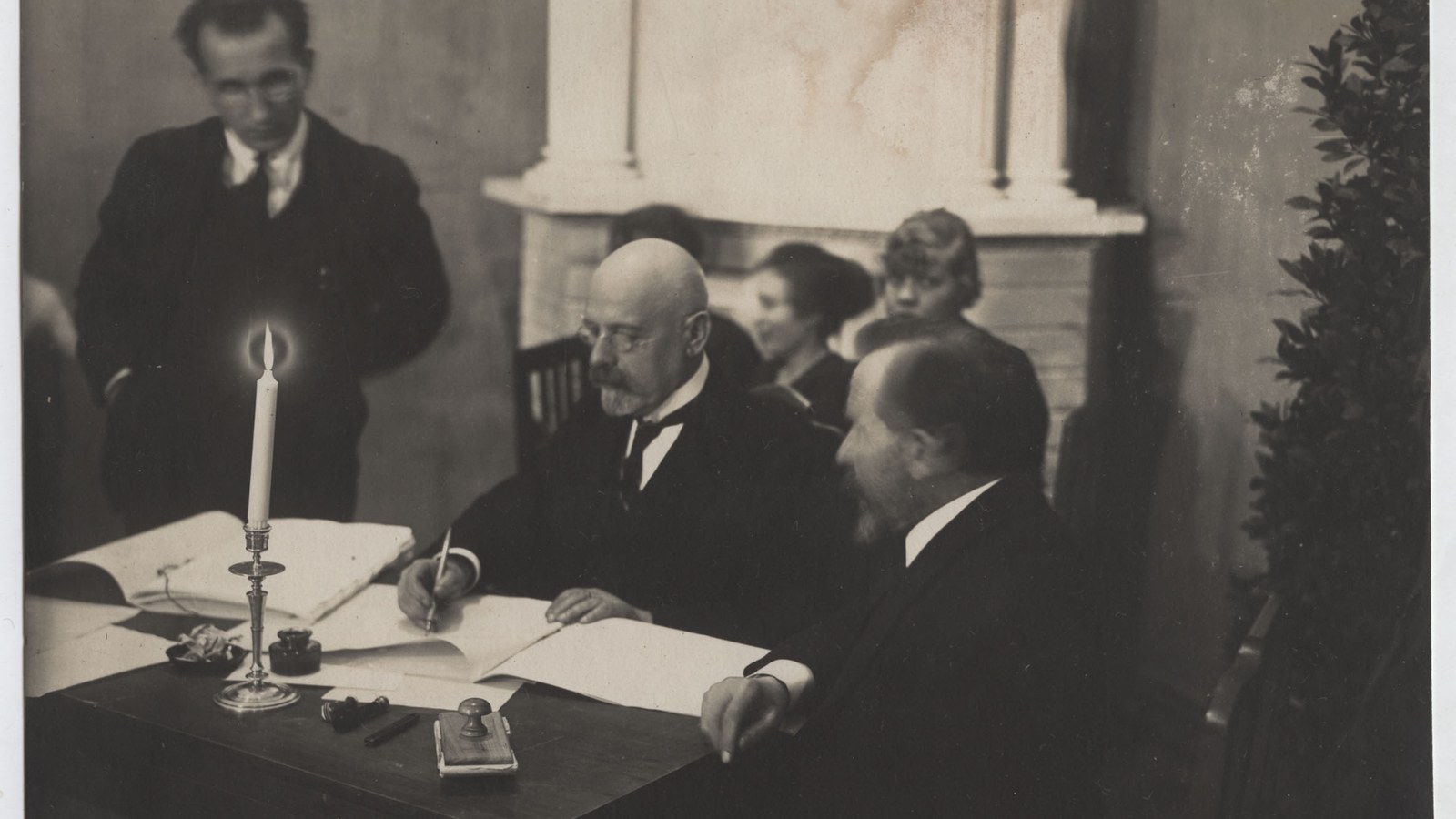
On 2 February 1920, at Tartu, the peace treaty between the Republic of Estonia and the Russian Socialist Federative Soviet Republic is signed. Authentic texts: Estonian and Russian. For Estonia: Jaan Poska, Ants Piip, Mait Püümann, Julius Seljamaa, Major-General Jaan Soots. For Russia: Adolf Joffe and Isidor Gukovsky. Article 20: ratification, exchange of instruments in Moscow as soon as possible; the treaty enters into force on ratification. The exchange takes place on 30 March. Registration with the League of Nations, 12 July 1922, LNTS volume 11. The Estonian War of Independence, from 1918, closes.
Article 1: from the day the treaty enters into force, the state of war ends. Article 2: proceeding from the right of self-determination proclaimed by Soviet Russia, to the point of complete secession from the State of which they form part, Russia unreservedly recognises the independence and sovereignty of the State of Estonia and renounces voluntarily and forever all sovereign rights possessed by Russia over the Estonian people and territory, whether based on the former public-law position or on international treaties, which lose their force. The Estonian people and land bear no obligation towards Russia from their former belonging to the Russian Empire.
Article 3: the frontier, from the Gulf of Narva, along the Rossoni, to the middle of Lake Peipus, one verst east of Piirisaar, then the straits, Lake Pskov, towards Sprechtitschi. The map at three versts to the inch; in case of conflict, the text prevails. A mixed demarcation commission, on ethnographic and economic marks. Until 1 January 1922 the Estonian strip east of the Narva and that south of Pskov are militarily neutral; Russia does the same, west of the Velikaya. On Peipus and Pskov, no armed vessels. Troops to the frontier within 28 days of ratification; evacuation of the neutral zones, 46 days.
Article 4: option of nationality, one year from ratification, for those over 18; wife and minor children follow the husband unless otherwise agreed. Those who opt for Russia leave Estonia within a year, with movable property. Reciprocally for Estonians in Russia. Article 5: if Estonia’s permanent neutrality is internationally recognised, Russia will respect it. Article 6: both join, if it is internationally agreed, the neutralisation of the Gulf of Finland. Article 7: no foreign troops, save those of the government and of allies not at war with the other party; disarmament of formations which, up to 1 October 1919, were not under government; a mixed commission at Rakvere and Pskov.
Article 8: no war indemnities. Article 9: prisoners home as soon as possible. Article 11: Russia renounces Crown property on Estonian territory — forts, harbours, ships, including warships — including what was there on 24 February 1918, at the German occupation; Estonia makes no claim on Russia from the old imperial belonging. Article 12: Russia pays Estonia 15 million gold rubles, eight within a month, seven within two; Estonia bears none of the imperial debt. Return of archives, libraries, the collections of the University of Tartu. Article 16: a preferential concession for a railway to Moscow and a million dessiatins of forest in the guberniyas of Petrograd, Pskov, Tver, Novgorod, Olonets, Vologda, Arkhangelsk.
Poska dies in March, before the Moscow exchange. The university museum collections, evacuated to Voronezh, do not return. In 1940 the Soviet Union occupies Estonia. Today’s border leaves with Russia land from Article 3.
Image: Armin Lomp, Jaan Poska signing the Treaty of Tartu, 2 February 1920, public domain, Wikimedia Commons. Cropped to 16:9.
Source consulted: Treaty of Tartu (Estonia–Russia). Treaty text: Rahuleping Eesti ja Venemaa vahel, Tartu, 2 February 1920 (LNTS vol. 11).











0 Comments
No comments on this article yet. Be the first!