


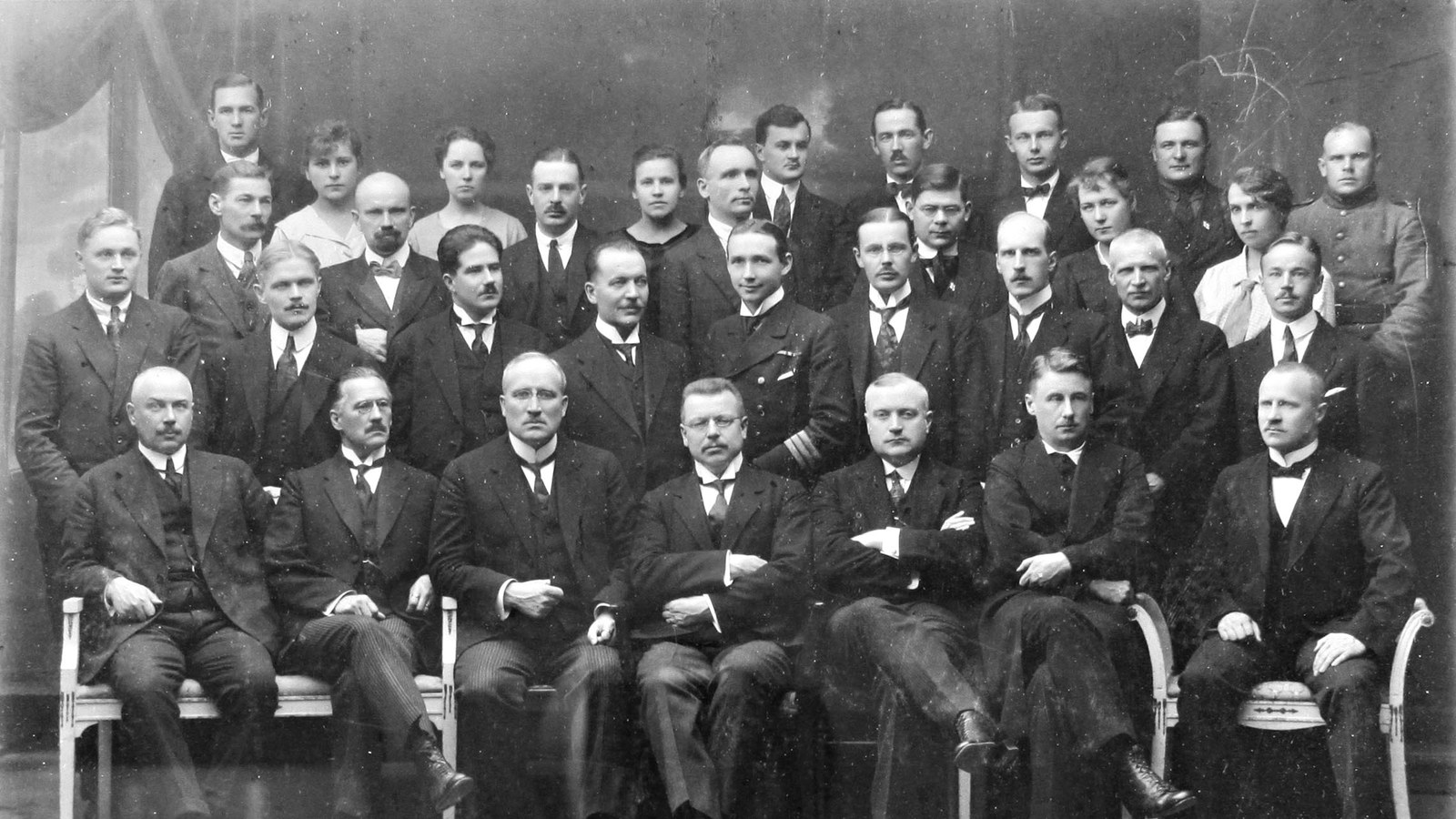
At Dorpat (Tartu), in the building of the Estonian Students’ Society, the Republic of Finland and the Russian Socialist Federative Soviet Republic sign a treaty of peace. The date of the instrument is 14 October 1920. The Finnish plenipotentiaries are J. K. Paasikivi, J. H. Vennola, Alexander Frey, Rudolf Walden, Väinö Tanner, Väinö Kivilinna and Väinö Voionmaa; the Russian, Jean Berzine, P. M. Kergentzeff and N. Tikhmeneff. Article I: the state of war ceases; the parties undertake peace and goodwill.
Article II: from frontier mark 90 at Korvatunturi to Lake Ladoga and along the Karelian Isthmus, the frontier follows the former Grand Duchy line; to the north, paragraph 1 traces the Petsamo (Pechenga) corridor to mark 90. The islands of Heinä (Ainovskie) and Kii pass to Finland. Article IV: the territory of Petsamo, with its territorial waters, is ceded to Finland in perpetuity; Russian troops evacuate it within 45 days. Article VI: in Arctic waters Finland shall not keep submarines, armed aircraft, or warships beyond the tonnage limits in the text. Article VIII: Russia is guaranteed free transit to Norway through Petsamo, goods free of customs, and unarmed aircraft may fly over the district.
Article X: within 45 days Finland withdraws her troops from the communes of Repola and Porajärvi; they are reincorporated in Russia and attached to the autonomous territory of Eastern Karelia (the Karelian population of the governments of Archangel and Olonetz), with a national right of self-determination. Article XI: amnesty under Article XXXV, a local militia for two years, property retained, and a right to leave Russia within one month. This is not a plebiscite for the whole of Eastern Karelia.
Articles XIII–XIV: Finland militarily neutralises the Gulf of Finland islands (Sommarö, Nervö, Seitskär, Peninsaari, Lavansaari, Tytärsaari, Rödskär) and Hogland, under an international guarantee. Article XV: at Ino and Puumala Finland removes the gun gear within three months and destroys the fortifications within a year. Article XVI: on Ladoga, its banks, rivers and canals, and on the Neva as far as the Ivanovski rapids, no offensive establishments; warships of at most 100 tons are allowed. Article XVII: Russia allows Finnish merchant vessels free navigation of the Neva between the Gulf and Ladoga, on the same terms as Russian vessels, not for war material.
Article XXII: Russian state property in Finland becomes Finnish, and vice versa, without indemnification; each keeps three urban properties for representation. Articles XXIV–XXVI: no war indemnity; Finland takes no share in Russia’s 1914–1918 expenses; mutual state debts are liquidated, including the 1917 wheat and exchange agreements. Article XXXV: prisoner repatriation and a political amnesty. Article XXXVIII: authentic texts in Finnish, Swedish and Russian; French is signed at the exchange of ratifications. Article XXXIX: ratification; exchange at Moscow; the treaty enters into force on that exchange.
At signature the Russian delegation records declarations outside the articles: autonomy for Eastern Karelia; minority rights for the Finnish population of the Petrograd government (Ingria); an amnesty for war refugees; and no Russian troops in Repola and Porajärvi for two years unless Finland stations troops there. At Moscow, on 31 December, Voionmaa signs the French text; Ahonen, Voionmaa, Chicherin, Karakhan and Litvinoff exchange the instruments of ratification.
It is not the Treaty of Tartu between Estonia and Russia, of February. It is not the Finnish–Russian armistice of August. It is not Finland’s declaration of independence, which the preamble recalls as an earlier fact. It is not the Winter War.
The cessions of Moscow 1940 and Paris 1947, which take Petsamo, are not this text. The line of Articles II and IV remains the one signed at Dorpat.
Image: Finnish deputation at Dorpat, 1920; unknown author; National Archives of Finland; public domain, Wikimedia Commons. Cropped to 16:9.
Source consulted: Treaty of Tartu (Finland–Russia). Treaty text: Peace Treaty between Finland and the RSFSR, Dorpat, 14 October 1920 (LNTS).











0 Comments
No comments on this article yet. Be the first!