


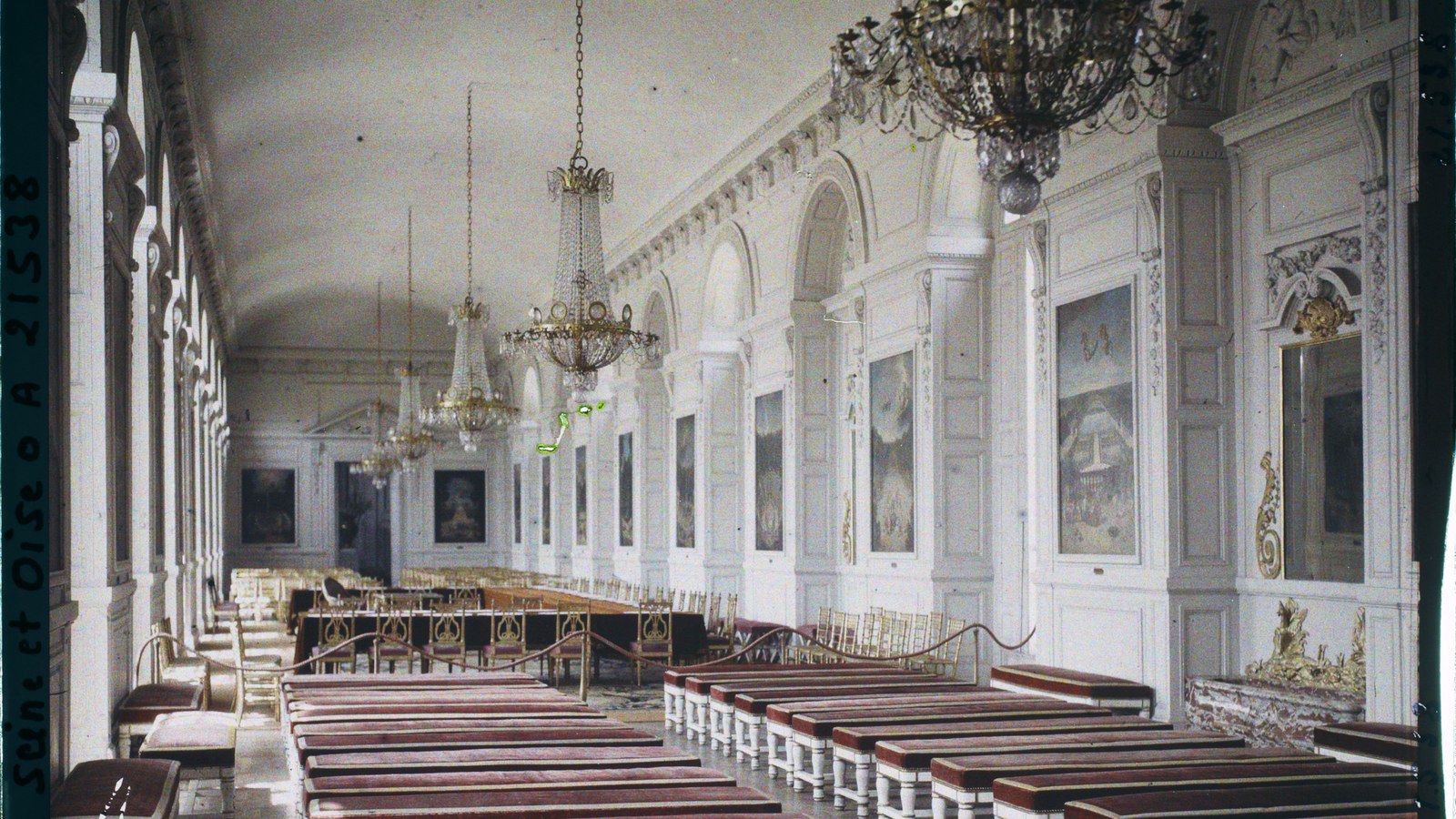
The Paris Peace Conference dealt with Hungary after Germany, Austria and Bulgaria. The U.S. Department of State’s Office of the Historian records the timetable: the Hungarian Conditions of Peace were dated 15 January 1920, Hungary’s Observations were handed in on 20 February, and the final text was submitted on 6 May. The treaty was signed at the Grand Trianon in Versailles and entered into force on 26 July 1921.
The Hungarian delegation, led by Count Albert Apponyi, arrived in Paris on 7 January 1920. The day after receiving the draft, Apponyi asked the Supreme Council for plebiscites in the territories about to be severed from Hungary and challenged the new borders. The Allies refused. The treaty was dictated, not negotiated: Budapest could accept or reject it in full. The Hungarian signatories were Ágost Benárd and Alfréd Drasche-Lázár.
On 4 June 1920, in the hall of the Grand Trianon, Hungary made peace with the Allied and Associated Powers. Part II of the instrument, articles 27–35, sets the frontiers with its neighbours. Transylvania and the eastern Banat were recognised as Romania’s. Slovakia and Subcarpathian Ruthenia passed to Czechoslovakia. Croatia-Slavonia and Vojvodina, including the western third of the Banat, entered the Kingdom of Serbs, Croats and Slovenes. Burgenland was assigned to Austria.
Post-war Hungary remained a landlocked state of 93,073 square kilometres and about 7.6 million people: 28 percent of the land and 36 percent of the population of the pre-war Kingdom of Hungary. The areas allotted to neighbouring countries contained some 3.3 million Hungarians, who became minorities. The army was limited to 35,000 men; the Austro-Hungarian navy ceased to exist; reparations were imposed.
Alexandre Millerand’s covering letter explained why the Allies organised no plebiscites: a popular consultation “would not produce significantly different results”. The League of Nations Council might mediate adjustments if the delimitation commission asked. The only plebiscite, in 1921, left Sopron with Hungary. The United States did not ratify Trianon; it concluded a separate peace that did not contradict the treaty’s terms.
The 1918–1919 demarcation lines — the Armistice of Belgrade of 13 November 1918, Czechoslovak occupation of the north, the Romanian advance across the Mureș, the union proclaimed at Alba Iulia on 1 December 1918 — were legalised as borders. The treaty lifted, de jure, the blockade on Hungary and required the resumption of trade, including coal deliveries from Czechoslovakia and Poland.
Budapest ratified the act on 16 November 1920, under protest, and made revision a foreign-policy aim. The 1920 frontiers have remained, in the main, those of today, with minor changes in 1921–1924 and 1947, apart from the 1938–1941 enlargement. The treaty recognised Hungary’s sovereignty and provided for the protection of property of Hungarian citizens left outside the new borders.
Sources: Treaty of Trianon; Office of the Historian, The Paris Peace Conference, 1919.











0 Comments
No comments on this article yet. Be the first!