


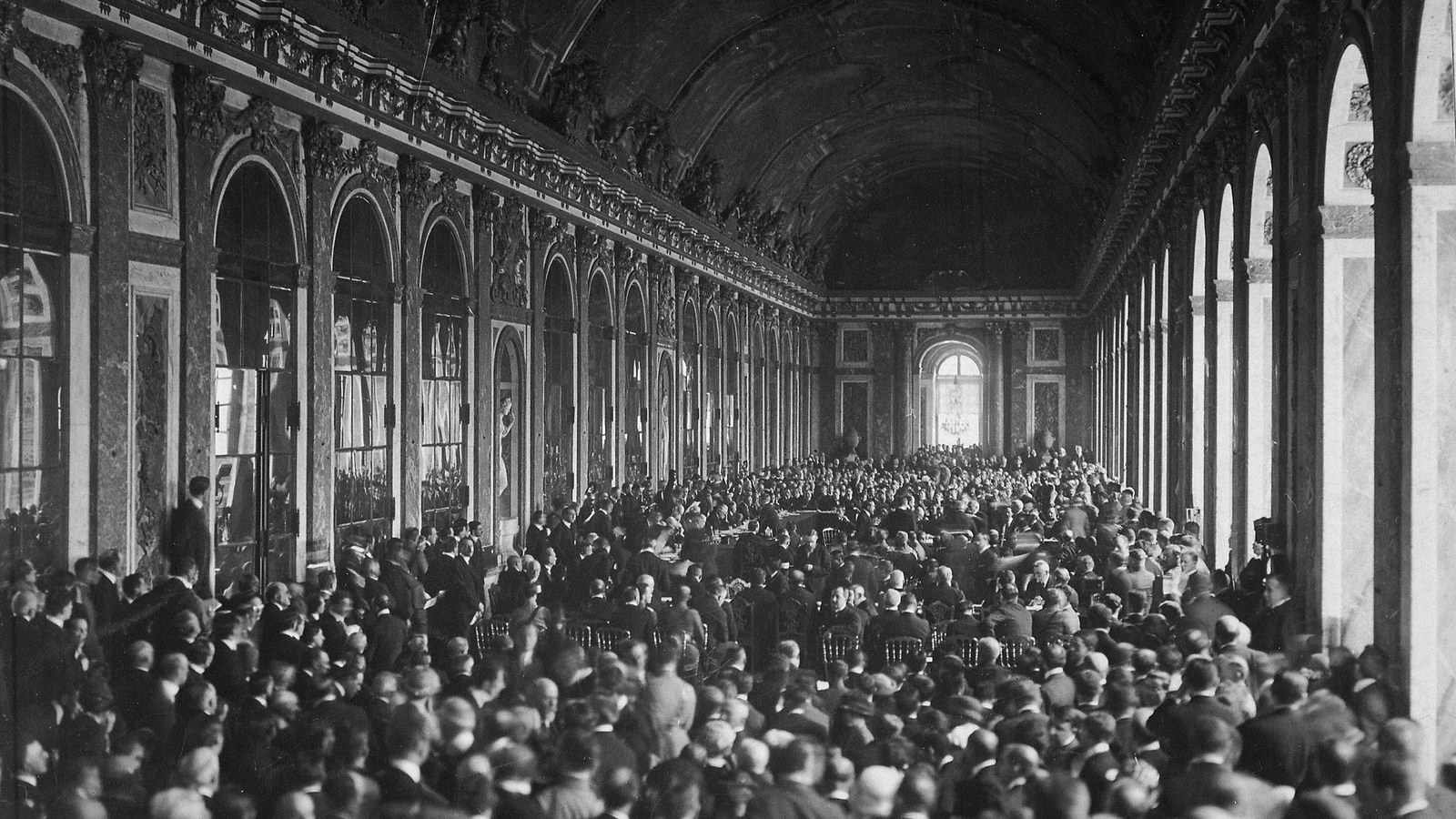
On 28 June 1919, in the Hall of Mirrors at the Palace of Versailles, the Treaty of Peace between the Allied and Associated Powers and Germany was signed. The date falls five years after the Sarajevo assassination. The armistice of 11 November 1918 had stopped the fighting; the peace text took six months of conference in Paris. Germany was not admitted to the negotiations before the signing.
The Big Four — Georges Clemenceau, David Lloyd George, Woodrow Wilson and Vittorio Orlando — held 145 closed sessions, usually at the Quai d’Orsay. The signing was at Versailles; the work, in Paris. Russia was excluded after Brest-Litovsk. Wilson’s Fourteen Points were the basis on which Berlin believed it had surrendered; the final text was a compromise among French security, the British balance and the League of Nations.
Article 231, the “war guilt” clause, affirms that Germany and her allies bear responsibility for Allied losses. Reparations were set on it. Keynes called it a Carthaginian peace; Marshal Foch found it too lenient. The German army was limited to 100,000 men; military aviation was banned; the Rhine was demilitarised and occupied for fifteen years.
France recovered Alsace-Lorraine. Poland received a corridor to the Baltic; Danzig became a free city. The Saar basin passed under League administration, with the mines for the French. German colonies became mandates. The independence of states carved from the Empire was recognised. The treaty also demanded the trial of Wilhelm II; the Netherlands did not extradite him.
The United States did not ratify. The Senate rejected both the treaty and the League; Washington made a separate peace with Germany, still based on the Versailles text. Entry into force, for the signatories, was on 10 January 1920. The food blockade lasted until the signing.
Yale’s Avalon Project keeps the full text: 15 parts, 440 articles, in French and English. Part I establishes the League of Nations. Part VIII, reparations, was later reorganised through the Dawes and Young plans.
No one left satisfied. Germany was neither pacified nor permanently weakened. Resentment of the “diktat” fed the politics of the 1930s. Locarno, in 1925, tried to mend the relations Versailles had left open.
Image: Helen Johns Kirtland and Lucian Swift Kirtland, signing of the Treaty of Versailles in the Hall of Mirrors, 28 June 1919, public domain, Wikimedia Commons. Cropped to 16:9.
Source consulted: Treaty of Versailles. Treaty text: The Versailles Treaty June 28, 1919 — The Avalon Project.











0 Comments
No comments on this article yet. Be the first!