


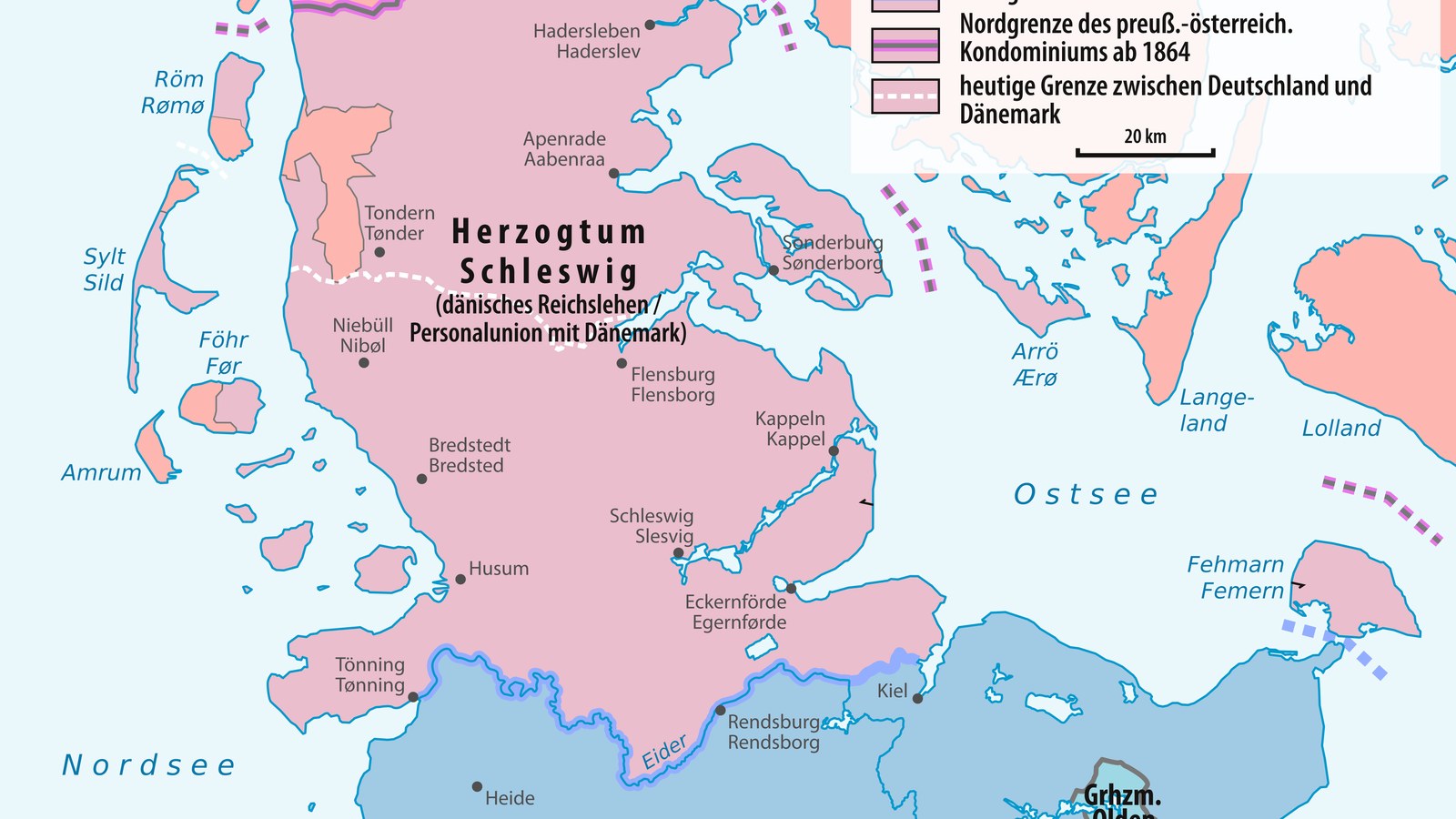
On 30 October 1864, in Vienna, the plenipotentiaries of Prussia, Austria and Denmark signed the peace that closed the Second Schleswig War. For Prussia, Karl von Werther and Armand-Louis von Balan signed; for Austria, Count Johann Bernhard von Rechberg-Rothenlöwen and Baron Adolph Marie von Brenner-Felsach; for Denmark, George Joachim Quaade and Henrik August Theodor Kauffmann. The preliminaries, with the same names plus Bismarck, had been set on 1 August. Ratifications were exchanged in Vienna on 16 November 1864.
Article I restores perpetual peace. Article III is the core: the King of Denmark, Christian IX, renounces all his rights over the duchies of Schleswig, Holstein and Lauenburg in favour of the King of Prussia and the Emperor of Austria, and undertakes to recognise whatever dispositions those two majesties may make. The cession does not go to a claimant duke, nor to the German Confederation: it goes to two sovereigns, in condominium.
Article IV says the cession of Schleswig covers every island of the duchy as well as the mainland. To cut the Jutland enclaves inside Schleswig, Denmark also cedes the possessions south of the Ribe district line — Møgeltønder, Amrum, the Jutland parts of Föhr, Sylt and Rømø. In return, Ærø and a strip linking Ribe to Jutland, plus a correction near Kolding, remain in the kingdom. Article V draws the frontier from Hejlsminde bay, on the Little Belt, to the line between Mandø and Rømø in the North Sea. The old Kongeå line becomes, for the first time, a state border.
A mixed commission marks the line immediately after ratification and apportions the Ribe–Tønder road. Article VIII charges the duchies with 29 million Danish thalers of the monarchy’s public debt; Article XII lets Prussia and Austria recover war costs from the duchies as well. Article XIX gives inhabitants six years to opt for Danish nationality and take movable goods, while keeping immovable property.
Article XXII and the annexed protocol require the allied troops to leave Jutland within three weeks of the exchange of ratifications, by counties: Hjørring, Thisted, Viborg, Aalborg, Randers in the first week; Aarhus, Skanderborg, Ringkøbing in the second; the rest in the third. On ratification the Danish king must proclaim the change of sovereignty to the ceded populations and release them from their oath.
The duchies remain, for the time being, jointly administered. The Gastein Convention of 14 August 1865 gives Prussia Schleswig and Austria Holstein; Lauenburg passes, for payment, to Prussia. The quarrel over administration leads to the Austro-Prussian War of 1866. After the Peace of Prague, Prussia annexes Schleswig and Holstein.
The French text of the treaty, with the evacuation protocol, is in the Nouveau Recueil Général. The Danish embassy in Vienna kept a scanned copy of the Fredstraktaten, now held in the web archive.
Image: Maximilian Dörrbecker (Chumwa), map of the border changes after the German-Danish war of 1864, CC BY-SA 3.0, Wikimedia Commons. Cropped to 16:9.
Source consulted: Treaty of Vienna (1864). Treaty text: Fredstraktaten, Wien, 30. oktober 1864.











0 Comments
No comments on this article yet. Be the first!