


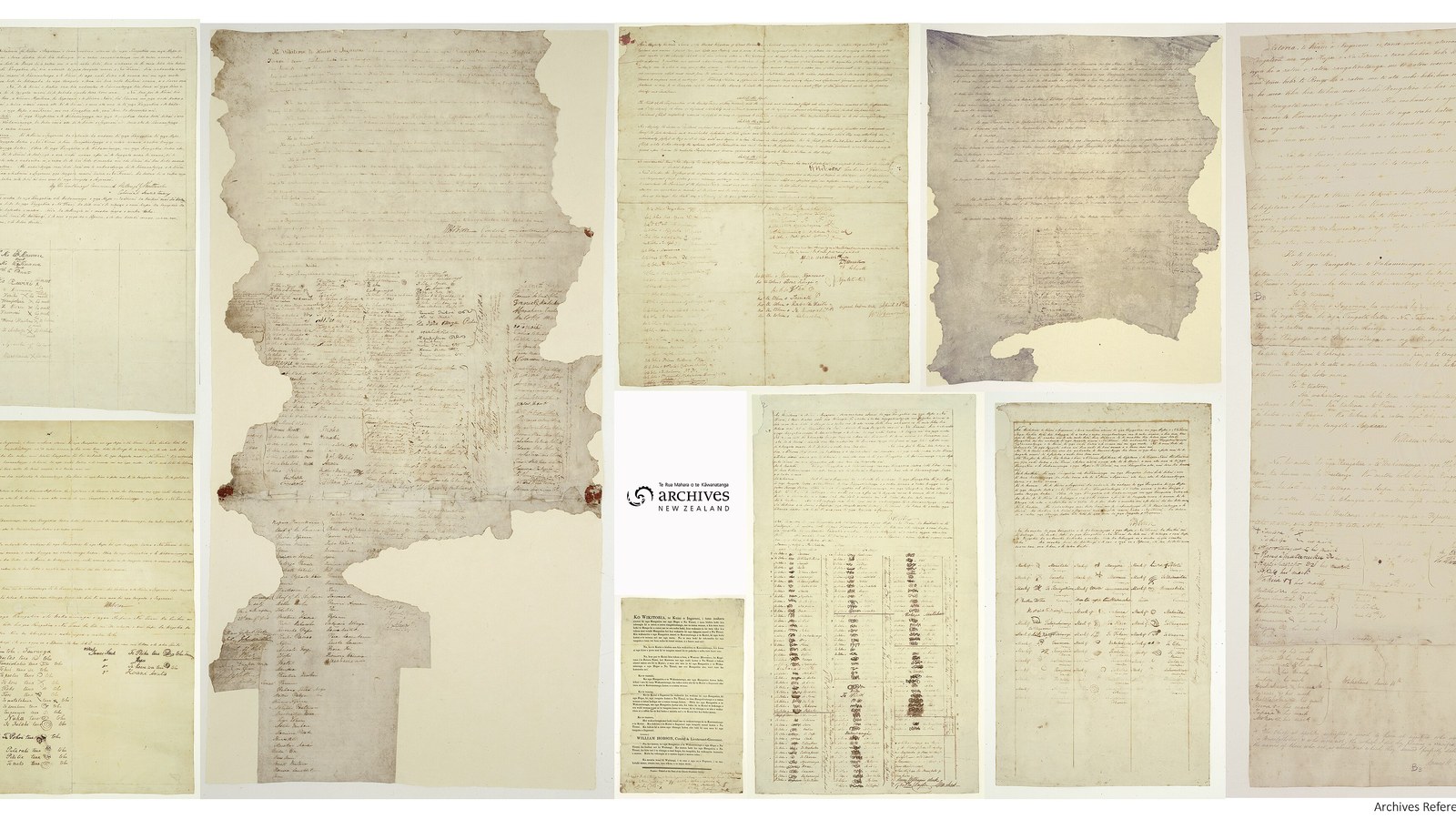
On 6 February 1840, at Waitangi in the Bay of Islands, Captain William Hobson signed Te Tiriti o Waitangi as consul for the British Crown, with northern Māori rangatira. The act is not a single sheet: Archives New Zealand holds nine documents, seven on paper and two on parchment.
The text was written in three days, with no draft from the Colonial Office. Hobson drew it up with his secretary, James Freeman, and the British Resident, James Busby. The missionary Henry Williams and his son Edward translated it into Māori overnight on 4–5 February, on the lawn of Busby’s house, later known as the Treaty House.
The next day Hobson read the English version, Williams the Māori text, and the chiefs debated for hours. The signing had been planned for 7 February. On the morning of the signing dozens of rangatira were already waiting; Hobson arrived in civilian clothes, not in uniform.
The two versions do not say the same thing. In English, article one cedes to the Crown “all the rights and powers of sovereignty.” In Māori the chiefs grant kāwanatanga, a calque of “governorship,” not a clear equivalent of sovereignty. Article two promises, in Māori, tino rangatiratanga over lands, villages and taonga; the English text speaks of full, exclusive and undisturbed possession, plus the Crown’s right of pre-emption.
Article three guarantees Māori the Queen’s protection and the rights of British subjects. In the months that followed, copies of the treaty were taken around the islands. More than 500 rangatira signed the Māori version; only 39 signed the English. At least 13 of the signatories were women. Hobson proclaimed New Zealand a British colony in May 1840.
The archives in Wellington keep the original sheets and note that Māori and Pākehā expectations diverged from the start. Nōpera Panakareao first summed it up as the “shadow of the land” going to the Queen while the “substance” stayed with Māori; he later reversed the formula.
The gap between the two texts remained the political conflict of the century. The Waitangi Tribunal, set up in 1975, is charged with reading both versions. Waitangi Day is a national holiday, not a settlement of the dispute.
Image: Archives New Zealand, Te Tiriti o Waitangi — The Treaty of Waitangi, 1840, 3 March 2016, CC BY-SA 2.0, Wikimedia Commons. Cropped to 16:9.
Source consulted: Treaty of Waitangi. Treaty text: Te Tiriti o Waitangi — Archives New Zealand.











0 Comments
No comments on this article yet. Be the first!