


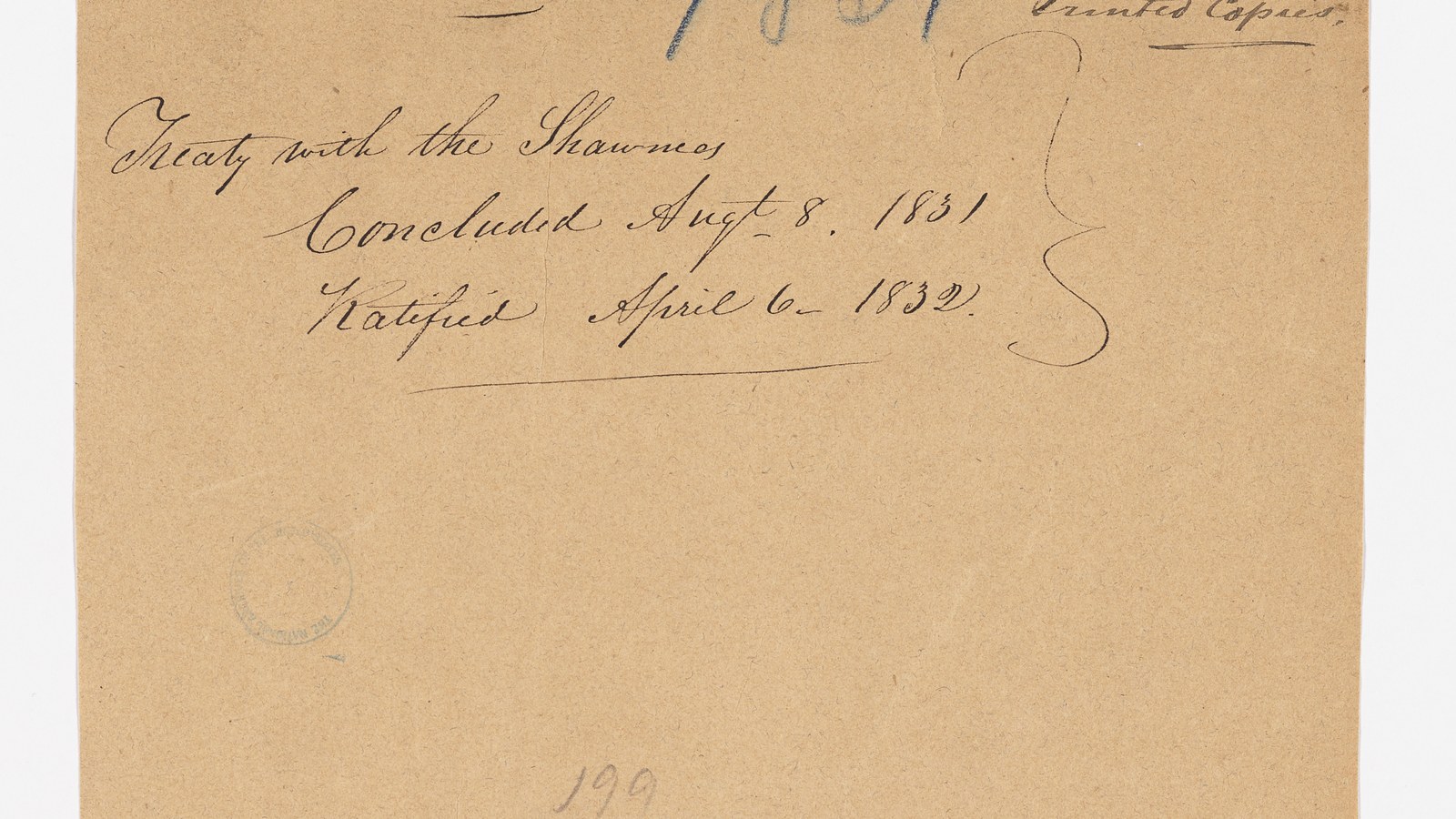
On 8 August 1831, at Wapaghkonnetta, in Allen County, Ohio, special commissioner James B. Gardiner and Indian agent John McElvain signed with the chiefs, headmen and warriors of the Shawnee residing at Wapakoneta and Hog Creek the articles of agreement. Among the signers were Lauloway (John Perry), Nolesimo (Henry Clay), Lawathtucker (John Wolf) and P. H. Thawtaw (Peter Cornstock). Joseph Parks, United States interpreter, certified that the text had been fully explained.
The preamble invokes the Act of 28 May 1830 and records that the band at Wapakoneta and Hog Creek, about four hundred souls, has expressed its assent to remove west of the Mississippi. The treaty binds when ratified by the President, with the advice and consent of the Senate. It was proclaimed on 6 April 1832.
Article I: the Shawnees cede the lands of the patent of 20 April 1821, issuing from the treaty at the foot of the Rapids of the Miami of 29 September 1817 — ten miles square centred on the council house at Wapakoneta, and twenty-five square miles at Hog Creek — plus 12,800 acres adjoining the reserve, from the treaty at St. Mary’s of 17 September 1818. In all, one hundred and forty-five sections, all the land they now own or claim in Ohio.
Article II: the United States will remove the band west of the Mississippi and grant, by patent, one hundred thousand acres, to be located by the President within the fifty-miles-square grant made to the Missouri Shawnees at Saint Louis on 7 November 1825. If good land is insufficient, the tract shall be located on contiguous or unappropriated lands designed for emigrating Indians.
Article III: the expenses of removal and a sufficiency of provisions for one year after arrival. Article IV: out of the first sales, a saw mill and a grist mill with two pair of stones and a bolting cloth, plus a blacksmith shop, solely for their use. Article V: thirteen thousand dollars in lieu of improvements, to be distributed by the chiefs in general council.
Article VII: public sale of the ceded lands; after seventy cents an acre, the cost of the mills, the shop and the advance, the balance forms a fund on which the United States pay the chiefs five per cent a year. Article X: the western lands shall not be sold except to the United States; they shall never be within the bounds of any State or Territory, nor subject to the laws thereof.
Article XIII, at the chiefs’ request, grants Joseph Parks, a quarter-blooded Shawnee, a section of 640 acres including his improvements at the old town near Wapakoneta, and reserves the price of an average section for the Shawnees on the Huron in Michigan, should they wish to follow. Article XII adds twenty-five rifle guns.
This is distinct from the Lewistown treaty of 20 July 1831 with the mixed Seneca and Shawnee, from the treaty at the foot of the Rapids of 1817, and from the Saint Louis convention of 1825. It is not the Removal Act of 28 May 1830, which the preamble invokes.
Image: NARA jacket of the treaty with the Shawnees, concluded 8 August 1831, ratified 6 April 1832; public domain, National Archives / DPLA / Wikimedia Commons. Cropped to 16:9.
Source consulted: Treaty of Wapakoneta. Treaty text: Treaty with the Shawnee, Wapaghkonnetta, 8 August 1831.











0 Comments
No comments on this article yet. Be the first!