


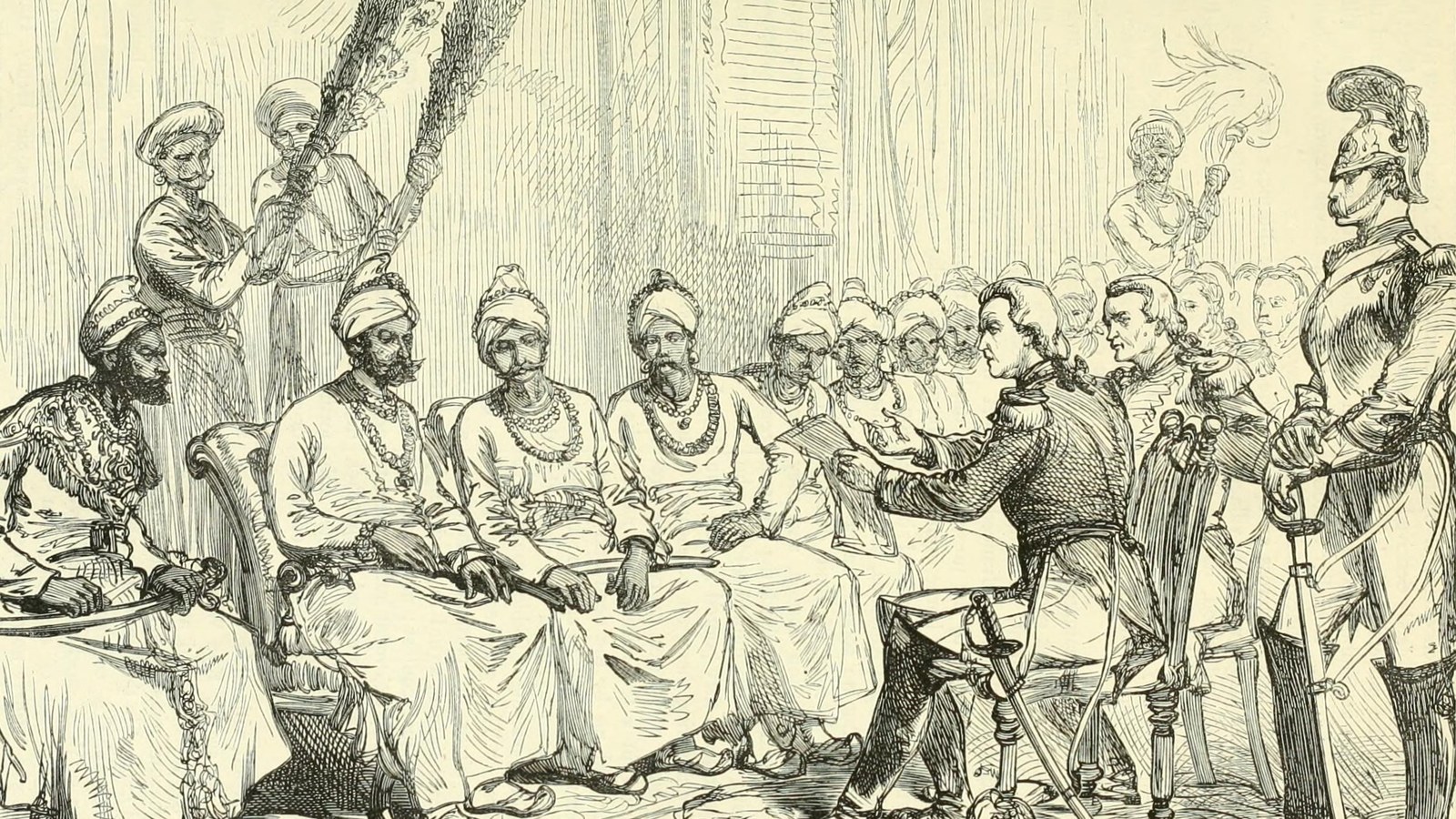
On 24 February 1826, at Yandabo in the Kingdom of Ava, the Treaty of Peace is signed between the Honourable East India Company and His Majesty the King of Ava. For the Company: Major-General Sir Archibald Campbell, commanding the expedition and senior commissioner in Pegu and Ava; Thomas Campbell Robertson, civil commissioner; Captain Henry Ducie Chads, commanding the naval force on the Irrawaddy. For the King: Mengyee Maha Men Kyan Ten, woongyee, Lord of Legaing, and Mengyee, Lord of the Revenue. Burmese date: the fourth day of the decrease of the Moon Taboung, year 1187 of the Gaudma Era. The war, opened on 5 March 1824, ends here, with the British army less than four days’ march from the capital.
Article 1: perpetual peace and friendship. Article 2: the King of Ava renounces all claims upon, and will abstain from all future interference with, the principality of Assam and its dependencies, and the contiguous petty states of Cachar and Jyntia. As to Manipur: should Ghumbheer Sing desire to return, he shall be recognised by the King of Ava as rajah thereof. Article 6: no person, native or foreign, is hereafter to be molested by either party for the part he may have taken, or have been compelled to take, in the present war.
Article 3: the British Government retains the conquered provinces of Arracan, including the four divisions of Arracan, Ramree, Cheduba and Sandoway. The King of Ava cedes all right thereto. The Unnoupectoumien or Arakan Mountains (Yeomatoung or Pokhingloung Range) form the boundary on that side. Doubts as to the line are settled by commissioners of suitable rank. Article 4: the King cedes Yeh, Tavoy, Mergui and Tenasserim, with the islands and dependencies, taking the Salween River as the line of demarcation on that frontier.
Article 5: as part indemnification for the expenses of the war, the King of Ava agrees to pay one crore of rupees. Additional article: upon payment of twenty-five lakhs, one-fourth of the sum, the army retires to Rangoon; upon a further like sum there within one hundred days, the army evacuates the King’s dominions with the least possible delay; the remaining moiety in two equal annual instalments, through the consul or resident in Ava or Pegu, from the day of signing.
Article 7: accredited ministers, retaining an escort of fifty men, reside at the durbar of the other; they may purchase or build a residence of permanent materials; a commercial treaty, upon principles of reciprocal advantage. Article 8: public and private debts contracted before the war are recognised as if hostilities had not taken place. Property of British subjects dying in the King’s dominions, without legal heirs, is placed in the hands of the British resident; likewise, property of Burmese subjects dying in the British dominions. Article 9: the King of Ava abolishes exactions upon British ships that are not required from Burmese ships in British ports; British vessels, European or Indian, entering the Rangoon River, are not required to land their guns or unship their rudders.
Article 10: His Majesty the King of Siam, the good and faithful ally of the British Government, is included in the treaty, as far as regards himself and his subjects. Article 11: ratification by the competent Burmese authorities, accompanied by all British prisoners, European, Native, American and other; the British commissioners engage that the Governor-General in Council shall ratify within four months or sooner, and that Burmese prisoners shall be delivered as they arrive from Bengal. Signed: Campbell, Largeen Meonja woonghee, Robertson, Chads, Shwagum Woon. Seal of the Lotoo.
British ratification: Fort William, Bengal, 11 April 1826, Amherst, Combermere, J. H. Harington, W. B. Bayley. The Company does not annex the whole Kingdom of Ava. The second and third Anglo-Burmese wars come later, in 1852 and 1885.
Image: C. R., negotiations for peace between the British and Burmese commissioners, c. 1879, Cassell's Illustrated History of India, public domain, Wikimedia Commons. Cropped to 16:9. An engraving of the 1825 talks, not the Yandabo signing.
Source consulted: Treaty of Yandabo. Treaty text: Aitchison, Collection of Treaties, vol. XII: Treaty of Peace at Yandaboo, 24 February 1826.











0 Comments
No comments on this article yet. Be the first!