


In Helsinki, on 24 March 1992, NATO members and former Warsaw Pact states sign the Treaty on Open Skies. Canada and Hungary are the depositaries; the authentic languages are English, French, German, Italian, Russian and Spanish. Provisional application begins at signature; entry into force follows on 1 January 2002 after Russia and Belarus complete ratification.
The treaty creates a regime of unarmed aerial observation flights over the entire territory of the parties (mainland, islands, internal and territorial waters) to build mutual confidence and verify military forces. Flights may be restricted only for flight safety, not for national security.
Eisenhower’s 1955 Geneva proposal of “mutual aerial observation” was rejected by the Soviets; George H. W. Bush revived it in 1989. Negotiations ran through Ottawa, Budapest, Vienna and Helsinki. At signature, U.S. Secretary of State James Baker and foreign ministers from 23 other countries signed the instrument.
Sensors (optical cameras, infrared, synthetic-aperture radar) must be commercially available and allow recognition of major military equipment, with resolution limited to about 30 cm. Imagery is available to any party for the cost of reproduction. Active and passive quotas govern how many flights each state may conduct or must accept.
The United States withdraws on 22 November 2020; Russia announces withdrawal in January 2021 and completes it in December 2021. About 32 parties remain, including Romania; the Consultative Commission meets monthly in Vienna alongside the OSCE.
The Treaty on Open Skies of 24 March 1992 remains the multilateral observation-flight regime that linked East and West after the Cold War, even after the recent U.S. and Russian withdrawals.
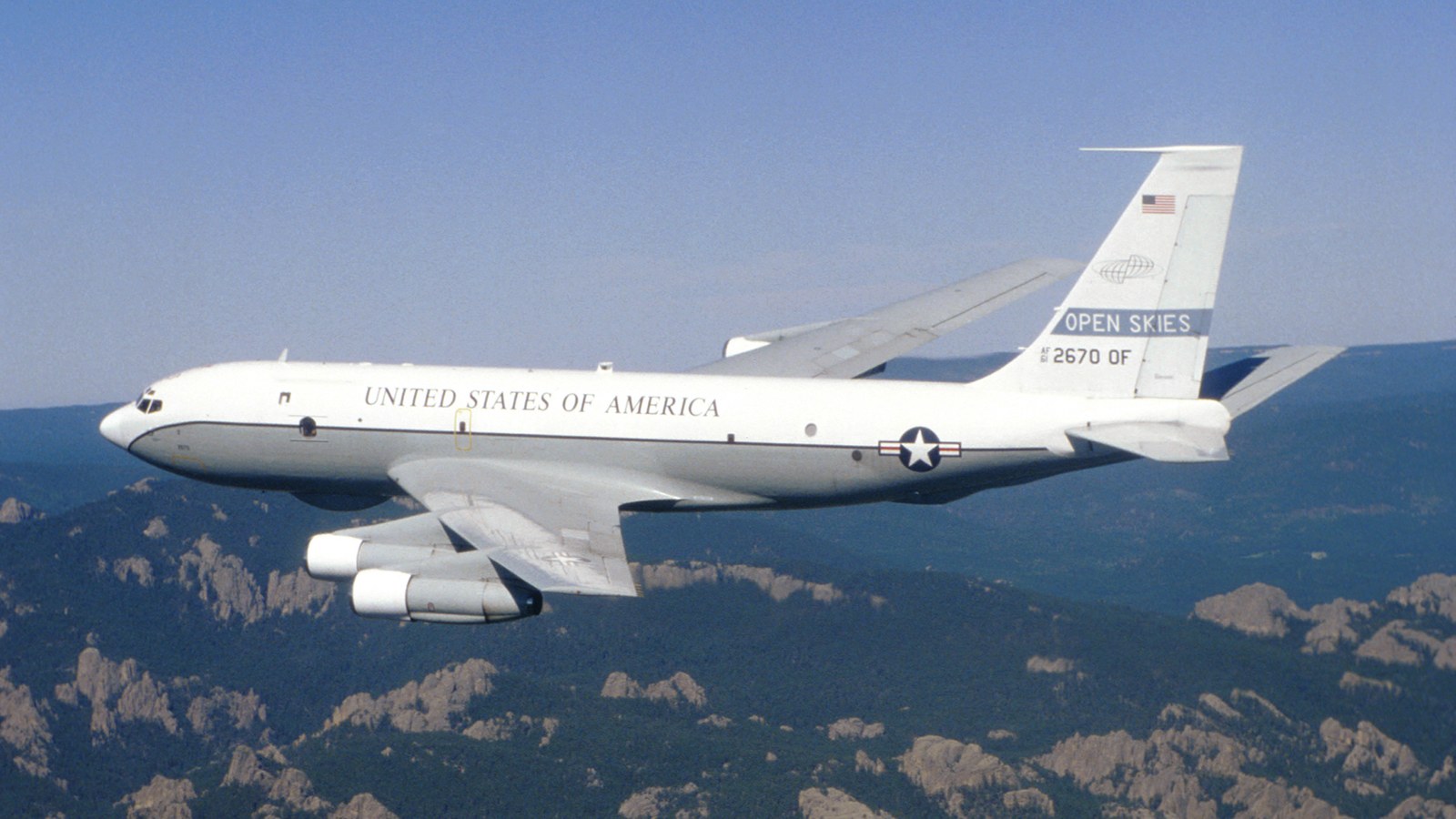
Image: Open Skies aircraft; Wikimedia Commons. Cropped to 16:9.
Source consulted: Treaty on Open Skies. Treaty text: Treaty on Open Skies (OSCE).











0 Comments
No comments on this article yet. Be the first!