


On 7 November 1962 the United Nations General Assembly adopted, by resolution 1763 A (XVII), the Convention on Consent to Marriage, Minimum Age for Marriage and Registration of Marriages. The same resolution opened the text for signature on 10 December 1962 at United Nations Headquarters in New York. Five equally authentic texts: Chinese, English, French, Russian and Spanish. It is not the 1956 Supplementary Convention on Slavery and not CEDAW of 1979.
The preamble recalls article 16 of the Universal Declaration of Human Rights — men and women of full age, without any limitation due to race, nationality or religion, have the right to marry; marriage shall be entered into only with the free and full consent of the intending spouses — and General Assembly resolution 843 (IX) of 17 December 1954. All States, including those responsible for Non-Self-Governing and Trust Territories until independence, should take appropriate measures to abolish inconsistent customs, ancient laws and practices by ensuring, inter alia, complete freedom in the choice of a spouse, eliminating child marriages and the betrothal of young girls before the age of puberty, establishing penalties where necessary, and establishing a civil or other register in which all marriages will be recorded.
Article 1: no marriage shall be legally entered into without the full and free consent of both parties, expressed by them in person after due publicity and in the presence of the authority competent to solemnize the marriage and of witnesses, as prescribed by law. Exceptionally, one party need not be present when the competent authority is satisfied that the circumstances are exceptional and that the party has, before a competent authority and as prescribed by law, expressed and not withdrawn consent. Article 2: States Parties shall take legislative action to specify a minimum age for marriage; no marriage under that age, except where a competent authority has granted a dispensation as to age, for serious reasons, in the interest of the intending spouses. The Convention does not fix a number of years. Article 3: all marriages shall be registered in an appropriate official register by the competent authority.
Article 4: open for signature until 31 December 1963 on behalf of Members of the United Nations, members of the specialized agencies, and any other State invited by the General Assembly; subject to ratification, instruments deposited with the Secretary-General. Article 5: accession for the same categories. Article 6: entry into force on the ninetieth day following deposit of the eighth instrument of ratification or accession; for later States, likewise ninety days. The United Nations Treaty Series records 9 December 1964, No. 7525, volume 521, p. 231.
Article 7: denunciation by written notification to the Secretary-General, taking effect one year later; the Convention ceases when a denunciation reduces the number of parties below eight. Article 8: disputes concerning interpretation or application which are not settled by negotiation shall, at the request of all the parties to the dispute, be referred to the International Court of Justice, unless the parties agree to another mode of settlement. Current signatory and party counts are not given here.
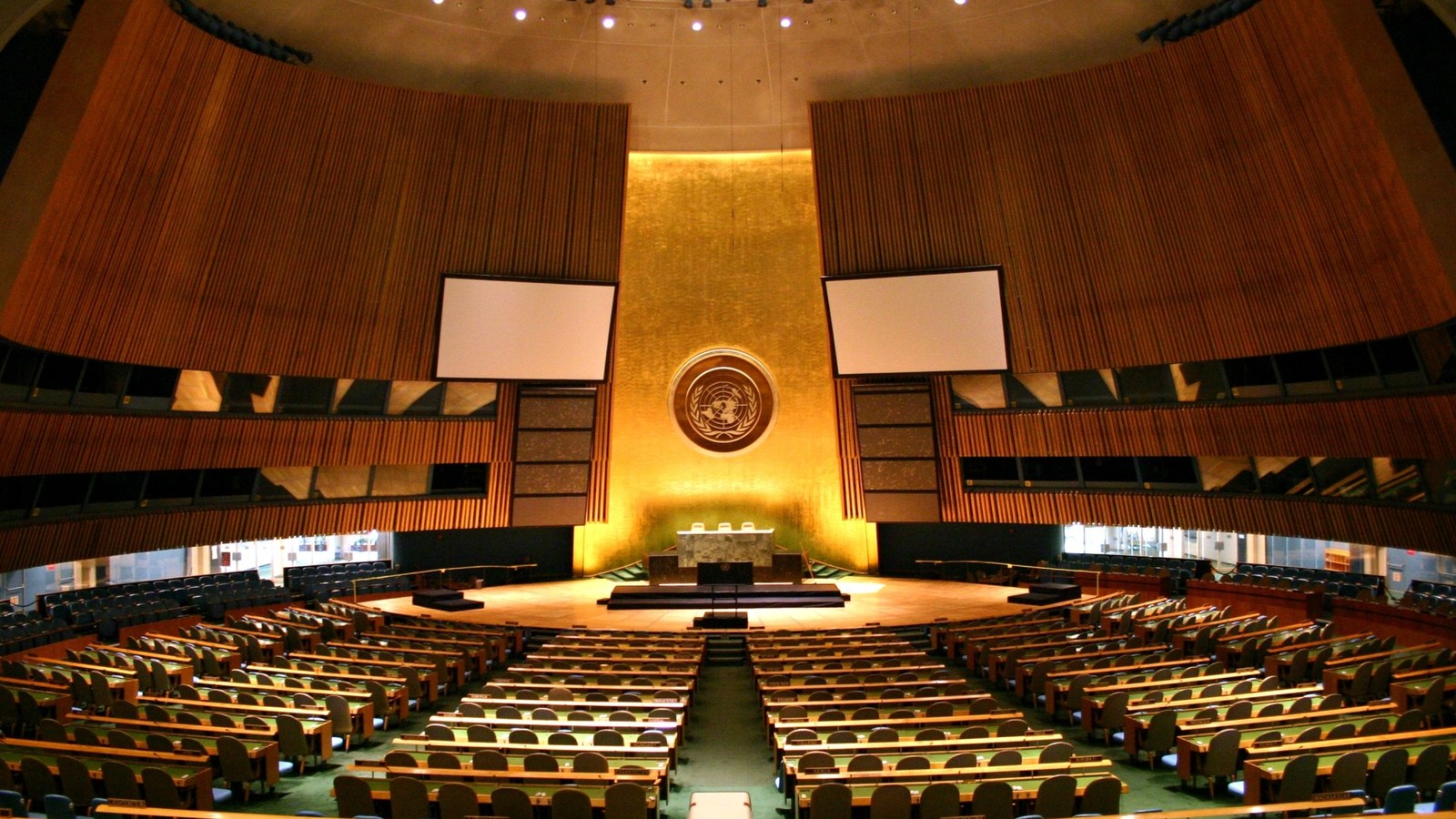
United Nations General Assembly Hall, New York. The headquarters at which signature opened, not a confirmed photograph of the 1962 sitting. Wikimedia Commons, CC BY-SA 2.0.
For context: Convention on Consent to Marriage, Minimum Age for Marriage and Registration of Marriages. The text: UNTS vol. 521, p. 231, No. 7525.











0 Comments
No comments on this article yet. Be the first!