


On 10 December 1984, in New York, the General Assembly adopted, by resolution 39/46, the Convention against Torture and Other Cruel, Inhuman or Degrading Treatment or Punishment. Authentic texts, equally authentic: Arabic, Chinese, English, French, Russian and Spanish. Depositary: the Secretary-General. 33 articles, three parts. It is not the Declaration of 9 December 1975 and not the Optional Protocol of 2002.
The preamble invokes the Charter, Article 5 of the Universal Declaration of Human Rights and Article 7 of the International Covenant on Civil and Political Rights. Article 1 defines torture: severe pain or suffering, whether physical or mental, intentionally inflicted by or with the consent or acquiescence of a public official, for purposes such as obtaining information or a confession, punishment, intimidation, coercion or any reason based on discrimination; it does not include pain arising only from, inherent in or incidental to lawful sanctions. Article 2: effective measures to prevent torture in any territory under its jurisdiction; no exceptional circumstances - war, instability, public emergency - may be invoked as justification; an order from a superior may not be invoked as a justification.
Article 3: no expulsion, return or extradition to a State where there are substantial grounds for believing the person would be in danger of being subjected to torture; the authorities shall take into account, where applicable, a consistent pattern of gross, flagrant or mass violations. Article 4: torture, attempts and complicity shall be offences, punishable by appropriate penalties. Article 5: jurisdiction over offences in territory, on board ships and aircraft, by a national, and, if the State considers it appropriate, where the victim is a national; and where the alleged offender is present and is not extradited. Articles 6-9: custody, preliminary inquiry, aut dedere aut judicare, extradition and mutual legal assistance.
Article 10: education of personnel involved in the custody, interrogation or treatment of any individual subjected to arrest, detention or imprisonment. Article 11: systematic review of interrogation rules, instructions, methods and practices. Articles 12-13: prompt and impartial investigation; a right of complaint, without retaliation. Article 14: an enforceable right to fair and adequate compensation, including rehabilitation. Article 15: any statement established to have been made as a result of torture shall not be invoked as evidence, except against a person accused of torture. Article 16: prevention of other acts of cruel, inhuman or degrading treatment or punishment which do not amount to torture as defined in Article 1.
Article 17: the Committee against Torture, ten experts, elected for four years by the States Parties, with regard to equitable geographical distribution and the usefulness of some persons having legal experience. Article 19: an initial report within one year of the Convention entering into force for the State concerned, then every four years. Article 20: if there is reliable information of a systematic practice, a confidential inquiry, including a visit with the State's agreement, unless a reservation under Article 28 has been made. Articles 21-22: inter-State communications and, optionally, individual communications, once five States have recognized the competence of the Committee.
Article 25: open for signature by all States; ratification with the Secretary-General. Article 26: accession. Article 27: enters into force on the thirtieth day after the twentieth instrument, hence 26 June 1987; for each later Party, on the thirtieth day after its own instrument. Article 28: a reservation to the inquiry competence in Article 20. Article 29: amendments, a conference if one third so requests, acceptance by two thirds. Article 30: negotiation, then arbitration; after six months, the International Court of Justice; a reservation is possible. Article 31: denunciation taking effect after one year.
Article 33: the six languages, equally authentic; the act is dated New York. It is not Article 7 of the 1966 Covenant, invoked only in the preamble, and not the first session of the Committee. Physical signatures began later at United Nations Headquarters, without changing the date of adoption.
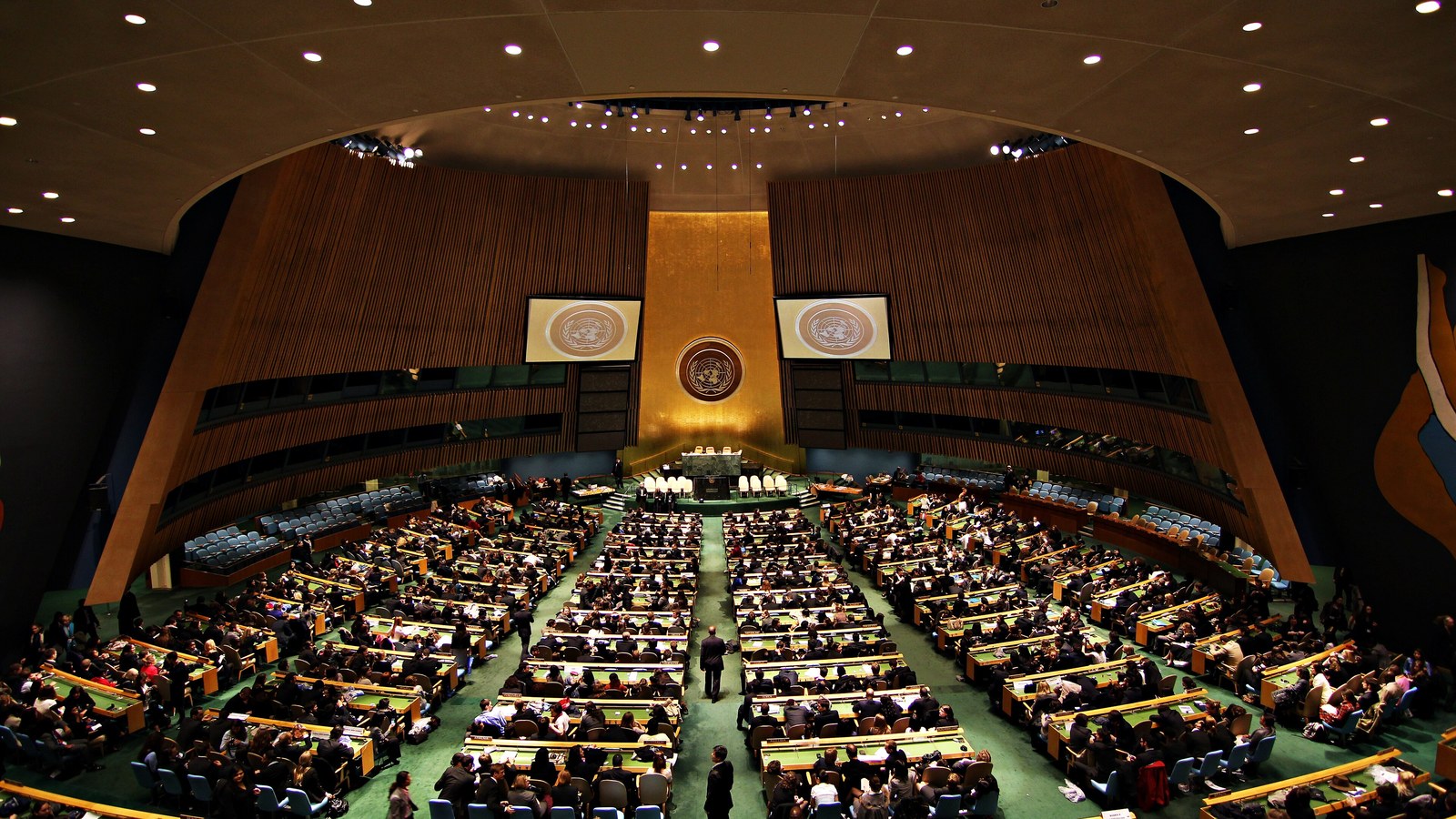
Image: General Assembly Hall, United Nations, New York; Basil D Soufi, 23 April 2011; CC BY-SA 3.0, Wikimedia Commons. Cropped to 16:9.
Source consulted: United Nations Convention Against Torture. Treaty text: Convention against Torture and Other Cruel, Inhuman or Degrading Treatment or Punishment, New York, 10 December 1984.











0 Comments
No comments on this article yet. Be the first!