


On 2 December 1922, at Bandar al-Uqair on the Najd coast, two frontier instruments were concluded. The first, later filed with the United Nations as the Agreement concerning the boundary between Nejd and Kuwait (UNTS II-1083, vol. 1750), is authentic in Arabic, with a map; it entered into force the same day. Saudi Arabia deposited it with the United Nations in December 1993. The signatures are those of Major J. C. More, British Political Agent at Kuwait, and Abdullah Sa'id (Damluji), delegated by the Sultan of Najd; Ahmad al-Jaber al-Sabah, Ruler of Kuwait, and Abdul Aziz bin Abdul Rahman Al Saud, Sultan of Najd, each agreed to the contents. Sir Percy Cox, British High Commissioner for Iraq, chaired the conference; he does not appear on this agreement. The second instrument, of the same day, is the Protocol of Uqayr, appended to the Treaty of Muhammarah of 5 May 1922, for the Iraq–Najd line.
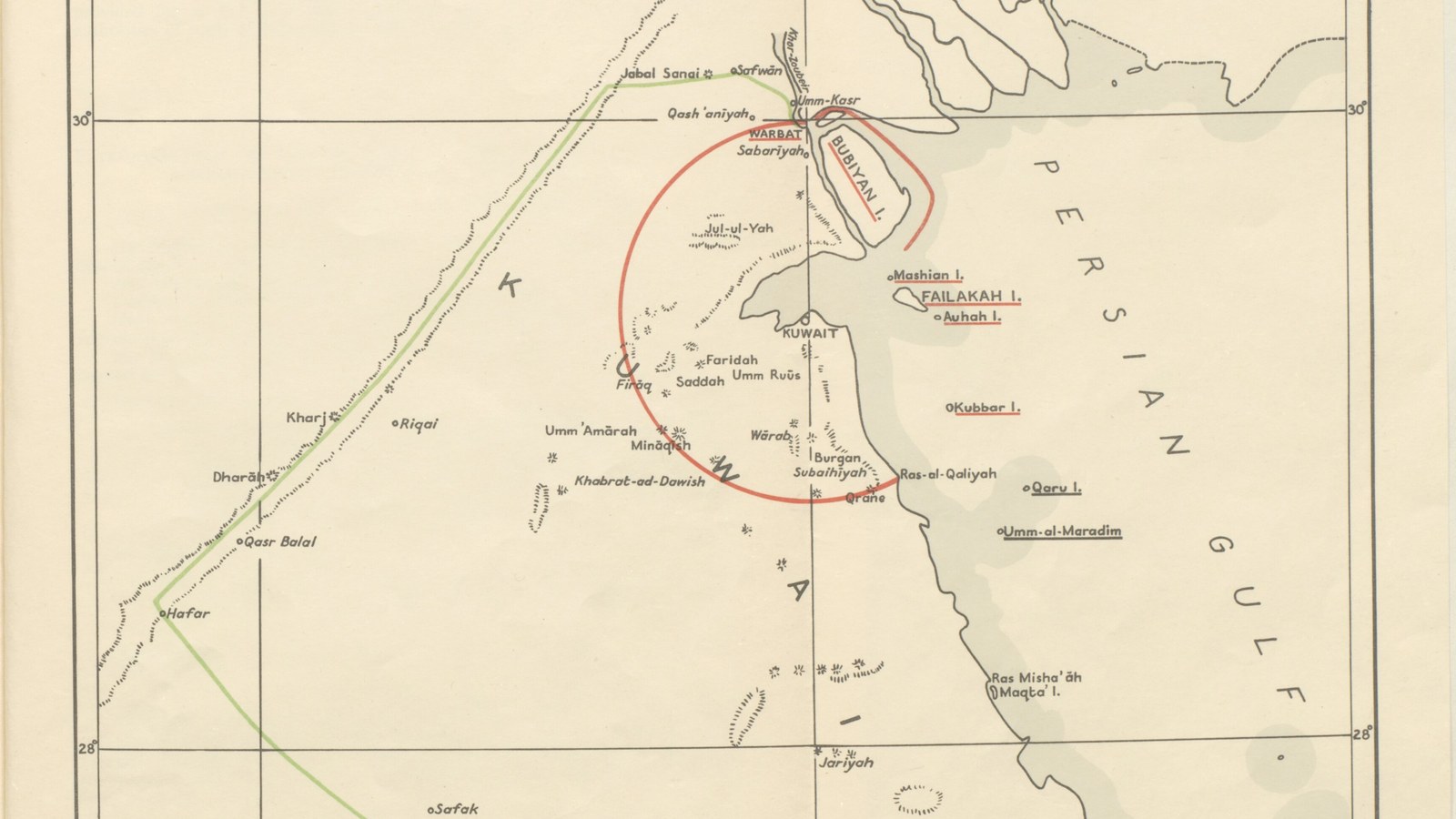
The Nejd–Kuwait frontier begins in the west from the junction of Wadi al-Awjah with Wadi al-Batin, leaving Al-Ruq'i to Nejd. From that point it continues in a straight line until it joins the 29th parallel and the red semi-circle referred to in article 5 of the Anglo-Turkish Agreement of 29 July 1913. The English body of the United Nations Treaty Series writes 1918, but the UN footnote points to the 1913 text; the contemporary British print likewise cites 1913. The line then follows the side of the red semi-circle to a point on the coast south of Ra's al-Qulay'ah: the indisputable southern boundary of the territory of Kuwait.
The portion bounded on the north by this line, on the west by barren land called Al-Shaqq, on the east by the sea and on the south by a line from Al-Shaqq to Ayn al-Abd and thence to the coast north of Ra's al-Mish'ab is shared: equal rights until a further agreement is concluded through the good offices of the British Government. The map indicated is Asia 1:1,000,000, Royal Geographical Society, War Office, 1918. The Hijri date in the instrument is 13 Rabi' II 1341.
The Iraq–Najd protocol of the same conference traces from that same Awjah–Batin junction a neutral area common to both governments, with equal rights, as far as Bir Ansab, then the state boundary to Birkat al-Jumaimah, Bir al-Uqbah, Qasr Uthaimin, Jal al-Batn, Bir Lifiyah, Bir al-Manaiyah, Jadidat Arar, Mukur and Jabal Anazan, near the intersection of 32°N and 39°E. Article 2: Iraq will not interfere with Najdi tribes using nearer Iraqi wells. Article 3: watering places near the border shall not be used for military purposes, such as building forts, nor shall troops be concentrated in their vicinity.
The 1913 British map of the limits of Kuwait, with the red semi-circle invoked by the agreement. Not the signing room at Uqair. Wikimedia Commons, public domain.
For context: Uqair Protocol of 1922. The text: UNTS, Agreement concerning the boundary between Nejd and Kuwait.











0 Comments
No comments on this article yet. Be the first!