


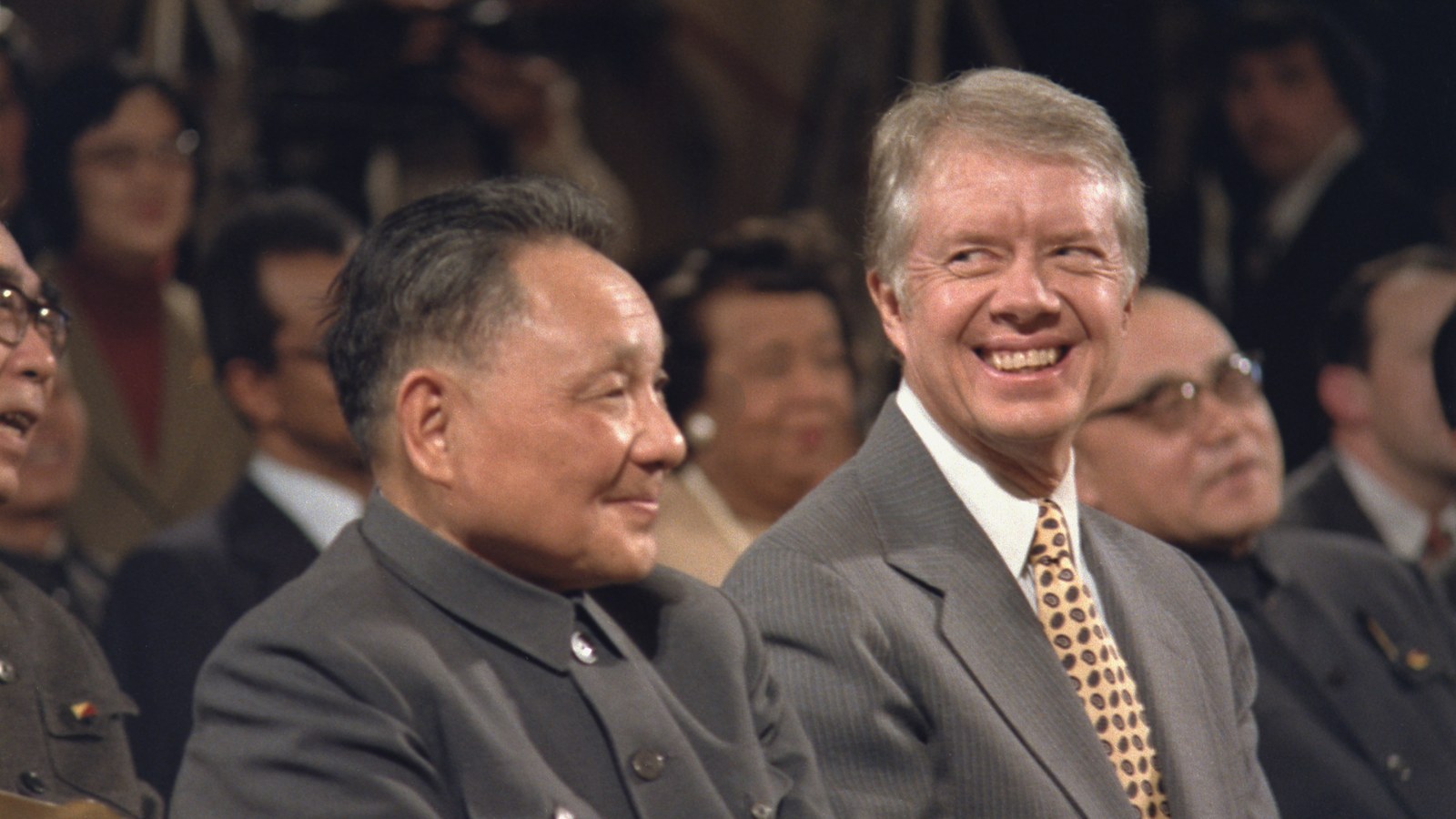
On 31 January 1979, in Washington, the Agreement between the Government of the United States of America and the Government of the People’s Republic of China on Cooperation in Science and Technology was signed. Signatories: Jimmy Carter and Deng Xiaoping. Authentic languages: English and Chinese, in duplicate. Article 11(1): it enters into force upon signature and remains in force for five years; it may be modified or extended by mutual agreement. Registered by the United States on 14 November 1979 (UNTS volume 1150, I-18102).
The preamble acts in the spirit of the Joint Communiqué on the Establishment of Diplomatic Relations of 1 January 1979. Article 1: cooperation on the basis of equality, reciprocity and mutual benefit; the principal objective is to provide broad opportunities in scientific and technological fields of mutual interest, promoting the progress of science and technology for the benefit of both countries and of mankind.
Article 2: agriculture, energy, space, health, environment, earth sciences, engineering and such other areas as may be mutually agreed, as well as educational and scholarly exchange. Article 3: exchange of scientists, scholars, specialists and students; exchange of scientific and technological information and documentation; joint planning and projects; joint research, development and testing, and exchange of results; joint courses, conferences and symposia. This is not a technical catalogue.
Article 4: the Parties shall encourage contacts between government agencies, universities and other entities, and the conclusion of implementing accords. Article 5: specific accords may cover procedures, intellectual property and funding; costs shall be borne as mutually agreed; all cooperative activities are subject to the availability of funds. Article 6: activities are subject to the laws and regulations in each country. Article 7: each Party shall use its best efforts to facilitate prompt entry and exit of equipment and personnel and access to relevant institutions, data and materials. Article 8: scientific information derived from cooperation may be made available to the world scientific community unless an implementing accord provides otherwise. Article 9: third-country or international participants may be invited upon mutual consent.
Article 10: a US-PRC Joint Commission on Scientific and Technological Cooperation, with co-chairmen, ordinarily meeting once a year alternately in each country. Executive Agents: the Office of Science and Technology Policy (United States) and the State Scientific and Technological Commission (China). The same day, Frank Press and Fang Yi exchanged letters under which the October–December 1978 understandings on students and scholars, agricultural exchange and civil space technology (including a broadcasting system and a Landsat ground station, under suitable conditions) become part of the specific accords under Article 5. Those are annexes, not the framework treaty.
Other instruments signed during the same visit (culture, high-energy physics, consular affairs) are distinct. The framework Agreement was extended repeatedly after the initial five years. Cover: Jimmy Carter and Deng Xiaoping at the signing ceremony, the White House. Wikimedia Commons, public domain (NARA).
For context: U.S.–China Agreement on Cooperation in Science and Technology. The text: Agreement on cooperation in science and technology (UNTS I-18102).











0 Comments
No comments on this article yet. Be the first!