


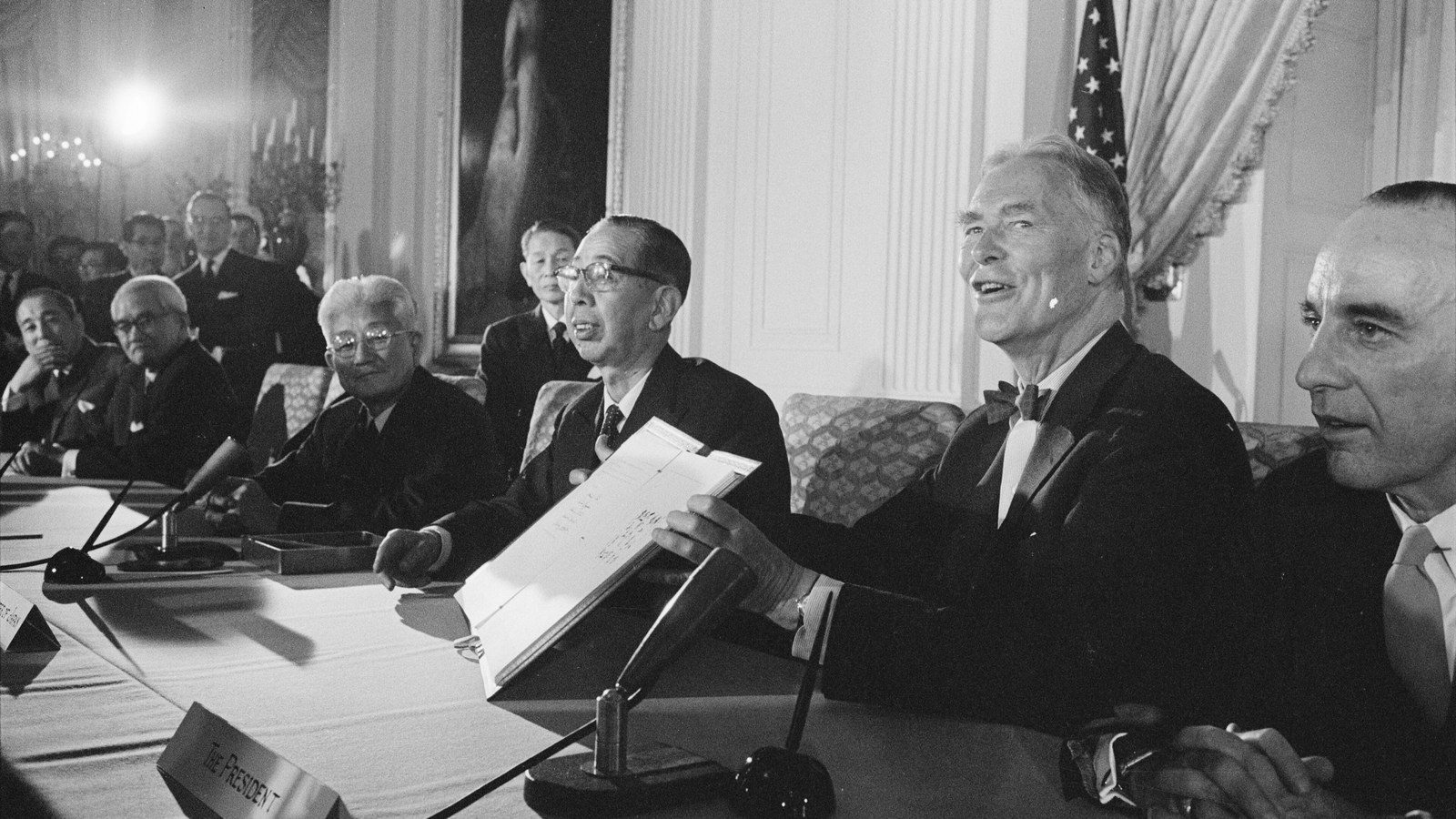
On 19 January 1960, in Washington, the plenipotentiaries of Japan and the United States signed the Treaty of Mutual Cooperation and Security. Authentic languages: Japanese and English, in duplicate. For Japan: Nobusuke Kishi, Aiichiro Fujiyama, Mitsujiro Ishii, Tadashi Adachi, Koichiro Asakai. For the United States: Christian A. Herter, Douglas MacArthur 2nd, J. Graham Parsons. Wikipedia places the ceremony in the East Room, with President Dwight D. Eisenhower present; Eisenhower does not appear among the plenipotentiaries. The treaty replaces the Security Treaty signed at San Francisco on 8 September 1951. Registered by Japan on 19 August 1960 (UNTS vol. 373, No. 5320; 11 UST 1632; TIAS 4509).
Article I: the Parties undertake, as set forth in the Charter of the United Nations, to settle disputes by peaceful means and to refrain from the threat or use of force. Article II: further development of peaceful and friendly relations, free institutions, and economic collaboration. Article III: by continuous and effective self-help and mutual aid, subject to their constitutional provisions, they will maintain and develop their capacities to resist armed attack. Article IV: consultation on implementation and, at the request of either Party, whenever the security of Japan or international peace and security in the Far East is threatened.
Article V: an armed attack against either Party in the territories under the administration of Japan is recognized as dangerous to the other Party’s own peace and safety; each declares that it would act to meet the common danger in accordance with its constitutional provisions and processes. Any such attack and all measures taken as a result shall be immediately reported to the Security Council under Article 51 of the Charter, and shall be terminated when the Council has taken the measures necessary. This is not an operations handbook.
Article VI: the United States is granted the use by its land, air and naval forces of facilities and areas in Japan, for the purpose of contributing to the security of Japan and to the maintenance of international peace and security in the Far East. The use of those facilities and the status of United States armed forces are to be governed by a separate agreement replacing the Administrative Agreement signed at Tokyo on 28 February 1952; that status-of-forces instrument is a distinct treaty, signed the same day. Article VII: this Treaty does not affect the Parties’ rights and obligations under the Charter.
Article VIII: ratification in accordance with constitutional processes; the Treaty enters into force on the date the instruments of ratification are exchanged in Tokyo. Article IX: the 1951 Security Treaty expires upon this Treaty’s entry into force. Article X: it remains in force until, in the opinion of the two Governments, United Nations arrangements satisfactorily provide for peace and security in the Japan area; after ten years either Party may give notice of intention to terminate, with effect one year later. The Tokyo exchange took place on 23 June 1960.
The Lower House of the Diet voted the treaty on 19 May; under Japanese procedure it was treated as approved thirty days later. Ratification provoked mass protests in Japan (Anpo). Eisenhower’s planned visit was cancelled. Agreed minutes provide for consultation with the Japanese government before major changes in U.S. force deployment in Japan or the use of bases for combat operations other than in defence of Japan; they are not reproduced here as a basing handbook.
Secretary of State Christian Herter, to the left of Nobusuke Kishi, with the signed treaty, East Room, White House. Wikimedia Commons, public domain (Marion S. Trikosko).
For context: Treaty of Mutual Cooperation and Security between the United States and Japan. The text: Treaty of Mutual Cooperation and Security between Japan and the United States of America.











0 Comments
No comments on this article yet. Be the first!