


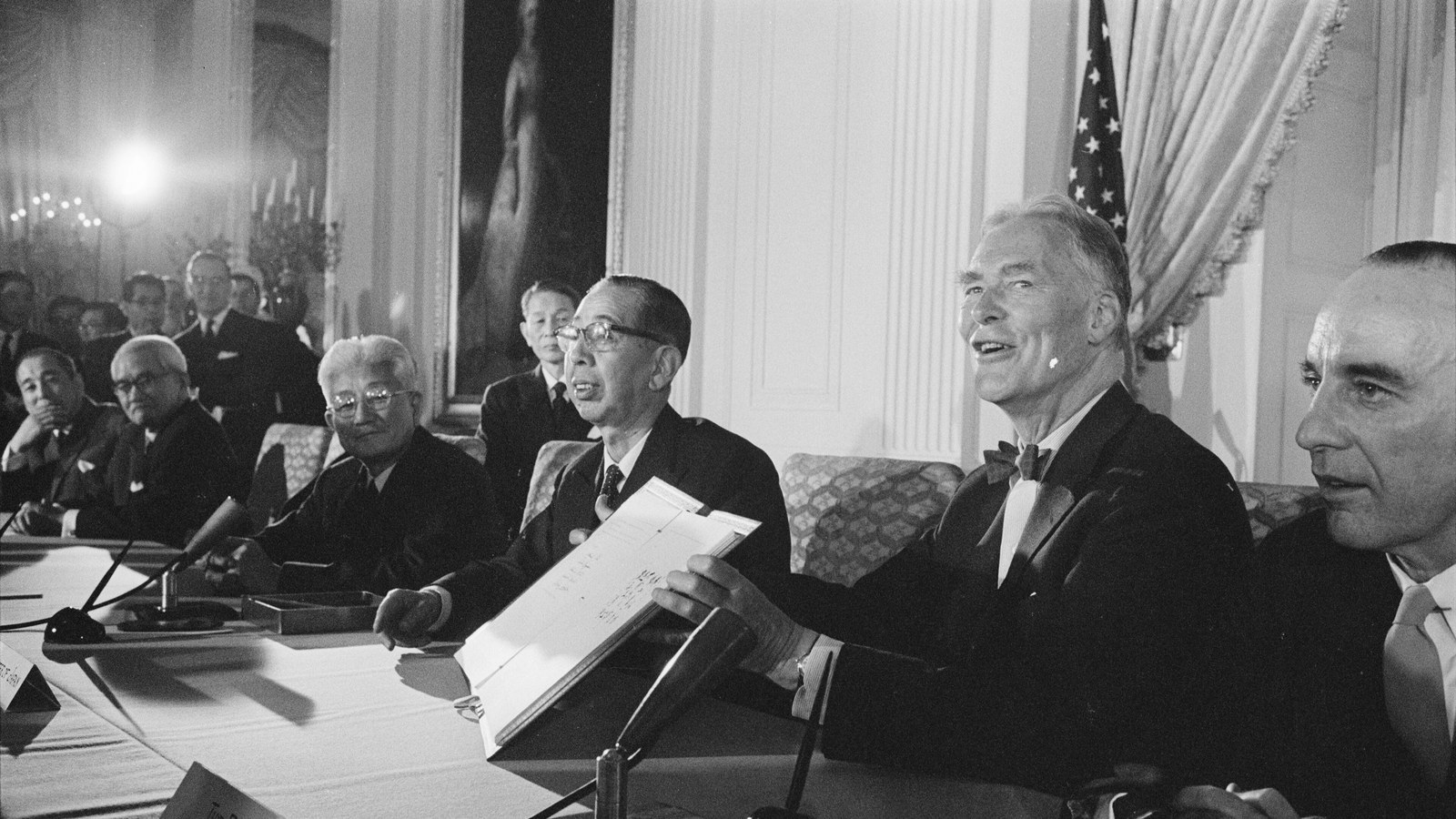
At Washington, Japan and the United States of America conclude on 19 January 1960 the Agreement under Article VI of the Treaty of Mutual Cooperation and Security regarding facilities and areas and the status of United States armed forces in Japan. For Japan the signatories are Nobusuke Kishi, Aiichiro Fujiyama, Mitsujiro Ishii, Tadashi Adachi and Koichiro Asakai; for the United States, Christian A. Herter, Douglas MacArthur II and J. Graham Parsons. It is done in duplicate in the Japanese and English languages, both texts equally authentic. It is entered into pursuant to Article VI of the Treaty of Mutual Cooperation and Security signed the same day at Washington.
Article I defines members of the United States armed forces as personnel on active duty belonging to the land, sea or air armed services of the United States when in the territory of Japan; the civilian component as civilian persons of United States nationality employed by, serving with or accompanying those forces in Japan, excluding persons ordinarily resident in Japan and persons mentioned in Article XIV; and dependents as the spouse and children under 21, and parents and children over 21 if dependent for over half their support. Article II grants the United States the use of facilities and areas in Japan; agreements as to specific facilities and areas shall be concluded through the Joint Committee provided for in Article XXV. Facilities in use at the expiration of the earlier Administrative Agreement shall be considered as agreed. They shall be returned whenever no longer needed; interim use by Japanese nationals requires Joint Committee agreement. Article III allows the United States, within the facilities and areas, all measures necessary for establishment, operation, safeguarding and control, without unnecessarily interfering with navigation, aviation, communication or land travel.
Article IV provides that the United States is not obliged, on return of facilities, to restore them to the condition in which they became available, and Japan is not obliged to compensate for improvements left thereon. Article V accords United States and foreign vessels and aircraft operated for official purposes access to any port or airport of Japan free from toll or landing charges, and military vehicles access between facilities free from toll. Articles VI to VIII require close coordination of air traffic control, the use of Japanese public utilities on conditions no less favorable than those applicable to Japanese ministries, and meteorological services including seismographic data. Article IX allows the United States to bring in members of the armed forces, the civilian component and their dependents: members of the armed forces are exempt from Japanese passport and visa laws, and all are exempt from alien registration, without acquiring any right to permanent residence. Article X requires Japan to accept United States driving permits without a test or fee, and privately owned vehicles to carry Japanese number plates.
Article XI leaves members of the forces, the civilian component and dependents subject to Japanese customs laws save as provided; materials imported for official use enter free of customs duties and shall not be disposed of in Japan to persons not entitled to such importation. Article XII allows the United States to contract for supplies and construction in Japan, exempts official procurement from specified Japanese taxes, and leaves income tax, social-security contributions and conditions of employment of local labor to the legislation of Japan; members of the civilian component shall not be subject to Japanese laws on terms and conditions of employment. Article XIII exempts the forces from taxes on property held, used or transferred by them, and exempts service income, but not income derived from Japanese sources. Article XIV governs designated contractors; Japanese authorities have the primary right to exercise jurisdiction over them for offenses committed in Japan and punishable by Japanese law. Article XV authorizes Navy exchanges, post exchanges, messes, clubs, theaters, newspapers and other non-appropriated fund organizations within the facilities, not subject to Japanese regulations, license, fees or taxes, except as to newspapers sold to the general public.
Article XVI makes it the duty of members of the United States armed forces, the civilian component and their dependents to respect the law of Japan and to abstain from any activity inconsistent with the spirit of this Agreement, and in particular from any political activity in Japan. Article XVII gives the military authorities of the United States the right to exercise within Japan criminal and disciplinary jurisdiction conferred on them by United States law over persons subject to United States military law, and gives the authorities of Japan jurisdiction over members of the forces, the civilian component and dependents for offenses committed within Japan and punishable by the law of Japan. Exclusive jurisdiction belongs to the United States for offenses punishable by United States law but not by Japanese law, and to Japan for offenses punishable by Japanese law but not by United States law. Where jurisdiction is concurrent, the United States has the primary right for offenses solely against the property or security of the United States, solely against the person or property of another member of the forces, civilian component or a dependent, and for offenses arising out of any act or omission done in the performance of official duty; in any other offense Japan has the primary right. The State having the primary right shall give sympathetic consideration to a request for waiver. Custody of an accused member of the forces or civilian component over whom Japan is to exercise jurisdiction shall, if he is in the hands of the United States, remain with the United States until he is charged by Japan. A death sentence shall not be carried out in Japan by the United States military authorities if the legislation of Japan does not provide for such punishment in a similar case. A person tried by one State shall not be tried again for the same offense by the other, without prejudice to trial for a violation of rules of discipline. In the event of hostilities to which Article V of the Treaty of Mutual Cooperation and Security applies, either Government may suspend this Article by giving sixty days notice.
Article XVIII provides that each Party waives claims against the other for damage to defense-service property caused in official duty, sets a regime of liability and compensation for other property and for third-party claims, and allows certain contract disputes to be submitted to the Joint Committee for conciliation. Article XIX subjects the persons concerned to Japanese foreign-exchange controls, without precluding transmission of official United States dollar funds. Article XX permits United States military payment certificates for internal transactions within the facilities. Article XXI allows United States military post offices. Article XXII allows enrollment and training of eligible United States citizens residing in Japan in reserve organizations. Article XXIII requires cooperation to ensure the security of the forces, their members, the civilian component, dependents and their property; Japan agrees to seek such legislation as may be necessary to protect United States installations, equipment, records and official information.
Article XXIV agrees that the United States will bear, without cost to Japan, all expenditures incident to the maintenance of the United States armed forces in Japan except those to be borne by Japan: Japan will furnish without cost to the United States all facilities and areas and rights of way, including jointly used facilities, as provided in Articles II and III. Article XXV establishes a Joint Committee, composed of a representative of each Government, as the means for consultation on implementation, in particular to determine the facilities and areas required; if unable to resolve a matter, it shall refer it to the respective Governments. Article XXVI requires approval in accordance with legal procedures and an exchange of notes; the Agreement will enter into force on the date of coming into force of the Treaty of Mutual Cooperation and Security, at which time the earlier Administrative Agreement, as amended, shall expire. Article XXVII allows either Government at any time to request revision of any Article. Article XXVIII keeps the Agreement in force while the Treaty of Mutual Cooperation and Security remains in force unless earlier terminated by agreement. This text is not the Treaty of Mutual Cooperation and Security signed the same day.
Image: Secretary of State Christian Herter and Prime Minister Nobusuke Kishi with the signed Treaty of Mutual Cooperation and Security, East Room, White House, 19 January 1960; Marion S. Trikosko, Library of Congress; public domain, Wikimedia Commons. Cropped to 16:9.
Source consulted: U.S.-Japan Status of Forces Agreement. Treaty text: Agreement under Article VI of the Treaty of Mutual Co-operation and Security, UNTS vol. 373, No. 5321.











0 Comments
No comments on this article yet. Be the first!