


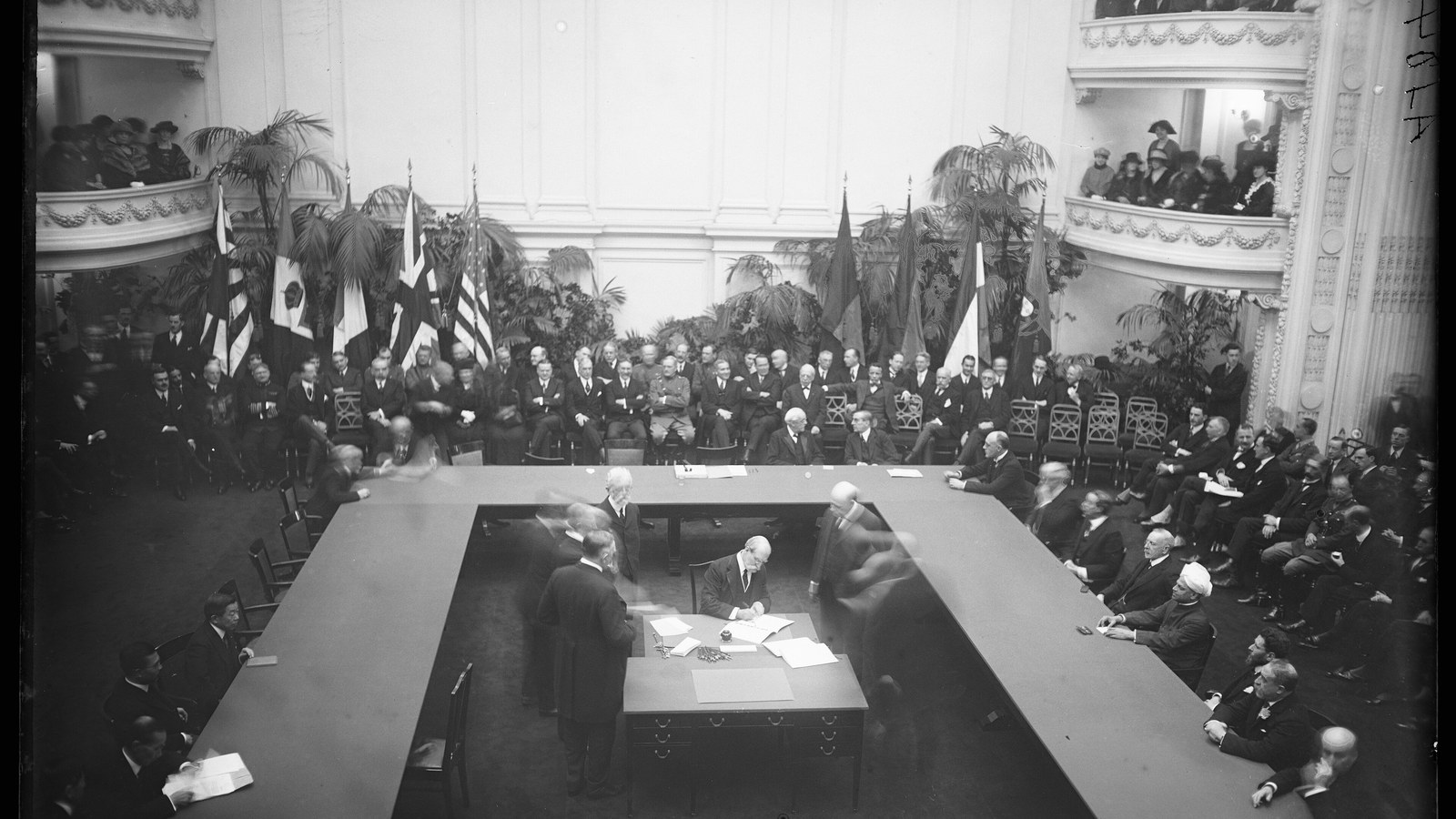
On 6 February 1922, at Washington, the United States, the British Empire, France, Italy and Japan signed the Treaty for the Limitation of Naval Armament — the Five-Power Treaty. Authentic texts: French and English. Article 24: the original remains in the archives of the Government of the United States, which transmits certified copies; ratifications are deposited at Washington. Plenipotentiaries included Charles Evans Hughes, Henry Cabot Lodge, Oscar W. Underwood and Elihu Root; Arthur James Balfour, Lee of Fareham and Auckland Geddes, with Robert Borden, George Foster Pearce, John Salmond and V. S. Srinivasa Sastri for the Dominions and India; Albert Sarraut and Jules Jusserand; Carlo Schanzer, Vittorio Rolandi Ricci and Luigi Albertini; Tomosaburo Kato, Kijuro Shidehara and Masanao Hanihara.
The Conference on the Limitation of Armament opened on 12 November 1921. Article 1: the Contracting Powers limit their naval armament as provided in the Treaty. Article 3: capital-ship building programmes are abandoned except replacement tonnage. The Four-Power Treaty of 13 December 1921 and the Nine-Power Treaty, signed the same day as this instrument, are distinct.
Article 4: total capital-ship replacement tonnage, standard displacement — United States 525,000 tons, British Empire 525,000, Japan 315,000, France 175,000, Italy 175,000. Article 5: no capital ship above 35,000 tons. Article 6: capital-ship guns not to exceed 16 inches (406 millimetres). This is not a naval-construction handbook.
Article 7: aircraft-carrier tonnage — 135,000 tons for the United States and the British Empire, 81,000 for Japan, 60,000 for France and Italy. Article 11: other vessels of war, other than capital ships and aircraft carriers, shall not exceed 10,000 tons. Article 19: the United States, the British Empire and Japan maintain the status quo of fortifications and naval bases in the specified Pacific insular possessions; no new bases. This article does not map those possessions operationally.
Article 24: the Treaty takes effect on the deposit of all ratifications. Proces-verbal: 17 August 1923, at the Department of State. Registered in the League of Nations Treaty Series, volume 25, on 16 April 1924. Article 23: remains in force until 31 December 1936; two years notice of termination, given to the Government of the United States, ends the Treaty for all Contracting Powers. Japan gave notice on 29 December 1934. The London Naval Treaty of 1930 is a separate instrument.
Wikipedia sometimes names the League of Nations as depositary; Article 24 places the original in the archives of the United States. The heads of state in the infobox are not the signatories on the instrument: the plenipotentiaries named above signed.
Cover: the Conference on the Limitation of Armament in Washington — the plenary hall, not claimed as the signing table. Wikimedia Commons, free licence.
For context: Washington Naval Treaty. The text: Treaty for the Limitation of Naval Armament (Treaty Series No. 5, 1924).











0 Comments
No comments on this article yet. Be the first!