


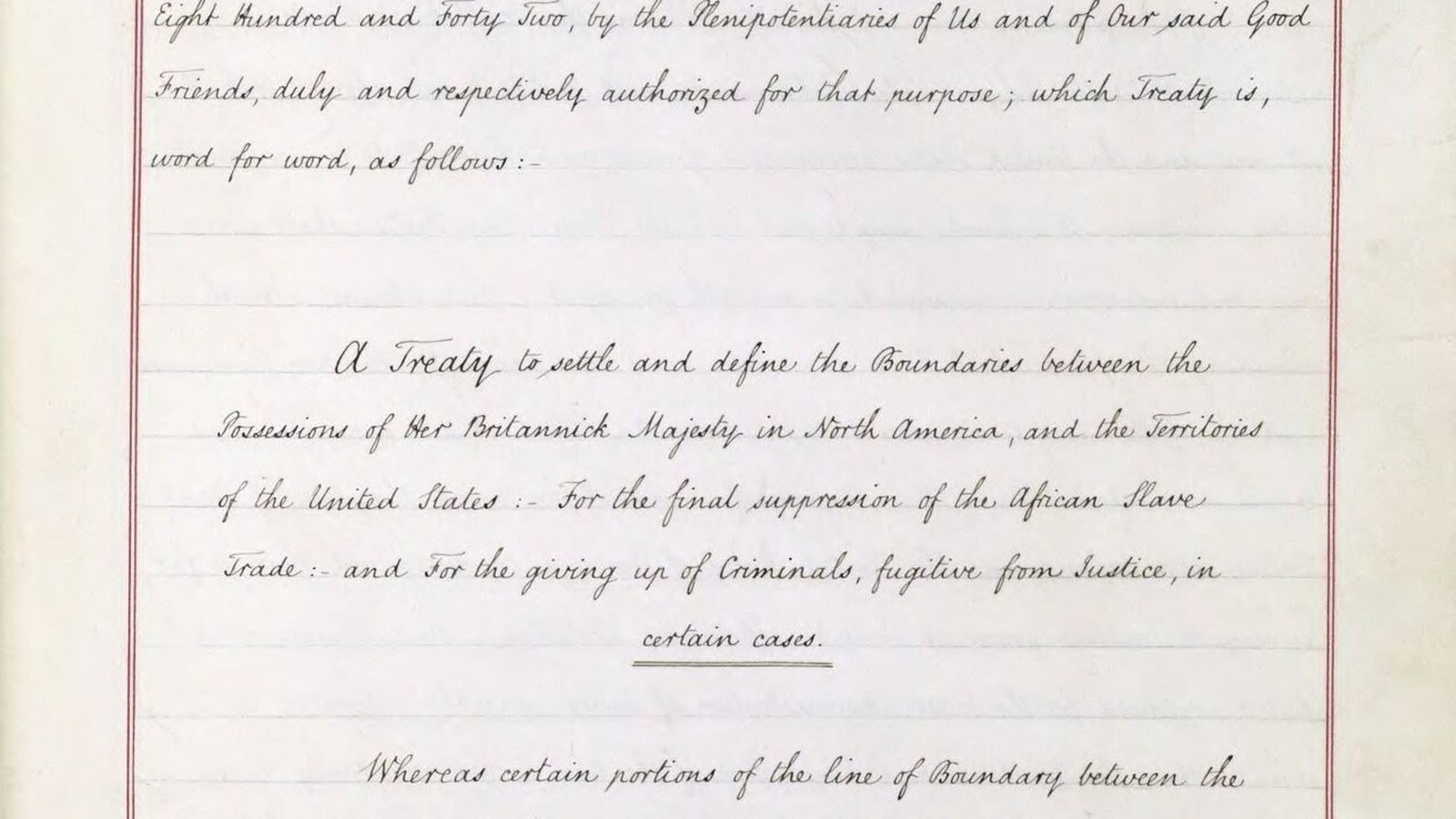
In Washington, Secretary of State Daniel Webster and Alexander Baring, 1st Baron Ashburton, sign a treaty that draws unsettled stretches of the boundary, joins naval patrols against the transatlantic slave trade, and provides for extradition in seven offences. The plenipotentiaries hold full powers from President John Tyler and from Queen Victoria; the instrument is dated 9 August 1842. It is not the Anglo-American convention of 1818, and it is not the Oregon treaty of 1846.
The preamble records that Article 2 of the 1783 peace still left parts of the line unascertained, despite repeated attempts, including the Dutch arbitration of 1831, which did not bind the parties. Rather than argue abstract rights any further, the two governments agree a conventional line, with equivalents. They also take up again Article 10 of the Treaty of Ghent of 24 December 1814, by which they had pledged to continue efforts to abolish the slave traffic.
Article I starts at the monument at the source of the St Croix, marked by the Jay Treaty commissioners of 1794, follows the 1817–1818 exploring line to the St John, takes the middle of the channel to the St Francis and to the outlet of Lake Pohenagamook, then a straight line to a point on the northwest branch of the St John ten miles from the main branch, with a seven-mile reserve from the crest that divides St Lawrence waters from those of the St John. The line meets latitude 46°25′ north on the southwest branch, climbs to the Metjarmette Portage, descends Hall’s Stream to the old Valentine and Collins survey, understood as the 45th parallel, and follows that line west to the St Lawrence. Indian Stream thus falls to the United States; the Halifax–Québec winter road remains British.
Article II resumes the Ghent commissioners’ work in the Neebish Channel, rounds Sugar Island, which it assigns to the United States, passes north of Isle Royale, ascends the Pigeon River through the Fowl Lakes to the height of land between Superior and the Lake of the Woods, continues through Lac la Croix, Rainy Lake and Chaudière Falls, and reaches the most northwestern point of the Lake of the Woods, 49°23′55″ north and 95°14′38″ west of Greenwich. From there, according to existing treaties, the line runs due south to the 49th parallel and along that parallel to the Rocky Mountains. The usual portages, including Grand Portage, remain free to citizens and subjects of both countries. Oregon stays outside the text.
Article III opens the St John to logs, lumber and unmanufactured farm produce from Maine, treated in New Brunswick as local produce, with a matching right for inhabitants of the upper St John now British. Article IV confirms earlier grants and six-year possessory claims. Article V turns over to the United States, for Maine and Massachusetts, their share of New Brunswick’s Disputed Territory Fund and adds three hundred thousand dollars, in equal moieties, as the price of the two states’ assent. Article VI names two commissioners, one from each side, to meet at Bangor, Maine, on 1 May next, to mark the line on the ground.
Article VII declares equally free the St Lawrence channels on both sides of the Long Sault Islands and Barnhart Island, the Detroit channels around Bois Blanc Island, and the passages at the junction of the St Clair River with the lake of that name. It is equal access on those channels, not a partition of the Great Lakes.
Article VIII binds each party to keep on the African coast a squadron of not fewer than eighty guns, independent, but under orders to act in concert. Article IX requires joint representations to close slave markets. Article X provides for extradition, on evidence that would justify committal where the fugitive is found, for murder, assault with intent to murder, piracy, arson, robbery, forgery and the utterance of forged paper; slave revolt is not listed. Article XI keeps Article VIII in force for five years from the exchange of ratifications, then until notice, and Article X until notice. Article XII requires the exchange of ratifications in London within six months.
The United States Senate gives advice and consent on 20 August, the American ratification follows on 22 August, the British ratification in October, and the exchange takes place in London on 15 October 1842; the proclamation is dated 10 November. The signatures on the instrument read “DAN WEBSTER” and “ASHBURTON”. The notes exchanged the same day in Washington, printed with the text, do not alter the twelve articles.
Image: scan of the Webster–Ashburton Treaty, 9 August 1842; public domain, DOCSTeach / Wikimedia Commons. Cropped to 16:9.
Source consulted: Webster–Ashburton Treaty. Treaty text: The Webster-Ashburton Treaty, Washington, 9 August 1842.











0 Comments
No comments on this article yet. Be the first!