
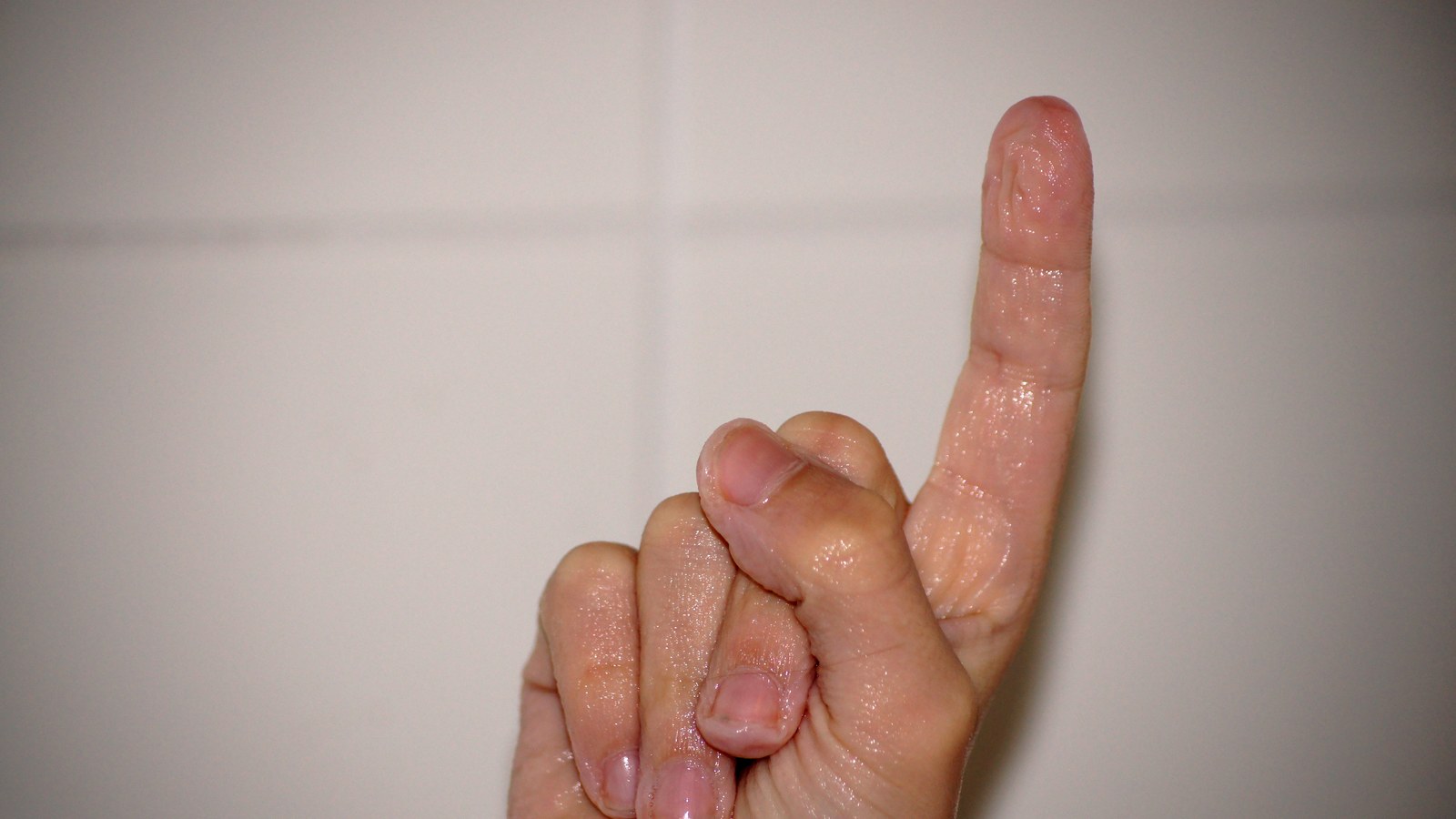
After a few minutes in water, fingers develop regular grooves, not chaotic swelling. Water uptake in the outer layer contributes, but it cannot by itself explain the pattern. Immersion triggers a sympathetic-nerve response: vessels in the fingertip pulp narrow, volume beneath the skin falls, and the surface forms ridges.
When certain nerve pathways are damaged, wrinkling may weaken or vanish. The reaction has therefore been used as a clue to autonomic function, though it is not a diagnosis on its own.
One hypothesis says the grooves shed water like tyre treads. A 2013 experiment found wrinkled fingers moved wet objects faster, but not dry ones. Other work does not always reproduce the benefit, so the evolutionary account remains open.
Hands and feet react more clearly because hairless skin there is specialised for contact. Timing varies with temperature, water composition and the person. After leaving the water, vessels recover and the ridges fade.
The normal response is temporary. Persistent or painful changes, especially with other symptoms, need medical assessment; causes may have nothing to do with a bath.
So “prune fingers” are a neural and vascular response, not merely waterlogged skin.
Image: Sebastian Wallroth, wrinkled fingers. Wikimedia Commons, CC BY 3.0. Cropped to 16:9. Licence. Original file.
Sources consulted: Biology Letters — Water-induced finger wrinkles improve handling of wet objects; PubMed — Skin wrinkling on immersion of hands.







0 Comments
No comments on this article yet. Be the first!