


World Vision published the fifth Price Shocks report. El País carried, on 15 October, the comparison of a ten-item staple basket with average income across 62 countries. The Spanish headline spoke of 12 hours in Ireland. The article body and the report put Ireland at 1.2 hours. The correction matters: the gap is tenfold.
The basket is the same everywhere: a kilogram of bananas, rice, flour, sugar, maize, a dozen eggs, a litre of oil, a raw chicken, a kilogram of tomatoes and a litre of milk. Staff and volunteers collected prices from November 2025 to May 2026 in markets and shops. The cost was converted to dollars, then to purchasing-power parity, and set against gross national income per capita. The result is hours of work needed to buy the basket, not a shop price from October.
The average, for countries with complete data, is 34.3 hours, more than four working days, down from 4.9 days in 2024. In the Central African Republic the report puts about 30 days, almost 241 hours. Finland is at 1.7 hours, Malawi at 20.4 days. Romania appears at 4.5 hours, beside Zambia at 8.5 days. The United States is also at 1.2 hours. These are affordability readings, not shopping advice.
In 33 of 47 countries with a comparable series the basket rose, by 28.3% on average. Zimbabwe is listed at plus 123%, Malawi at plus 112%. Fifty-six countries entered the hours-of-work analysis. Japan and Mauritania had incomplete baskets, missing maize. Afghanistan, South Sudan, Syria and Venezuela lacked GNI data.
Paul Kinuthia, World Vision’s senior director for food, cash and markets, ties the result to pressure on children when staples eat the whole income. The report does not tell a government what to do. It says how long an average income works to fill the same bag.
The method smooths differences inside a country. A low wage and a high wage do not buy the basket in the same number of hours. The figure is an indicator, not the reader’s fridge.
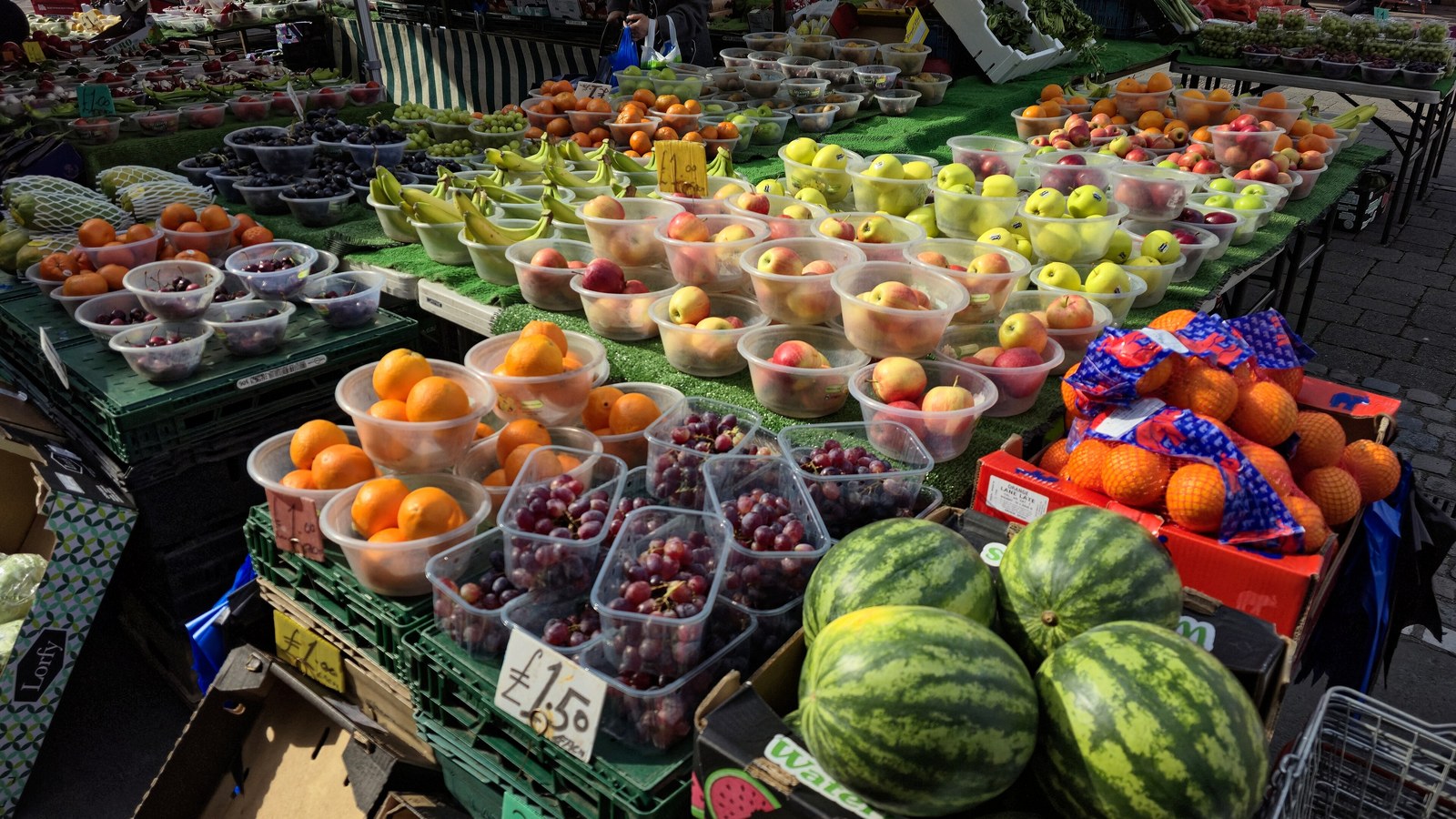
Image: Acabashi, fruit stall, Market Place, Romford, CC BY-SA 4.0, Wikimedia Commons; an archive British market, not a 2026 World Vision collection.
Sources consulted: The cost of basic groceries, measured in wages: 12 hours of work in Ireland and a month in the Central African Republic - El Pais; Price Shocks 2026: The Affordability Crisis Moving Nutritious Diets Out of Reach - World Vision.











0 Comments
No comments on this article yet. Be the first!