
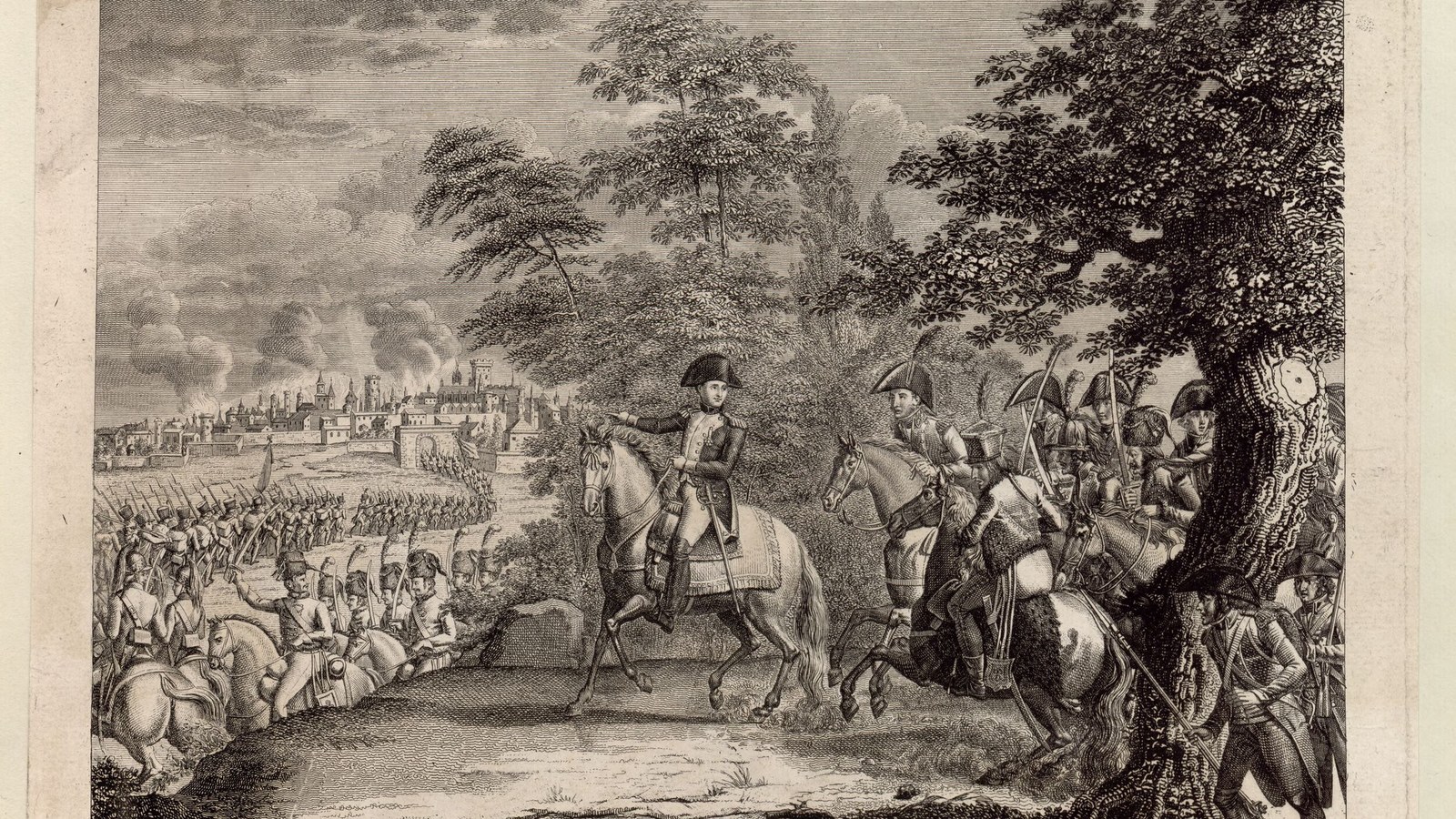
On 14 September 1812, after months of advancing through the Russian Empire and only a week after the bloody Battle of Borodino, Napoleon's army reached Moscow. The French emperor expected the occupation of the great city to force Tsar Alexander I to negotiate peace. Instead, he found a largely evacuated city that would soon be engulfed by fire. Two hundred and fourteen years later, the episode remains one of the most striking examples of a military victory that failed to produce strategic success.
Napoleon began the invasion of the Russian Empire in June 1812. The Grande Armée was an enormous multinational coalition force: not only French troops, but also soldiers from numerous allied states or territories under the influence of the French Empire. Estimates of its size differ according to what is included in the count; this article does not reduce the army to the formula “600,000 Frenchmen”. Napoleon sought a decisive battle. For a time, however, the Russian army avoided a major engagement, withdrawing deeper into the territory. As the Grande Armée advanced, supply lines grew longer, food became harder to find, horses died, and disease and desertion reduced its strength. Napoleon's army was thus already weaker before the decisive confrontation.
That confrontation came on 7 September 1812. The French call it the Bataille de la Moskova; in Russia and internationally it is known chiefly as the Battle of Borodino. It was one of the bloodiest clashes of the Napoleonic Wars. The Fondation Napoléon chronology records some 124,000 soldiers of the Grande Armée committed by Napoleon — without the Guard held in reserve — against about 104,000 Russians. The Russian forces under Mikhail Kutuzov withdrew after the fighting. Napoleon remained master of the field, but he had failed to destroy the Russian army. That difference would prove decisive.
After Borodino the Russian army retreated towards Moscow. The Russian command had to choose between another battle to defend the city and the preservation of the army. Kutuzov chose withdrawal. On the night of 13–14 September the military evacuation of Moscow was under way: Russian artillery began to leave the city, the infantry followed, and a large part of the civilian population had already left or was trying to leave. On 14 September the French vanguard under Joachim Murat approached Moscow. The Russian general Mikhail Miloradovich negotiated with the French terms that would allow the army to withdraw without a fight inside the city. French troops then began to enter Moscow.
Historical sources do not all use exactly the same wording for the emperor's personal entry. The Fondation Napoléon chronology notes 14 September — Napoleon enters Moscow. Other detailed materials from the same institution describe the French vanguard on 14 September and Napoleon's entry into the city on the morning of 15 September. The historical anniversary of the occupation of Moscow is traditionally associated with 14 September 1812. The safe formulation is that, on 14 September 1812, Napoleon's forces began the occupation of Moscow, and chronologies place the emperor's entry into the city between the 14th and the morning of the 15th.
Napoleon expected a familiar scenario: after the occupation of an important city, representatives of the authorities would come to negotiate, to acknowledge the new military situation and, perhaps, to open the way to peace. In Moscow the delegation did not come. The city had been largely evacuated. Tsar Alexander I did not intend to negotiate peace merely because Moscow had been occupied. Moscow was not the capital of the Russian Empire in 1812; the capital was St Petersburg. It remained, however, one of the empire's most important and symbolic cities, with historical, religious and economic weight. According to the estimate presented by the Fondation Napoléon, Moscow had about 262,000 inhabitants before the events of 1812; after the evacuation some 10,000 would have remained. These are historical estimates, not an exact census.
Fires began shortly after the French entered. In the days that followed, the blaze spread through a city in which a large part of the buildings were of wood; the wind and the lack of effective means of extinguishing the flames made the situation worse. Exact responsibility for the fires of Moscow remains disputed, although there is evidence of deliberate Russian actions, alongside other possible causes. There are accounts pointing to a role for Governor Fyodor Rostopchin and the possibility of an action linked to the Russian scorched-earth strategy, but the fires may also have come from chaos, looting, uncontrolled blazes and multiple simultaneous sources. The Fondation Napoléon stresses that the question remains complex. One documented detail: on the night of 13–14 September, according to the same institution, Rostopchin evacuated from the city some 2,000 members of the fire brigade and nearly 100 water pumps. The fire became so intense that Napoleon was temporarily forced to leave the Kremlin and withdrew to Petrovski Palace, outside the city centre; after the blaze subsided, he returned to the Kremlin.
Napoleon had Moscow, but he did not have what he wanted: peace. Alexander I did not capitulate. The Russian army still existed. The Grande Armée stood hundreds of kilometres inside Russia, with very long supply lines, in a city gravely damaged by fire, with winter approaching. Napoleon remained in the Moscow area for several weeks, hoping for a negotiation. Peace did not come. The Fondation Napoléon chronology records that the Grande Armée began to leave Moscow on 19 October 1812. What followed became one of the best-known military disasters. The army faced cold, famine, exhaustion, disease, lack of supplies, attacks by Russian forces and the massive loss of horses. Winter was extremely important, but the disaster had already been prepared by the campaign's losses, logistics, distances, lack of food, Russian strategy, disease and military decisions. One of the most dramatic episodes came at the end of November 1812, at the River Berezina: French and allied forces managed to cross under pressure from the Russian armies; the crossing avoided the immediate destruction of the remnants of the army, but the losses were enormous.
The entry into Moscow seemed, at first sight, a victory. Napoleon had occupied one of the most important cities of the Russian Empire. But he had not destroyed the opposing army, had not obtained the tsar's capitulation, had no secure supply base, and stood extremely far from the territories his empire controlled securely. Moscow thus became the classic example of the difference between a tactical victory and strategic success.
Two hundred and fourteen years after 14 September 1812, the occupation of Moscow remains one of the defining moments of the Napoleonic age. Napoleon had gone extraordinarily far. But that very distance had become one of his greatest weaknesses. Moscow was not the end of the war he had hoped for. It was the beginning of the retreat that would destroy a large part of the Grande Armée and shake the image of the French Empire's invincibility.
Image: Louis-François Charon, “Entrée des Français dans la ville de Moscou”, engraving, Gallica / Bibliothèque nationale de France, public domain. Historical depiction of Napoleon's army entering Moscow in 1812, not a photograph from the period. The image was cropped to 16:9.
Sources consulted: Chronologie de la correspondance générale de Napoléon Bonaparte, tome 12 — La campagne de Russie, 1812 | Fondation Napoléon; Napoleon's Russian Campaign: From the Niemen to Moscow | Fondation Napoléon; Napoleon's Russian Campaign: The Retreat | Fondation Napoléon; Entrée des Français dans la ville de Moscou | Gallica / BnF.



0 Comments
No comments on this article yet. Be the first!